
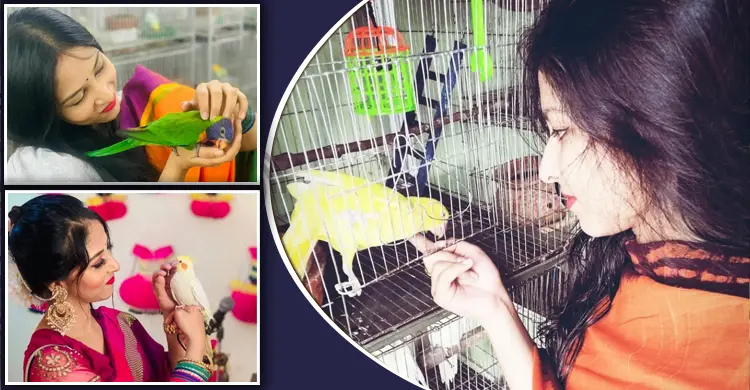
Her father had countless pigeons of many colours and breeds, and she loved watching them fly and flap their wings. As an adult she keeps foreign birds in cages alongside pigeons, and her home rings with their calls. Alongside teaching, Fahmida Ahmed has found success rearing cage birds. She has a master's degree from the Islamic University and lives in Banasree, Dhaka, with her husband and only son.
Watching her father's pigeons sparked her childhood interest in birds, which carried into adulthood. She began in 2011 with just one pair of budgerigars. Her collection now includes one conure, 2 pairs of ringnecks, 16 pairs of budgerigars, 2 pairs of cockatiels, 6 pairs of finches, 20 pairs of Australian doves and 10 pairs of pigeons.
She said the birds lay eggs and raise chicks in their cages, and when numbers grow too large she sells some. People contact her online to buy birds. Managing home, child and guests as well as her birds, her success may show others the way: a hobby can be pursued alongside everything else.
"A hobby keeps you in good spirits," Fahmida said. "When free time is plain or even dull for others, for me it is colourful. The life of cage birds is worth watching."
Pigeons, and a warning about release
She has kept up her father's tradition of rearing pigeons, collecting Lakkha, Siraji, Lahori, Satin, good-quality Kagji, Gia Chulli and racer breeds. Her experience with pigeons is longer than with other birds. She watched her father keep them before her marriage, and after moving to her in-laws' home she started on her own with Lakkha pigeons.
Many people cannot accept foreign birds in cages and release them on various pretexts, which Fahmida deeply regrets. "These birds have been developed to be kept in cages. Releasing them is the same as killing them. They cannot survive in the wild. The budgerigar is the most popular cage bird and has been kept in cages since 1805," she said.
Fahmida wants the number of cage bird keepers to grow and hobbyists to correct their mistakes. That is why she set up the Budgerigar Treatment and Care Zone, which has about 30,000 members. She said the group mainly works on proper treatment for birds among keepers, providing information and raising awareness about cage birds. Selecting the year's best keepers and honouring them with crests is another of its main activities.
Fahmida has served at various times as an admin and as organising secretary. In those roles she has given online treatment advice for birds, visited keepers' farms to observe birds and worked to get newcomers interested in bird keeping. Besides the joy, she is satisfied with what she earns from cage birds. "Housewives can profit by setting up a bird farm in an orderly way. At least they can build a separate identity of their own," she said.
Care and advice
Caged foreign birds cannot eat whatever they like as wild birds do. Asked how to care for them, she said: "Birds should be given good-quality seed mix, vegetables and boiled eggs. It is best to give fresh food and water every day. The seed mix must be cleaned; you cannot give it straight from the market mixed with dust and grit."
Fahmida's view is that one should keep birds for a while to gain some experience, and start a commercial farm only once one's knowledge is solid. She has written a lot about bird keeping on Facebook and has videos on YouTube for anyone interested, and she never refuses anyone who asks her a question in her inbox. Her door is always open to pet bird lovers.
It is not only the myna that talks; the ringneck, a caged pet bird, can talk too. Fahmida has taught her ringneck to speak. "Teaching my ringneck to talk was great fun. I raised it from a baby, and now it talks beautifully," she said.
Her husband always encourages her and has built a fine bird room on the roof, where the birds spend their time happily in decorated cages, playing, building nests, laying eggs and raising their chicks. Fahmida said her husband is also a bird lover and has many pigeons.
Besides keeping cage birds, Fahmida is well known as an artist and has taken part successfully in two exhibitions. She hopes to open an art academy for children.
Written by Muhammad Shafiqur Rahman, assistant manager, sales operations, Fair Distribution Limited.
Source: Jagonews24. First published in Bengali on The Agro News.


Comments
(0)