
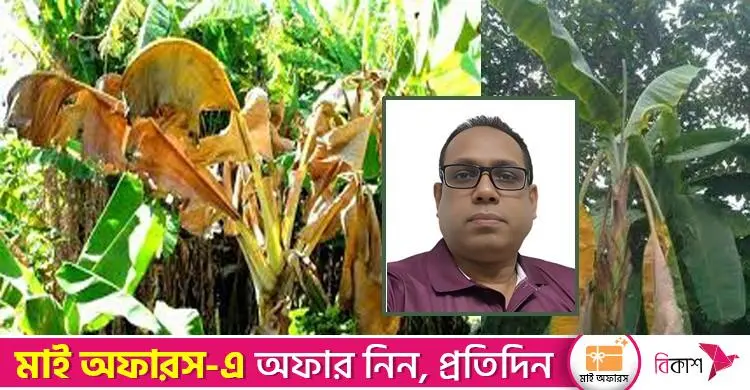
Bananas are grown in almost every country in the world and are available all year round. In Bangladesh too, the banana is a very important fruit. It is grown on about 40,000 hectares, producing about seven lakh tonnes of fruit a year, or about 42 per cent of total fruit production. The banana ranks first in the country by production but second by cultivated area. It also matters greatly in international markets, ranking second in world fruit trade after citrus fruit such as oranges and malta.
Many countries earn substantial foreign currency by exporting bananas. In Bangladesh, however, weaknesses in production, quality and processing mean the sector does not deliver the expected benefits, so farmers grow bananas mainly for the domestic market. Many also miss out on the expected profits because they lack adequate knowledge of scientific cultivation.
Against this background, it is essential to understand Panama disease, a serious banana disease, and the steps to control it. They are summarised here.
The disease
Panama disease is a serious fungal disease of bananas, known scientifically as Fusarium wilt of banana. It is caused by the fungus Fusarium oxysporum and spreads through the soil.
Conditions that favour it
The disease is likely to return the next year if the previous crop was infected or if seedlings were taken from infected plants. It also occurs when seedlings are too young at planting, when soil drainage is poor, when there are many weeds and grasses, and when intercultural care is lacking.
Symptoms
Yellow spots appear on older leaves, and the whole of each older leaf gradually turns yellow. Leaf edges and stalks split. The leaf blades droop and dry out. Within two or three days all the leaves hang down, except the central heart leaf. The base of the banana plant splits lengthwise near ground level. Infected plants produce abnormal inflorescences, and inside, the infected plant and its rhizome look blackish.
Organic management
- Collect suckers from disease-free fields.
- Remove diseased plants from the field and burn them.
- Use disease-resistant varieties.
- Do not grow bananas with crops that act as hosts for the disease, such as aubergine, tomato and okra.
- Rotate crops every two or three years.
- Apply lime to raise the soil pH.
Once the disease spreads in a field it is difficult to control, so prevention is the most important measure.
Chemical management
- Soak the planting material in a solution of 10 g carbendazim per 10 litres of water.
- From six months after planting, treat the soil every two months.
- Before planting, soak the pits with 1% formalin and 50 parts water, and plant 10–12 days later.
- Apply a carbendazim-group fungicide (such as Autostin, Emcozim or Bendazim) at 2 g per litre of water to the base and the whole plant every 7–10 days.
Precautions
Always wear special protective clothing when spraying pesticides, and follow the label instructions correctly, including the dose, the time of application and the interval between the last application and harvest.
Source: Jagonews24. First published in Bengali on The Agro News.
Comments
(0)