
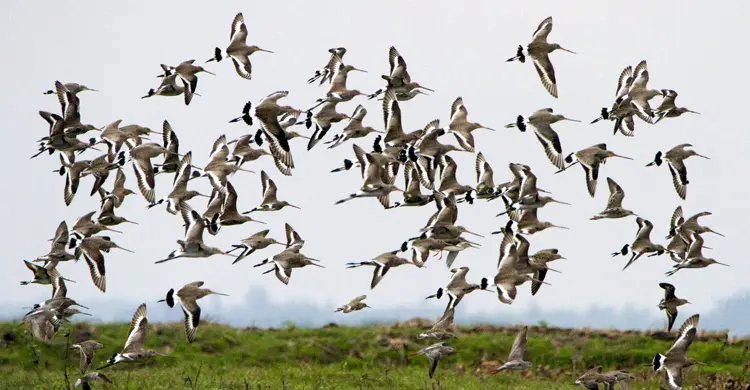
Every winter, Baikka Beel in Hail Haor, Sreemangal upazila of Moulvibazar, comes alive with migratory birds. Local and foreign tourists enjoy the calls, the squabbles, the flights, the dives and the flocks swimming together of birds of many colours and species. This year, however, the birds are not being seen as in other years. Their number has fallen, though the number of species has risen.
The voluntary organisation Boro Gangina Resource Management Organisation has worked to protect Baikka Beel's biodiversity since the roughly 120-acre beel in Hail Haor was declared a sanctuary in 2003. According to the organisation, the number of birds this year has fallen sharply compared with the past few years. It blames two main causes: the loss of aquatic vegetation and a mild winter.
While bird hunting has stopped inside Baikka Beel itself, it cannot be stopped across the vast area of Hail Haor for lack of manpower. Poachers hunt birds every night in new ways, using poison bait and various kinds of nets.
Aquatic vegetation destroyed by water hyacinth
The organisation's president, Abdus Soban Chowdhury, said: "This year the winter was not very cold, and on top of that the aquatic vegetation has shrunk for natural reasons. A large share of migratory birds live around water chestnut, helencha, balluya, challiya and lotus leaves. They like to eat various plants and insects from this aquatic vegetation. But because there was a great deal of water hyacinth during the last monsoon, the underwater vegetation was destroyed. That is why the number of waterbirds has fallen. The 120-hectare Baikka Beel has been enlarged in response to our application, and it now covers about 300 hectares. Our six guards can keep Baikka Beel free of poaching, but an area as large as Hail Haor needs a lot of manpower."
A visit to Baikka Beel showed that birds have arrived, but very few. The birds once seen in the aquatic vegetation in front of the watch tower are missing this year. Apart from some patches to the left of the tower, a large area is bare of aquatic vegetation, which has shrunk by at least 50 per cent. Although there are fewer birds than in other years, there are more species: 39 species were seen at Baikka Beel last year, while 70 species had been seen this year up to 5 January, which shows that the beel is an ideal place for many kinds of birds.
Wildlife photographer Md Samiyat Zaman Khan Ziko, who came to photograph birds at Baikka Beel, said: "I come to Baikka Beel every year in this season to photograph birds. This year there are fewer birds than in other years, but I have seen 70 species." Among those he named were the fulvous and lesser whistling ducks, cotton pygmy goose, common teal, ferruginous duck, garganey, gadwall, oriental darter, common coot, common moorhen, purple swamphen, cormorants, pond heron, white-breasted waterhen, pheasant-tailed jacana, little grebe, purple and grey herons, kingfishers, cattle egret, greater spotted eagle, Pallas's fish eagle, brahminy kite, five to seven species of warbler, black-tailed godwit, spotted redshank, marsh sandpiper, black-winged stilt, red-wattled lapwing and grey-headed lapwing.
Poaching by night
There are allegations that poachers take birds from Baikka Beel and Hail Haor every night under cover of darkness. The birds are handed over to particular people at particular places, arranged by mobile phone, before dawn breaks. Photographs have also shown evidence of birds killed with poison bait. Bird lover Khokon Singha said he comes to Baikka Beel every week, has often seen the bodies of birds killed with poison bait, and recently photographed one.
On bird hunting, Divisional Forest Officer (Wildlife and Nature Conservation Division) Abdul Wadud said: "We are extra alert so that no one can hunt the birds. But with our manpower it is not possible to guard such a vast area. If the public is aware and we receive specific complaints, it becomes easier for us to take action."
According to the Bangladesh Bird Club, migratory birds come to Baikka Beel every year. Last year the beel received its highest number of birds, breaking the record of the previous 10 years. The 2019 bird census counted 11,615 birds of 39 species, notably five globally threatened species: greater spotted eagle, Pallas's fish eagle, oriental darter, black-headed ibis and ferruginous duck.
Census still to come
Ornithologist Dr Enam Ul Haque, founding president of the Bangladesh Bird Club, said: "Since this year's bird census has not yet taken place, we cannot say whether fewer or more birds have come." He said he had visited Baikka Beel in the first week of November: "I saw many species of birds. But if fewer birds have come, that would be sad. We will carry out the census at the end of this month. Then it will be clear whether fewer or more birds have come."
A S M Saleh Suyel, convener of the Moulvibazar district committee of Bangladesh Poribesh Andolon (BAPA), said: "Bird hunters are catching birds in various ways and selling them in the market, so these migratory birds no longer think Baikka Beel is safe. That is why their number is falling. Fisheries are also being built around Baikka Beel without following the rules, so there is no plant and aquatic diversity. If the place can be kept safe by protecting its biodiversity, there will be birds here all year round. Migratory birds hide in aquatic plants to protect themselves from enemies and to find food, and many species, including the pheasant-tailed jacana, lay eggs in the aquatic vegetation. So without it, the birds will not come. We demand more action from the administration on these issues."
Source: Jagonews24. First published in Bengali on The Agro News.


Comments
(0)