
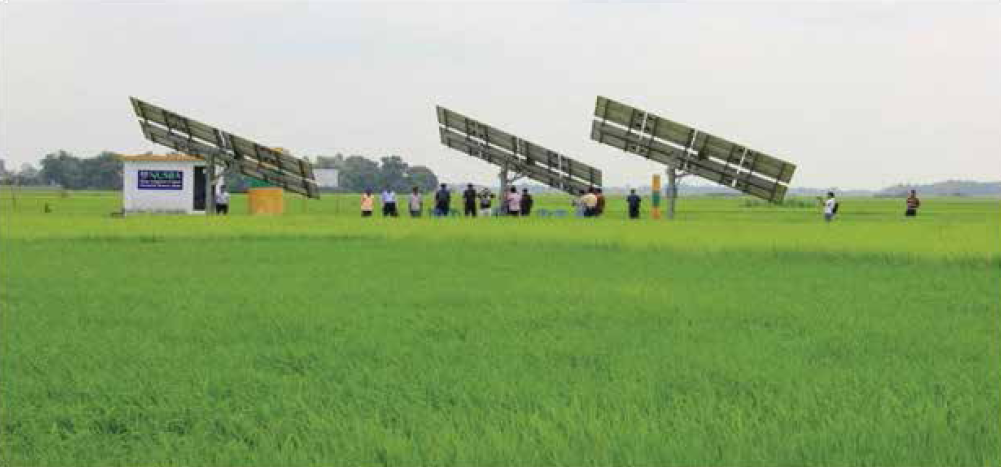
In Bagerhat, irrigation is now in the hands of women farm entrepreneurs, and their pumps run on sunlight. Each of the seven solar-powered irrigation pumps installed in Sadar and Rampal upazilas is run by a committee of 40 women. With no fuel or power bill, they save time, labour and money.
The pumps stand in Rampal's Ujalkur union (three), Bhojpatia (two) and Sayera village in Sadar's Shatgambuj union (two). The private organisation IRV supplied them as part of a climate-resilience effort to ease irrigation for women entrepreneurs in this fish- and farm-dependent area. Less dependence on diesel and electricity also means more use of renewable energy.
Dipika Mistri, president of the East Sayera Purbapara women farm entrepreneurs' forum, said that in winter they used to haul water from fish enclosures or canals to their vegetable plots, so they could not farm as much land as they wanted. Now the pump can be moved and water piped to distant plots, and the time saved goes into farming more land.
Lovely Mondal, president of the East Sayera Moddhopara forum, said they used to hire someone else's shallow machine, and carrying it about and paying for fuel made the work hard. Now sunlight sends water straight to their rice and vegetable fields with no fuel or extra electricity.
Marina Juthi, executive head of IRV, said solar irrigation pumps are playing a big part in climate-resilient farming and women's empowerment: the women are not just pump users now but entrepreneurs. She said women-friendly technology and incentives need to grow.
Motahar Hossain, deputy director of the Department of Agricultural Extension in Bagerhat, said solar power is keeping irrigation running through the power shortage; the government is taking up similar projects and the department plans to give farmers solar pumps. The report also covers Jhenaidah's 36 pumps, where RRF says irrigation has fallen from Tk 400-500 to about Tk 200 a bigha. Agricare24 published the report from Bangla Tribune.
Photo: Power Division, Government of Bangladesh / Wikimedia Commons (CC BY-SA 4.0)
Source: Agricare24
Comments
(0)