
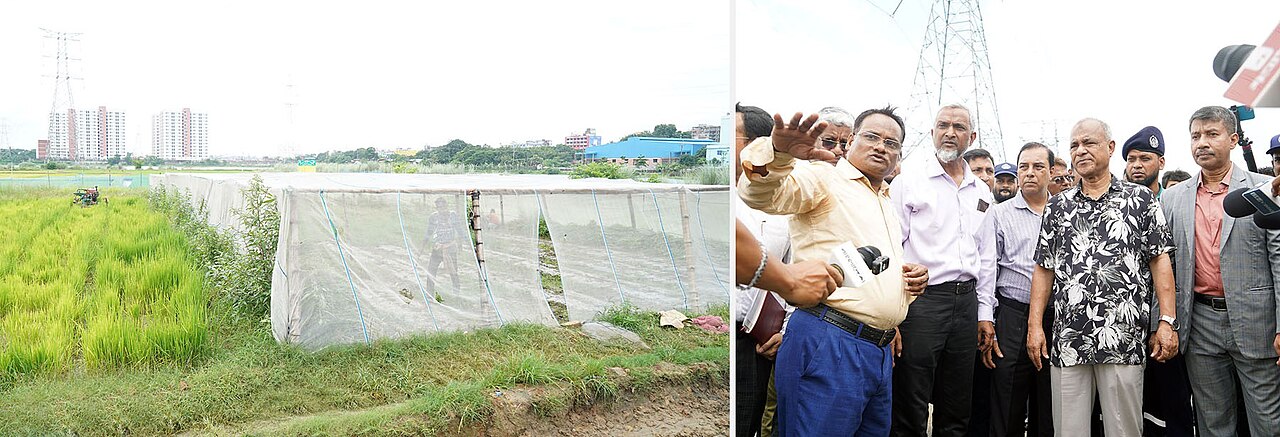
The Bangladesh Agricultural Development Corporation (BADC) was founded on 16 October 1961, the date now marked as World Food Day. As it turns 65, a Desh Rupantor feature sets out what the corporation does in seed, irrigation and fertiliser.
Seed: BADC began in 1962-63 by supplying about 13.8 tonnes of seed. In 2025-26 it produced 144,000 tonnes of seed of rice, wheat, maize, potato, jute, pulses, spices, vegetables and oilseeds, and distributed 147,000 tonnes to farmers. It runs 34 seed farms, 92 contract-grower zones with 105,775 contract farmers, 65 processing centres, 30 potato seed cold stores and eight tissue-culture laboratories. Forty varieties are registered in its name, and it is concentrating on salt-, drought- and submergence-tolerant seed.
Irrigation: modern irrigation began in 1961-62 with 1,555 power pumps. In 2025-26, irrigation was provided or extended on 22,000 hectares, with 820 km of canals dug or re-excavated, 662 irrigation structures, 49 km of crop-protection embankments, 161 solar-powered irrigation pumps and 478 rainwater harvesting structures. The emphasis is on using surface water instead of groundwater.
Fertiliser: in 2025-26 BADC imported 2.627 million tonnes of TSP, MoP and DAP and distributed 2.41 million tonnes, meeting 75.37 percent of the national demand for non-urea fertiliser.
Newer technology: 82 polysheds have been built so far for raising seedlings under controlled conditions, with 60 more planned by June 2028, so seedling production continues through extreme cold, heat or heavy rain. A vapour heat treatment plant at Gabtoli, Dhaka, disinfects mangoes and other fruit and vegetables to make them fit for export.
Under a four-year plan for self-sufficiency in jute seed, 2,210 tonnes are being produced in the 2026-27 season. Demand for maize seed was 11,458 tonnes in 2025-26, and BADC supplied low-priced seed of the hybrid maize B-3355 that season, which the feature says opens a path to cutting imports.
Photo: Press Information Department / Wikimedia Commons (public domain); BADC seed processing at Gabtoli, August 2025
Source: Desh Rupantor

Comments
(0)