
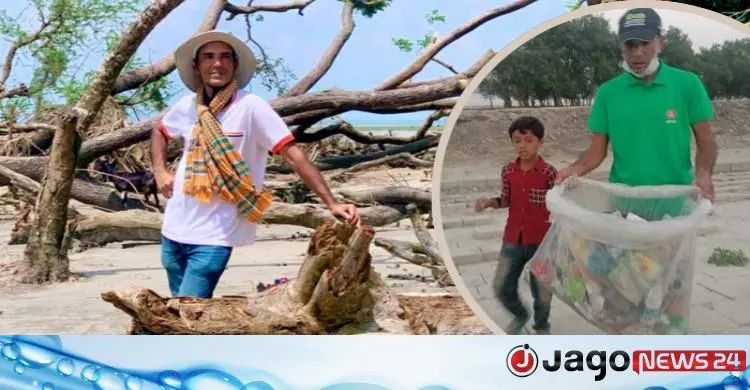
Leaving behind busy city life, newspaper headlines and the daily rush, a photojournalist chose a different life. His name is Arifur Rahman. Having worked for years with the country's leading media, he fell in love with nature.
The pull of trees, wind and sea gradually drew him away from his professional life, and he began a new journey close to nature. He left his profession to become a sweeper protecting beaches and nature. From photojournalist to guardian of nature, he has written his life story differently, picking up rubbish on beaches and spreading awareness, and he carries on today.
Arifur Rahman lives in Barguna Sadar upazila and is past forty. Early in his career he worked as a photojournalist for Prothom Alo and The Daily Star, among other national and international media. His job was to travel the country with a camera. But gradually those travels brought him to a realisation: nature's beauty is boundless, yet human neglect is quickly destroying it. That realisation changed him.
From a busy life to nature
Leaving a long career in journalism was not easy, but he followed his heart. "Journalism gave me a lot and let me see many parts of the country," Arifur Rahman said. "But at some point I felt I was only watching and taking pictures, while doing nothing for nature. Then I felt I needed to be close to nature."
"It is not enough just to enjoy nature; we also have to take responsibility for protecting it. That thought is why I changed my way of life," he added.
Since then he has called himself a "traveller". The purpose of his travels is not just to see nature but to take small steps to protect it.
Walking from villages to remote places
His route is not fixed. Sometimes he walks to a remote village, sometimes to a quiet stretch of beach. Finding nature's beauty is his joy, and he also notes where and how nature is being harmed. On his travels he does not just take photos; he talks to people and explains to locals how nature can be protected, often talking to children and teenagers about the environment too. "Nature gives me contentment. If I can do a little in return, that is my joy," he said.
Picking up rubbish on the beach
Beaches are his favourite places; the wide sands, the sound of the waves and the open air draw him back again and again. But he is often pained by the heaps of plastic and other rubbish. So when he walks on a beach, he carries a bag and picks up plastic, food packets and other litter from the sand. He is often seen doing this at Kuakata beach. While many tourists enjoy the view, he quietly sets about cleaning the beach.
"I don't want to blame anyone. But if we ourselves throw rubbish anywhere, how will nature stay beautiful? So I think everyone should at least take responsibility for their own part," he said.
Besides collecting rubbish, he tries to raise awareness, talking to tourists and explaining to locals why keeping nature clean matters. In his words: "Saving nature doesn't always need a big movement. Small actions can bring big change too. If everyone throws their own rubbish in the right place, many problems will shrink." He often talks to local shopkeepers and fishermen, and asks many of them to keep dedicated bins beside the beach.
A different life, a different contentment
Compared with the busy life of a photojournalist, his life now is simple, free of a fixed office and schedule, and he has no regrets. "Before, I might have photographed big news. Now I do small things. But the satisfaction I get now is different," he said. He believes protecting nature is not only the government's duty but ordinary people's too.
His efforts are having a positive effect on many tourists. Some, inspired by him, pick up litter themselves or try to make others aware. This small effort is slowly spreading a larger message.
Few people can leave a busy career to return to nature, but Arifur Rahman had the courage to do so, showing that love of nature can be shown in deeds, not just words. "Nature gives us so much. If we care for it a little, future generations will also be able to see this beauty," he said.
Environmentalists and prominent people believe Arifur Rahman has turned from a photojournalist into a quiet fighter for nature conservation. Suman Shikder, a volunteer and founder of the coastal voluntary organisation Social Development Worker Forum, considers his journey unusual and inspiring, and believes the small efforts of people like him may one day grow into a large movement to protect nature.
Source: Jagonews24. First published in Bengali on The Agro News.
Comments
(0)