
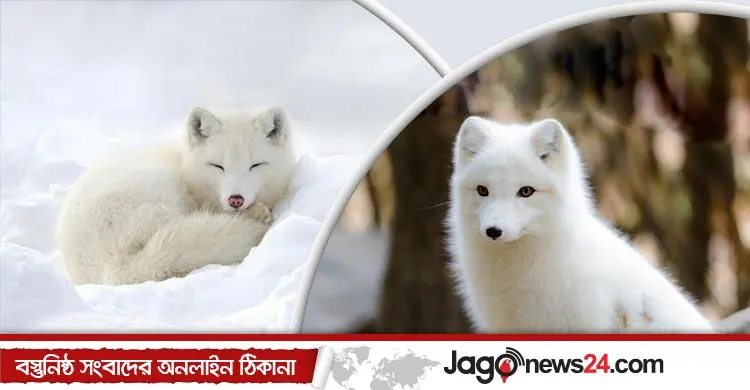
By Sanjana Rahman Juthi. The fox is a very familiar animal, and among its many species the Arctic fox is notable. Besides Arctic fox, it is also known as the white fox, polar fox or snow fox. It is a small, cold-tolerant carnivorous mammal found in the Arctic region of the northern hemisphere.
Most interestingly, it is the only fox in the world that changes colour with the seasons, the article says. In winter the Arctic fox's fur turns completely white, its main strategy for blending into the snow. In summer, when the snow melts, its fur becomes light brown, grey or bluish-grey, a colour that helps it blend into its surroundings.
Built for the cold
The Arctic fox weighs 3 to 9 kg on average and measures about 40 to 68 cm (16 to 27 inches) in length. Arctic foxes have to tolerate a temperature difference of up to 90-100 degrees Celsius between their surroundings and their core body temperature. To protect themselves from the cold, they curl up tightly, tucking their legs and head under the body or behind their furry tail.
Arctic foxes hunt many small animals such as lemmings, and also take sea plants, fish, waterfowl and seabirds. They cannot gather as much food in winter as in summer, mainly because food sources are scarce. In summer there are plenty of animals to eat and hunt, but in winter almost everything is buried under snow, making it hard to find food.
Two genes in the Arctic fox, GLTPD1 and AKT2, play an important role in helping it survive extreme cold and periods of starvation. Through them fat is stored in the body, so the animals can go without food for long periods.
Behaviour and status
Foxes communicate with each other through various sounds, such as growls and screams, as well as body posture and scent. The Arctic fox usually prefers to live alone, but during the breeding season it lives in pairs. It breeds once a year, at the end of winter or the start of spring.
Some subspecies or regional populations are under threat; the Scandinavian Arctic fox, for example, is nearly extinct. The species as a whole, however, is not endangered.
The Arctic fox is a unique creation of nature, with a remarkable ability to survive even in extreme conditions. Its adaptations, diet and ability to change colour make nature's diversity all the more fascinating.
The article cites the IUCN Red List of Threatened Species as its source.
Source: Jagonews24. First published in Bengali on The Agro News.



Comments
(0)