
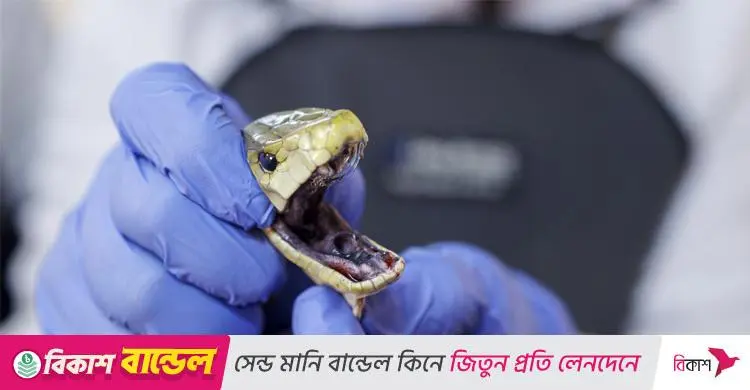
He has deliberately let snakes bite him more than 200 times, and has injected himself more than 700 times with the venom of some of the world's most dangerous snakes, including cobras.
His name is Tim Friede, and he lives in the United States. He once earned his living repairing trucks; later, working with snakes became his passion.
At first he wanted to build up his own immunity so that he could protect himself when handling snakes, and he filmed his exploits and recorded them on YouTube.
He has collected venom from some of the deadliest snakes on earth, including several species of mamba, cobra, taipan and krait.
Antibodies that protect against venom
Scientists say antibodies found in Tim Friede's blood can work against deadly kinds of venom.
The antibodies from his blood were tested on animals, and the tests showed they protected various species from lethal doses of snake venom.
Current snakebite therapies work against the venom of specific species: a person must be given antivenom made for the species of snake that bit them.
Scientists hope Friede's 18 years of effort could be an important step towards a universal antivenom against all kinds of snakebite.
Tim Friede has been deliberately taking snake venom into his body for almost two decades. Before he began, however, two cobra bites put him in a coma.
"I didn't want to die. I didn't want to lose a finger. I didn't want to end up unable to work," he said.
The work Tim Friede has been doing for about 18 years raises hope of a universal medicine, or antivenom, for treating snakebite. Snakebites kill about 140,000 people worldwide every year, and more than three times as many suffer amputation or permanent disability.
Friede said his goal was to develop better therapies for other people around the world.
How antivenom is made today
Antivenom is currently made by injecting small doses of snake venom into animals such as horses.
Their immune systems produce antibodies against the venom, which are collected and used as therapy.
But the venom and the antivenom have to be matched, because the venom of each species of snake is different.
Even within the same species there is variation from region to region, and the venom differs. For example, antivenom made from snakes in India is less effective against the same species in Sri Lanka.
To solve this problem, scientists began looking for broadly neutralising antibodies, which work not against a specific part of a venom but against the parts common to all kinds of venom.
It was at this point that Dr Jacob Glanville, chief executive of the biotech company Centivax, came across Tim Friede.
"I immediately thought, if anyone in the world has developed broadly neutralising antibodies, it's Tim. So I got in touch. On the very first call I said, this may sound strange, but I'd love to get some of your blood," he said.
Friede agreed, and the research received ethical approval because he was not given any more venom for it; only his blood was taken.
The report drew on the BBC.
Source: Jagonews24. First published in Bengali on The Agro News.

Comments
(0)