
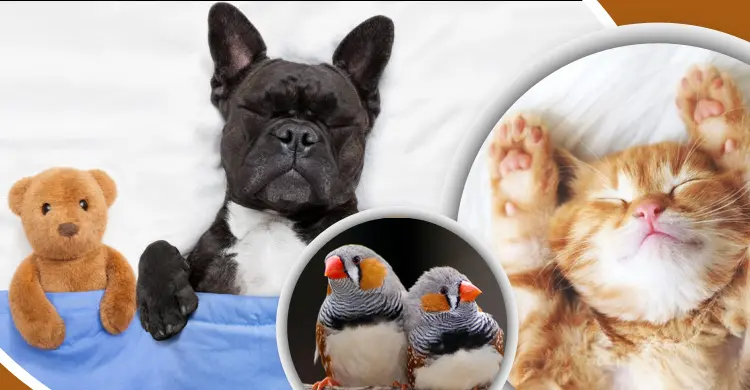
It is hard to find anyone who does not dream. Some dream of the future while awake, others in their sleep. A dream is a mental state in which a sleeping person unconsciously experiences imagined events. The events are imaginary, but while dreaming they feel real, and the dreamer usually feels part of them. The raw material of dreams comes from the dreamer's daily experiences, thoughts, actions and memories.
Many animals besides humans dream too. It sounds surprising, but researchers have described the dreams of several animals. The research began as early as the 1960s, when a group of scientists started a series of experiments to unravel the mystery of human dreams, with striking results.
Cats
In the early 1960s, MIT researcher Michel Jouvet chose the cat for his research. Researchers call the part of sleep in which people weave their dreams rapid eye movement, or REM, sleep. Jouvet noticed that during a cat's REM sleep its heart rate rose unusually, and its muscles began to contract and relax.
Jouvet did not reach a firm conclusion, but he guessed that his pet cat was hunting in its dreams, which at least was what its muscle movements suggested: in its sleep the cat moved its muscles just as it would when leaping or running.
His research won praise from some scientists at the time but was also widely mocked. In the 1990s the Mexican researcher Pena-Guzman revisited the work and reached much the same view.
Rats
About a decade after the research on cats' dreams, the report says, an experiment startled the world. In 2001, MIT neurologist Dr Matthew Wilson released a cat and a rat into a maze, built so that the rat could never come within the cat's reach however hard it tried. Wilson repeated this several times. About three days later he placed the sleeping rat in the empty maze, and the rat crossed the whole route with its eyes closed without bumping into anything.
Fish and others
Fish have no eyelids, so their eyes stay open even when they sleep. Fish also dream in their sleep, the report says: their heart rate and brain activity rise, and in their dreams they defend themselves from predators.
According to a National Geographic report, a team of researchers at San Francisco State University recently observed the same kind of pattern in a species of zebrafish, in spiders and in birds. Recording nerve pulses, they showed that activity in a particular part of the brain, closely linked to memory, rises unusually during REM sleep. An article titled "The Hidden World of Animal Conscience" on the sleep of wild animals has also been published by an American university. Researchers also found that animals, like humans, have deep and light sleep.
Citing National Geographic.
Source: Jagonews24. First published in Bengali on The Agro News.


Comments
(0)