
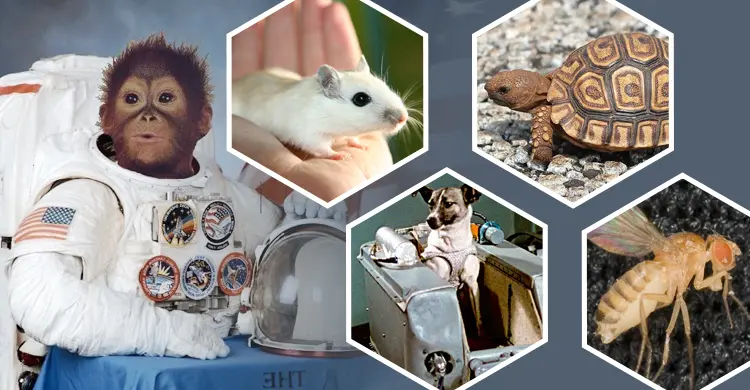
Everyone is deeply curious about space, and many astronauts have floated there so far. In 1969, American astronaut and engineer Neil Armstrong and Buzz Aldrin first successfully travelled through space on Apollo 11 and landed on the Moon.
But did you know that, alongside humans, many animals have also travelled into space and are still remembered in history? Many met a tragic end, losing their lives during the journey. Many others returned safely to Earth.
Flies
Flies were the first to be sent into space. American scientists chose flies to find out how much cosmic radiation would affect astronauts, because flies and humans share genetic similarities.
At the end of the Second World War, a V-2 ballistic missile recovered from the Nazis was loaded with flies and sent 109 kilometres into the air. On the return to Earth, the flies' capsule was brought down by parachute over New Mexico.
When the capsule was opened, scientists found the flies alive, with no evidence of any effect from cosmic radiation. The scientists concluded that humans could travel in space.
Monkeys and chimpanzees
So far 32 monkeys and chimpanzees have gone into space. The first to make the journey was a monkey named Albert II. In 1949 it reached 134 kilometres, but unfortunately died on re-entering Earth's atmosphere because of a parachute failure.
The year before, another monkey named Albert I suffocated soon after launch, before reaching space.
Mice
To learn more about how space travel would affect the human body, scientists have sent many mice into space one after another. NASA recently published an extensive study of mice aboard the International Space Station.
NASA's study found that the mice adapted quickly to microgravity. The first mouse travelled 137 kilometres into space in 1950. It died when the rocket broke apart because of a parachute failure.
Dogs
Several dogs went into space under the former Soviet Union. The most famous is Laika. In 1957 scientists sent this dog, rescued from a Moscow street, into space as a suitable animal. Although other dogs had gone to space before her, Laika is famous as the first animal to orbit in space.
But Laika never came back. She was sent with food for only one meal and seven days of oxygen. The Soviet government claimed she lived for seven days, but according to experts Laika died of overheating within just five hours of the journey.
Tortoises
In 1968 the United States and the Soviet Union were racing to send someone to the Moon. The Russians then sent soil, some seeds, worms and two tortoises into space in the capsule of the Zond 5 spacecraft. The tortoises circled the Moon and returned to Earth six days later.
Zond 5 was supposed to land in Kazakhstan, but when the capsule shut down it ended up falling into the Indian Ocean, from where it was recovered. The good news is that the two tortoises were found alive, though they had lost 10 percent of their weight.
Frogs
In 1970 NASA sent two bullfrogs into space aboard the Orbiting Frog Otolith spacecraft, to understand balance. The frogs returned six days later, and in good health.
Spiders
After the first successful human Moon landing in 1969, less emphasis was put on sending animals into space. But scientists were still keen to learn more about the effect of microgravity on animals' biological functions.
In 1973 scientists decided to send two spiders named Anita and Arabella for their next experiment. They wanted to know whether the spiders could move about in space. The spiders were found to move successfully in space, though less than on Earth.
Fish
Fish have gone into space too. In 1973 mummichog fish and 50 of their eggs were sent into space in salt water; NASA sent them to learn about the effect of microgravity on animals. But the fish fell ill within a few days.
In 2012 the Japanese space agency decided to send fish to the International Space Station. Their aquarium had an automatic feeding system, a water circulation system and LED lights to represent day and night. The aim was to understand the effect of radiation on bone loss and muscle wasting in fish.
Tardigrades
Tardigrades are also known as water bears. They were sent into space in 2007, completely dried out, on a rocket to orbit in space for 10 days.
When they were rehydrated on returning to Earth, scientists found that 68 percent of the water bears had survived the cold and cosmic radiation.
Nematodes
In 2003 the Columbia spacecraft broke apart on entering Earth's atmosphere, killing the seven astronauts on board. Although the craft was destroyed, some nematode worms aboard were recovered alive.
Source: Jagonews24. First published in Bengali on The Agro News.
Comments
(0)