
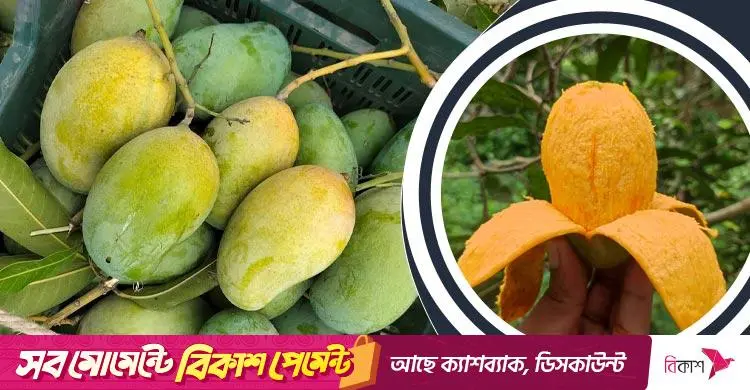
Golden in colour, intoxicating in scent and unrivalled in taste, the mango has held its throne as king of fruits for centuries. Himsagar, Langra, Amrapali, Gopalbhog, Fazli: each variety is like a character with its own story. But the story of the Amrapali, born of a union of science and nature, is a little different and a little more thrilling, and many mango lovers do not know it.
Around 800 varieties of mango are now found across Bangladesh, and scientists are still working to develop high-yielding, tasty, improved varieties. Among them, Amrapali stands out for its colour, aroma and taste.
Here is the remarkable history behind the name of this fibreless, sweet and juicy mango.
The girl born in a mango grove
About 2,500 years ago there was a kingdom called Vaishali in ancient India. A baby girl was born in one of its mango groves, and the city's gardener took responsibility for raising her. Because she was born in a mango grove and raised in a gardener's care, she was named Amrapali.
The word "amra" is used in Sanskrit; its root is "amba" (in Pali), meaning a young leaf or shoot, and it refers mainly to the young leaves or blossom of the mango tree. The name Amrapali thus carries a close link between the mango and nature.
Amrapali was unique not only in beauty but in talent. She sang, danced, played the veena and wrote poetry in Pali, and in time became Vaishali's finest dancer. Kings, princes and ordinary people at home and abroad were captivated, and conflict broke out because everyone wanted to see and marry her.
Worried, her foster parents consulted Vaishali's notables. After long discussion it was decided that no one could marry Amrapali, because no single person could claim her incomparable beauty and gifts. She was instead declared Vaishali's "nagarbadhu" (courtesan of the city), an unusual and historic decision.
As nagarbadhu, Amrapali became the owner of great wealth and her fame spread far and wide. Later, however, she gave up everything and became a disciple of Gautama Buddha. History remembers her as a rare figure.
From a cross-breed to BARI Aam-3
So how did the mango get her name? Indian researchers developed a new mango variety by crossing male pollen of the Dasheri variety from northern India with female pollen of the Neelum variety from southern India. The mango was exceptional in taste, aroma and form, so the variety was named after the famous nagarbadhu Amrapali.
Had one not known the Amrapali, one might hardly believe that so much history, culture and romance could lie behind the name of a mango. It is a wonderful blend of history and flavour.
The variety was first planted in Nadia district of West Bengal in India, and from there it spread to Bangladesh. An official of the Bangladesh Agricultural Research Council (BARC) collected some Amrapali saplings on a visit to India and planted them at Khamarbari in Dhaka.
In 1996 the Bangladesh Agricultural Research Institute (BARI) formally released the variety and named it BARI Aam-3. Some people now also call it "Aam Rupali".
What the mango is like
The Amrapali is small to medium in size, pointed at the bottom and rounded at the top. Ripe fruit is yellowish green, sometimes reddish orange, and the skin is fairly smooth and oily.
It is sweeter than Langra or Himsagar and contains high levels of beta-carotene, which is good for health. Amrapali trees bear many mangoes together in clusters, but the trees are relatively short-lived. Ripe Amrapali usually reaches the market from mid-June and keeps at home for several days.
Source: Jagonews24. First published in Bengali on The Agro News.
Comments
(0)