
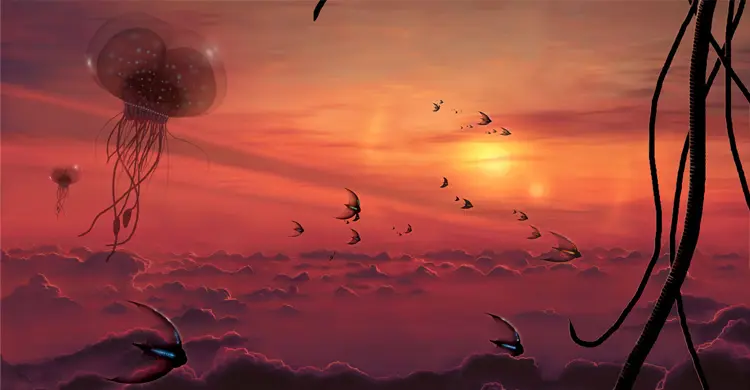
Many scientists no longer ask whether life exists elsewhere in the universe. Their question now is when it will be found. Some are hopeful that life may be discovered on a distant planet within our lifetime, perhaps in the next few years.
One scientist running a mission to Jupiter goes a step further, saying it would be surprising if there were no life on that ice-covered world.
According to a report by the British broadcaster BBC, NASA's James Webb Space Telescope recently detected hints of life on a planet outside the solar system, and NASA believes there are many more Earth-like planets there.
Finding life beyond Earth would be the biggest scientific discovery of all time, and several missions have already begun or are about to begin.
Scottish astronomer and professor Catherine Theimans said: "We live in a universe of infinite stars and planets. We surely cannot be the only intelligent beings there. We now have the technology and the ability to search for an answer to whether we are alone in this universe."
The Goldilocks zone
The telescopes used in scientific searches can now analyse the atmospheres of planets orbiting distant stars, and can look for chemicals of the kind produced by living things on Earth. Early last month, gas of a kind produced on Earth by marine organisms was detected in the atmosphere of a planet called K2-18b, 120 light years from Earth.
Scientists describe this planet in terms of the "Goldilocks zone": it lies at such a distance from the star it orbits that its surface is neither too hot nor too cold, and the temperature is right for liquid water, which is essential for life.
A team of expert scientists hopes to learn within the next year whether these intriguing hints really confirm that there is life there.
The research is led by Professor Nix Madhusudan of the Institute of Astronomy at the University of Cambridge. He told the BBC that if the signs are confirmed, it would radically change our thinking about the search for life.
If signs of life are found on this planet, the chances of more life (aliens) in the universe will rise further, he said. Perhaps within five years there will be a major change in our understanding of life in the universe.
The BBC says that if life is not found on K2-18b, scientists have another 10 Goldilocks planets on their list to keep studying, and a further list of planets after that.
NASA plans to launch the Habitable Worlds Observatory (HWO), a facility to find habitable planets, by 2030. It will use advanced technology to identify and examine the atmospheres of Earth-like planets.
ELT
The Extremely Large Telescope (ELT) is due towards the end of this decade. It will look up at the sky from the desert of Chile.
It will have larger mirrors than other telescopes, so it will be able to see planets' atmospheres better. Its mirrors are so incredibly powerful that they will be able to detect tiny fragments of light from the atmosphere of a planet orbiting a star hundreds of light years away.
Is there life in the solar system?
While many scientists are looking for life on distant planets, another group is searching other worlds in our own solar system. One of the most promising places for life, it is claimed, may be Jupiter's ice-covered moon Europa.
Space scientists say there is an ocean beneath Europa's icy surface, from which water vapour ice spreads out into space.
NASA's Clipper and the European Space Agency's Jupiter Icy Moons Explorer (JUICE) missions will both reach Europa in the early 2030s. NASA is also sending a spacecraft called Dragonfly to land on Saturn's moon Titan.
NASA says the Saturnian moon has lakes and clouds made of carbon-rich chemicals, which have wrapped it in an orange haze. Along with water, these chemicals are thought to be ingredients necessary for life.
Scientists have assumed there are no living things on Mars. But astrobiologists believe the planet once had a thick atmosphere and oceans suitable for life. A NASA rover is now collecting samples from a crater that was once an ancient river delta. The rover will return to Earth with all the samples around 2030, and analysing them will give scientists a clearer picture, the report says.
Could aliens contact us?
Although many scientists regard this idea as science fiction, research into whether radio signals are coming from other worlds has gone on for many years. Besides the Search for Extra Terrestrial Intelligence, many other organisations are doing this research.
These random searches across the vast universe have so far produced no combined result. But if possible places for life elsewhere are identified, they will be able to search there.
Thirty years ago scientists had no evidence of any planet orbiting another star. Now more than 5,000 such planets have been discovered, and astronomers are studying them.
Citing the BBC.
Source: Jagonews24. First published in Bengali on The Agro News.


Comments
(0)