
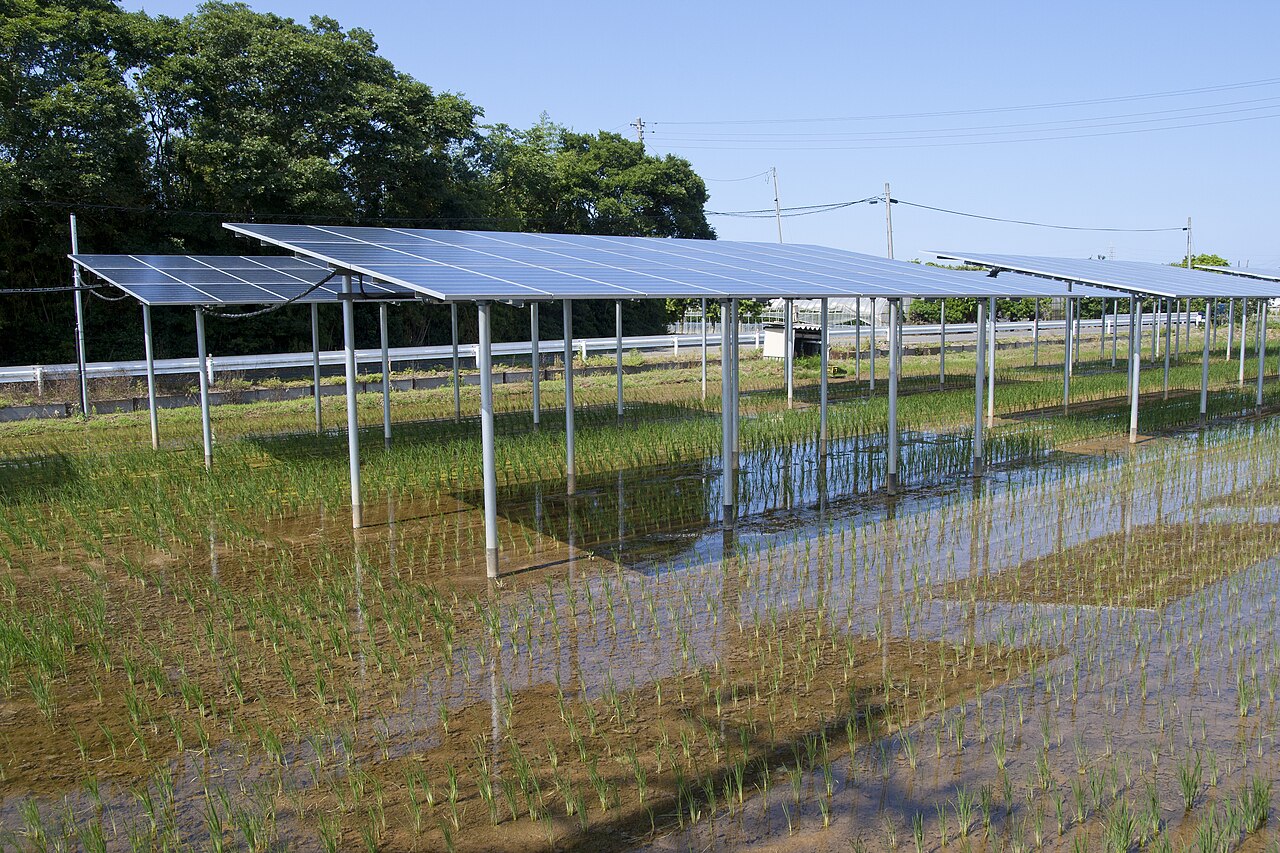
Instead of covering haor farmland with ordinary solar farms, Bangladesh should use agrivoltaics, with solar panels on tall pillars and rice growing underneath, argue geneticist Dr Abed Chowdhury, BrightGreen Energy Foundation founder Dipal Barua, M Khasru Chowdhury, member secretary of the Haor Rakkha Andolon in Moulvibazar, and researcher Dr Rohini Kamal in a joint column in Samakal. The views are the writers' own.
The problem, as they describe it: the haors supply about 20 percent of the country's boro rice. With a target of 40 percent renewable power by 2041, large companies are eyeing haor land, which lies empty in the dry season, comes in large unbroken blocks and is cheap. A megawatt of solar power needs about four acres of land in Bangladesh. A BIGD case study of three haors in Moulvibazar found that 93.7 percent of the roughly 100 acres used for a 10-megawatt plant at Puber Athangiri had been cropland.
How the technology works: an ordinary solar plant sets panels about half a metre off the ground, leaving nothing growing beneath. In agrivoltaics the panels sit on pillars four to five metres high, with gaps between them so that sunlight and rain reach the ground and people and tractors can move underneath. With six-metre pillars, the writers say, panels would stay safe even in four metres of floodwater, while boro rice grows below in the dry season. Japan calls this solar sharing and cancels the licence if the land under the panels is not farmed; Germany gave agrivoltaics its own law in 2023.
On whether rice can grow in shade, the writers cite research from China in which 30 percent shade cut rice yields by only 2 to 5 percent while reducing water use by 20 percent. Besides developing the multi-harvest Panchabrihi rice in his home village in Kulaura, Abed Chowdhury is working on what he calls "shade rice", varieties the writers hope will yield well under panels or trees.
On the economics, they say an ordinary solar plant takes a farmer's rice land for 25 years, while with agrivoltaics the farmer keeps the land, the rice and a rent. By their figures, an acre of boro earns a profit of Tk 40,000 to 50,000 and solar rent Tk 60,000. Moisture rising from the paddy keeps panels 3 to 5 degrees cooler, adding about 2 percent to output, and shade cuts irrigation water by 15 to 20 percent.
They also point to biodiversity: concrete solar farms block fish movement and leave birds nowhere to land, while rice below keeps the soil alive and native fish can be kept along the field bunds. Their proposals: discourage ordinary solar in the haors and require panels at least four metres up; run a 10-megawatt pilot in Kishoreganj or Moulvibazar testing 10, 20 and 30 percent shade with shade rice, BRRI dhan107 and Tepi Boro; and count birds and fish twice a year at every project.
Photo: Σ64 / Wikimedia Commons (CC BY 3.0)
Source: samakal

Comments
(0)