
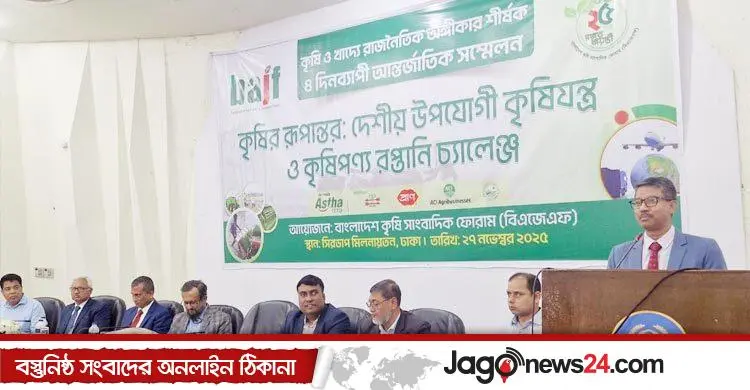
The government is preparing a 25-year master plan to make the country's agriculture modern and sustainable in the long term, taking account of future risks and technological progress. Work on the integrated framework is nearly finished, and the final draft will be ready in December.
Agriculture Secretary Dr. Mohammad Emdad Ullah Mian gave the information as chief guest on Thursday, 27 November, on the first day of an international conference titled "Political Commitment in Agriculture and Food", organised by the Bangladesh Agricultural Journalists Forum (BAJF) at the CIRDAP auditorium in Dhaka. The first day's theme was "Transforming agriculture: locally suitable farm machinery and the challenges of exporting farm products".
The plan
The plan covers 13 main sectors and many sub-sectors, and separate 25-year roadmaps are being prepared for 17 agencies and research institutes linked to agriculture. Several five-year projects will also be taken up in the short term, each after detailed research and review.
On fertiliser reform, the secretary said a policy is being drawn up to save Tk 2,000 crore to Tk 3,000 crore a year; Tk 1,000 crore was saved this year. Tk 600 crore of the agricultural mechanisation project was returned to the treasury after the whole project was completed with Tk 20 crore. He set a target of self-sufficiency in ginger and onion within three years and expressed deep regret over farmers' suicides after potato prices collapsed.
"Made in Bangladesh" farm machinery
Dr. K. M. Saiful Islam, director of the Bangladesh Rice Research Institute's (BRRI) mechanised rice cultivation project, presented the keynote. BRRI is building a complete ecosystem for local farm machinery production to reduce imports, and with technical support from Sri Lanka, Japan and other countries, quality machinery is now being made in the country. BRRI is working on field-level entrepreneurs, mechanic training, service hubs and spare parts supply.
BRRI scientific officer Durul Huda said inefficiency in the light engineering sector, a lack of CNC-based technology and a shortage of skilled workers prevent local firms from making international-standard combine harvesters or rice transplanters, and that in 54 years of independence no state institution has been able to make engines.
Other speakers
- PKSF managing director Md. Fazlul Kader said partner organisations disburse Tk 1.4 lakh crore a year, 40 percent of it to agriculture, and about 85 percent of farm finance comes through microfinance institutions.
- BRRI director general Dr. Mohammad Khalequzzaman said rice yields rose from 1.5–2 tonnes a hectare after independence to 8–10 tonnes in many places, and hybrid development and technology will push average yields above 10 tonnes.
- PRAN-RFL director (marketing) Kamruzzaman Kamal said the global agro-processing market is worth $4 trillion against about $1 billion in Bangladesh; exporters need permission from 18 offices, so a one-stop service, country branding and more international-standard laboratories are needed.
Source: Jagonews24. First published in Bengali on The Agro News.
Comments
(0)