
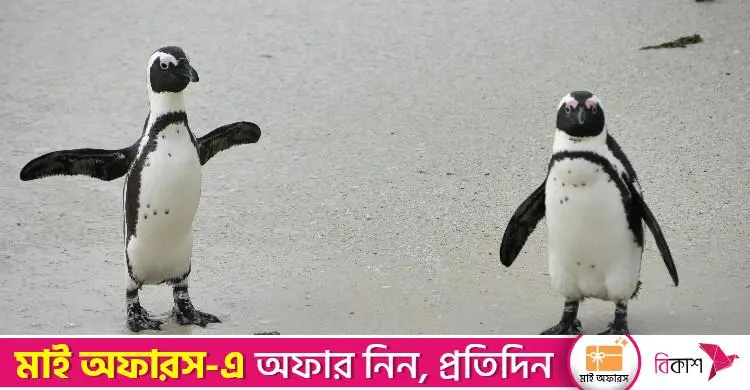
On a clear summer morning on the coast at Betty's Bay in South Africa, a group of penguins stands with white bellies turned to the sun. These are African penguins. Unlike the penguins of Antarctica, this relatively small species can survive in warm weather. They generally live along the temperate coasts of South Africa and Namibia.
These attractive birds draw thousands of tourists to South Africa every year, but the reality is that they are disappearing fast. In 2024 the International Union for Conservation of Nature (IUCN) listed the African penguin as critically endangered. Fewer than 10,000 breeding pairs are now thought to remain in the wild.
SANCCOB, a South African coastal bird conservation organisation, has long worked to protect penguins and other seabirds. Founded in 1968, it plays an important role in conserving African penguins through rescue, rehabilitation and research.
Jade Sukhoo, SANCCOB's rehabilitation manager, said badly injured and malnourished penguins arrive every day. In her words, the birds are struggling badly in the wild.
Starvation now a leading cause of death
Over the past three decades the number of African penguins has fallen by about 80 per cent because of pollution, habitat destruction and food shortages. A recent study found that starvation is now one of the main causes of death.
A joint study by South Africa's Department of Forestry, Fisheries and the Environment and the University of Exeter in the United Kingdom found that more than 6,000 penguins died of malnutrition on Robben and Dassen islands between 2004 and 2011. These two islands are the country's most important breeding grounds.
African penguins depend mainly on small shoaling fish such as sardines and anchovies. But climate change and commercial overfishing have severely depleted these stocks.
Sardine numbers off the South African coast are steadily falling, so penguins have to travel much farther out to sea in search of food, which affects the survival of adults and chicks alike.
Research shows that over the past two decades sardine numbers have fallen to just 25 per cent of their earlier level. Off Namibia sardines have all but disappeared. Behind this lie rising sea temperatures, changes in salinity and overfishing.
Robin Fraser-Knowles of SANCCOB said the fishing industry matters to the economy, but unchecked fishing will bring the whole ecosystem down.
Stones in the stomachs of chicks
SANCCOB's rehabilitation centre gives round-the-clock care to injured, sick and malnourished penguins. Last year 948 penguins were brought there, most of them severely weak.
One adult penguin there weighed only 1.9 kg, when its normal weight should be about four kg.
Pointing to some stones kept in his lab, SANCCOB researcher Albert Snyman said they had been found in the stomachs of dead penguin chicks. In extreme hunger the parents had fed the chicks stones. The stones block the absorption of nutrients from food, so the chicks did not survive.
Abandonment by parents has also become a big problem. Staying at sea for long periods in search of food, one parent sometimes never returns. The other parent then also leaves the nest to find food, leaving eggs or chicks orphaned.
SANCCOB veterinarian David Roberts said that besides malnutrition, penguins are being injured by pollution, entanglement in plastic, and seal and shark attacks. Weakened by the shortage of fish, they cannot escape predators.
Shipping, oil pollution, noise pollution, bird flu and avian malaria have also become major threats.
Some signs of progress
Despite all this there has been some progress. Last year South Africa declared "no-take zones" for 10 years around six important breeding areas, where fishing and mining will be banned.
Through its abandoned-chick rescue project, SANCCOB has already returned more than 10,000 penguins to the wild. In 2021 the country's first artificial protected penguin colony was also established.
SANCCOB says that to succeed over the next five to 10 years it is vital to stabilise the natural colonies, expand protected areas and substantially cut the catch quotas for sardines and anchovies.
According to the organisation, the deaths of African penguins show that the whole ecosystem is in serious crisis. Without food security, the effects will ultimately reach human lives too.
The report is based on CNN.
Source: Jagonews24. First published in Bengali on The Agro News.
Comments
(0)