
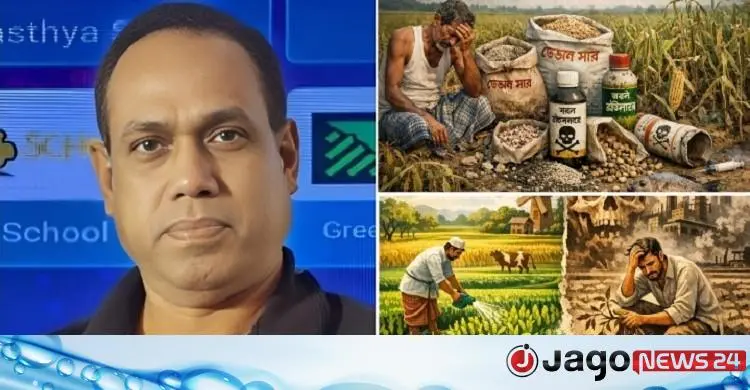
Bangladesh is an agricultural country. Farming is one of the foundations of the nation's food security, rural economy, employment and social stability. Yet for a long time the sector has suffered a silent but serious crisis: the unchecked spread of adulterated, fake, illegal and substandard fertiliser, pesticide and seed. This directly raises farmers' production costs, cuts yields, creates risks to the environment and public health, and above all breaks farmers' trust.
The problem is no longer confined to farmers' losses. It has become a deep threat to the country's food security, its environmental balance and the health and lives of future generations. Quality seed, fertiliser in the right dose and effective pesticide are the basis of crop production. But because adulterated and unapproved inputs enter the market freely, yields are falling, production costs are rising and farmers are steadily losing money.
The overuse of substandard and harmful pesticides is also badly damaging soil, water and biodiversity. Soil fertility is destroyed, and toxic residues in food grains create long-term risks to human health. When farmers are cheated with adulterated seed, the effect falls on the whole food production system, raising the risk of future food shortages and malnutrition.
Against this background, effective control of adulterated and fake inputs, an accountable market system and greater awareness among farmers are the need of the hour. Making farming safe and sustainable means securing the future of the country's people, its environment and the next generation.
How deep the problem goes
Many farmers today do not know whether the fertiliser, seed or pesticide they use is genuine or fake. Several brands under the same product name, near-identical packaging, misleading labels and exaggerated advertising confuse them. In many cases, low-quality pesticides or those with banned ingredients do nothing for crop disease; instead they destroy soil fertility, kill beneficial insects and pose a serious risk to human health. The question then is why, despite a problem of this size, effective action against adulterated, fake and illegal farm inputs is not visible.
Responsibilities and practical limits
The Department of Agricultural Extension (DAE) is mainly a technology-extension and farmer-support body. Its main duties are training farmers in modern technology and good farming practice, advising on crop disease and pest management, helping to implement government farm policy in the field, and improving farmer-focused information, data and awareness.
The reality is that direct law enforcement against adulterated, fake and illegal products is not the DAE's core mandate. In most cases it lacks sufficient mobile court powers, modern laboratories and rapid quality testing, enough staff for regular market monitoring, and strong punitive powers. As a result it is often limited to gathering information or issuing warnings, and cannot take tough action.
Policy and institutional weaknesses
Bangladesh has laws to control adulterated farm inputs, but there are several weaknesses in enforcement.
- Too many agencies: the DAE, the Department of Plant Quarantine, the Directorate of National Consumer Rights Protection, the district administration and law enforcement agencies all have a partial role, and the lack of coordination is a big problem.
- Weak penalties: fines are often low and cases are settled slowly, so offenders are not deterred.
- Weak registration of dealers and companies: many illegal or unapproved firms enter the market easily.
- Farmers' lack of knowledge and dependence: most farmers rely on what the dealer tells them, and many cannot read a label, understand the ingredients or check an approval.
Solutions and the way out
Escaping this crisis needs not one institution but coordinated, structural reform.
- Stronger enforcement and surveillance: regular joint drives by the DAE, the district administration and the consumer rights authority; more and more effective mobile courts; cancelled licences and exemplary punishment for repeat offences.
- Digital traceability and technology: a QR code or digital ID on every approved fertiliser, pesticide and seed, so farmers can check a product is genuine by scanning it with a mobile app; a supply chain based on blockchain or a central database.
- A stronger DAE: limited law-enforcement powers for the DAE, modern testing kits and training in the field, more staff and incentives.
- Farmer awareness and empowerment: awareness campaigns through farmer field schools, the media and digital platforms; a "know before you buy" programme; joint purchasing through farmer organisations and cooperatives.
- Encouraging honest, quality companies: incentives and recognition for companies that maintain standards, and blacklisting of those making substandard products.
A national priority
Adulterated, fake and substandard fertiliser, pesticide and seed are not only the farmer's problem; they are a serious threat to the country's food security, environment and future generations. The DAE cannot solve this crisis alone, but nor can it escape its responsibility. What is needed is strong policy, effective law enforcement, technology-based surveillance and an aware farming community.
If the farmer is not safe, farming will not be sustainable, and if farming is not sustainable, the country's development will not be sustainable either. Ensuring adulteration-free farm inputs is therefore no longer a luxury but a matter of national priority.
Source: Jagonews24. First published in Bengali on The Agro News.

Comments
(0)