
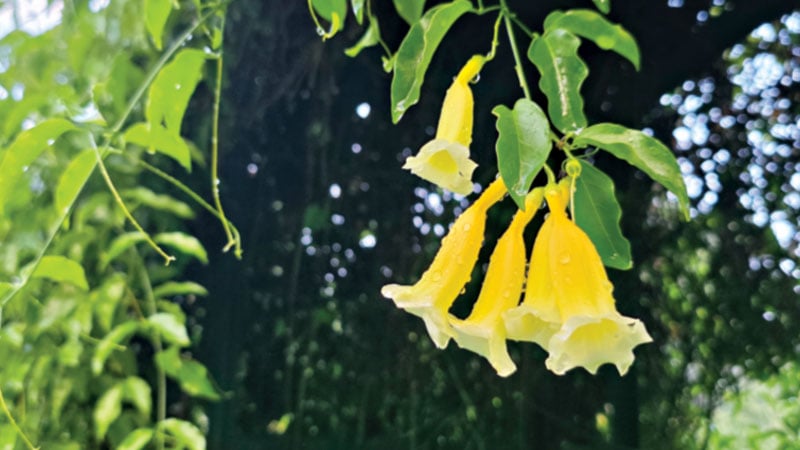
Inside the nursery at Ramna Park in Dhaka, trained over an arch-like frame, stands a single yellow trumpet vine, the only one seen anywhere in the country. The plant is rare in Bangladesh, and this year it is flowering even in autumn.
The British botanist John Sims first named and formally described the species in Curtis's Botanical Magazine in 1820, classifying it as Bignonia chamberlaynii. The French botanist Edouard Bureau and the German botanist Karl Moritz Schumann later moved the species into the genus Anemopaegma, giving it the accepted modern binomial Anemopaegma chamberlaynii and the English name yellow trumpet vine. The genus name is Greek and means, literally, 'wind-player'; the species name honours the Reverend Honourable Joseph Chamberlayne, a notable English orchid grower of Birmingham.
The plant was first formally recorded in England in the early nineteenth century. There is no precise record of when it arrived in Bangladesh; botanical documents and the personal observations of some writers suggest it came sometime before the middle of the twentieth century, but no information was kept or recorded at the time. During the colonial period and after it, a few botanists and wealthy individuals collected plants they liked from various countries and planted them in parks, gardens and homes. The specimen in Ramna Park is probably the reason the species was formally recorded in 2014.
Its native range is South America, particularly Brazil, Bolivia and Paraguay. Bangladesh's high temperatures and humidity suit the Brazilian plant, and it has survived here well.
Yellow trumpet vine is an evergreen, perennial, woody climber with an unbranched stem that can reach five metres. Slender, thread-like green tendrils emerge from the nodes and grip whatever supports the vine. The leaves are pinnately compound, made up of two leaflets with a leaf-like false stipule. The flowers are funnel-shaped, large tubular blooms with an open mouth; the five-lobed limb is whitish, the tube at the base is yellow, and the tube bends slightly near the stalk. It is grown as an ornamental in gardens in many countries.
Though it has been in the country for decades, the plant does not seem to have spread much. Yet it is easy to propagate: cuttings of semi-hardwood stem with two or three nodes root from late summer through the monsoon, and air layering works as well. Plants in full sun flower more and better, and occasional pruning gives a good shape and more blooms, which makes this rare climber a straightforward addition for a nursery or a keen gardener.
The piece was written for Samakal by Mrityunjoy Roy, an agriculturist and environment specialist.
Source: Samakal
Comments
(0)