
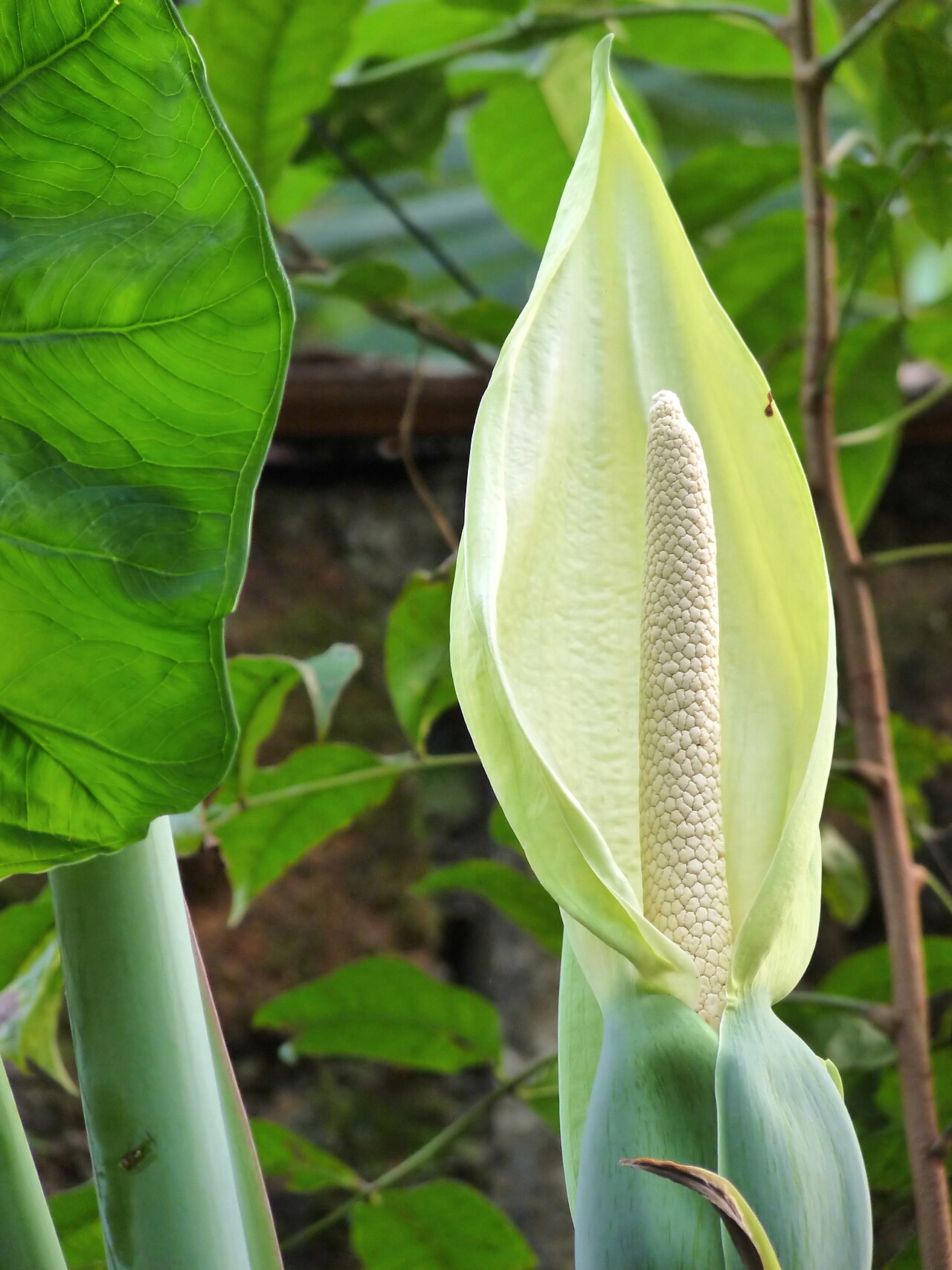
An agriculturist and environment specialist has written a nature note in Desh Rupantor on dudh kochu, a taro of village pond banks. Seeing it in flower at Zinda Park in Rupganj, Narayanganj, this Bhadra, the writer recalls Rabindranath Tagore's poem "Adhikar", in which the bakul, palash and rose boast of scent and colour, and the humble taro wins by showing its hold beneath the soil.
The plant is called dudh kochu, or dudhman kochu, the writer explains, because a cut stalk weeps a milk-white sap; its scientific name is Xanthosoma sagittifolium. Because it forms a corm like a mukhi kochu, some call it mukhi kochu or dudhmukhi kochu; in Pabna it is moulvi kochu, and in the writer's childhood its stalks were cooked with prawns. Its huge arrowhead leaves give it the English name arrowleaf elephant ear.
The leaf blade is 60-100 cm long with a pointed tip, and leaves and stalks are a pale milky green with a waxy upper surface. In Khakjana village of Tangail Sadar the writer saw a plant about one and a half times his own height. In Fakirhat, Bagerhat, and Tala, Satkhira, he found a form with dark purple veins and stalks, locally called surma kochu, which also bleeds milky sap.
Like other members of the arum family (Araceae), dudh kochu flowers on a rod-shaped inflorescence, a spike, inside a sheath like a banana flower. The sheath grows up to 30 cm long, green and tubular below and creamy white above. The flowers are tiny, petal-less and unisexual: male flowers at the top of the spike, female flowers below.
Insects pollinate it, drawn by a strong smell from the inflorescence. After fertilisation it bears small, round yellow fruits. It flowers and fruits from May to October and new plants grow from the underground corm. Though native to the Americas, dudh kochu is now a wild and cultivated plant of rural Bangladesh.
Photo: Jeevan Jose, Kerala, India / Wikimedia Commons (CC BY-SA 4.0)
Source: Desh Rupantor

Comments
(0)