
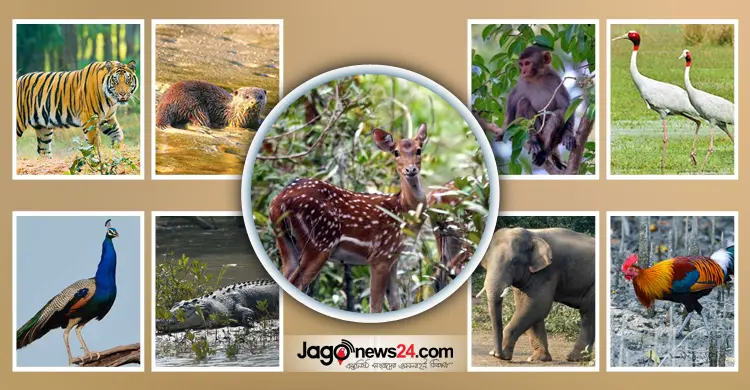
The number of raids against wildlife crime in the country is steadily falling, while conditions for wildlife to survive are becoming more hostile by the day and the numbers of various species are declining. Those involved say the unit charged with tackling wildlife crime and conservation cannot play its proper role because of a shortage of funds and staff.
The Wildlife Crime Control Unit comes under the Forest Department. According to the unit, the number of raids in 2023 fell to about half the 2022 figure. The number is expected to fall further this year, possibly to half the 2023 level.
According to "Eliminate, Neutralize and Disrupt" (END), a US report on wildlife trafficking prepared in consultation with the US Departments of the Interior and Commerce and USAID, Bangladesh is one of 28 countries in the world regarded as a major source or a major consumer of trafficked wildlife or products made from it. Bangladesh is also one of the main transit points for such products.
Wildlife being trafficked through Bangladesh has been seized on various occasions, and the Wildlife Crime Control Unit has played a part in this. But officials say the unit is steadily weakening because of shortages of money and staff.
A 12-person unit
The unit began work under the Wildlife (Conservation and Security) Act 2012. From 2012 to April last year it carried out 3,259 raids and rescued more than 46,000 wild animals. It has a wildlife forensic laboratory, yet only 12 staff. Alongside the shortage of funds and manpower, it also lacks rescue equipment.
According to a survey by the International Union for Conservation of Nature (IUCN), 31 species of wildlife, including amphibians, reptiles, birds and mammals, have disappeared from Bangladesh for ever in the past 100 years because of various threats. Another 90 species are close to being at risk.
Asked why the number of raids keeps falling, Md Chhanaulla Patwari, director of the Forest Department's Wildlife Crime Control Unit, told Jago News: "Raids are linked to manpower, and there is a financial link too. We are not in the mainstream and do not get a budget directly from the government. So even when we want to and need to, we often cannot carry out raids. When we get the necessary support, we conduct raids."
"People have become more aware"
However, Rathindra Kumar Biswas, wildlife and biodiversity conservation officer at the unit, told Jago News: "In 2022 we carried out extensive raids. At the same time we ran a wide publicity campaign. There were workshops and seminars and a lot of field activities. We believe people have become much more aware. When public awareness rises, wildlife crime also falls considerably."
He said: "We took various actions against several dramas, films and mobile phone companies, and this was widely publicised. Now if any television channel, drama or film has anything involving wildlife, they discuss it with us first and ask whether showing it is an offence. Now dramas and films show a disclaimer when they have a scene involving wildlife."
Asked how the unit carries out raids, he said: "We have informers, and we also act on information from the media and social media. Alongside that, we coordinate with RAB, PBI, district administrations, police and whoever else is needed at the time. The wildlife law is in the schedule of the Mobile Court Act, so district administrations can run mobile courts on the matter."
The numbers year by year
Analysis of the unit's raids from July 2012 to April 2024 shows 610 raids in 2022 and 316 in 2023. In the first four months of this year, to April, only 26 raids were carried out. If the trend continues, the number of raids in 2024 will not even pass 100.
Between 2012 and 2024, the most raids were carried out in 2022. That year, 610 raids rescued 3,241 birds, 223 mammals, 930 reptiles and 150 amphibians. In 2023, 316 raids rescued 2,593 birds, 152 mammals, 640 reptiles and 5 amphibians.
As trophies, 8 maunds and 7 kg of shapla pata fish (stingray) were recovered in 2022, and in 2023, 5 maunds of shark and shapla pata fish and 100 kg of peacock feathers.
In the four months from January to April this year, 26 raids rescued 153 birds, 4 mammals, 3 reptiles and 4 amphibians, the unit said.
In 2022, 17 cases were filed over various wildlife crimes and 34 offenders were arrested. In 2023, 13 people were caught in 10 cases. No case was filed in the first four months of this year, though five people were detained.
According to the unit, a total of 3,269 raids were carried out from 2012 to April 2024. These raids seized or rescued 34,650 birds, 1,134 mammals, 10,522 reptiles and 419 amphibians, and recovered 1,399 trophies. Over the same period, 299 people were arrested in 411 cases, the Forest Department said.
A trophy is any part of a scheduled wild animal, such as meat, skin, bone or feathers. Trophies are of two kinds, complete and incomplete. Unprocessed meat or any part of an animal is an incomplete trophy, while a processed part is called a complete trophy.
By the unit's count, it carried out 141 raids in 2012, 137 in 2013, 240 in 2014, 259 in 2015, 185 in 2016, 112 in 2017, 247 in 2018, 129 in 2019, 460 in 2020 and 407 in 2021.
Under the wildlife conservation law, 36 people were arrested in 46 cases in 2012, 28 in 46 cases in 2013, 30 in 47 cases in 2014, 28 in 50 cases in 2015, 34 in 63 cases in 2016, 5 in four cases in 2017, 14 in 29 cases in 2018, 25 in 47 cases in 2019, 26 in 28 cases in 2020 and 21 in 25 cases in 2021.
Bangladesh's wildlife and biodiversity
Because of its geographical position, Bangladesh is rich in biodiversity. A 2015 survey by the IUCN found that Bangladesh currently has 1,163 species of vertebrate wildlife, including 49 amphibians, 167 reptiles, 566 birds, 138 mammals and 253 species of freshwater fish. Among invertebrates, 141 crustaceans and 305 other species are included. In all, vertebrates and invertebrates together number 1,619 species.
The forests, inland wetlands and Bay of Bengal of Bangladesh hold a great wealth of biodiversity, including some rare and endangered wildlife. Among plants, the Forest Department says Bangladesh has 470 species of viruses and bacteria, 1,988 species of algae, 275 species of fungi, 248 mosses, 195 ferns, 7 gymnosperms and 3,611 species of angiosperms (2,633 dicotyledons and 988 monocotyledons).
Source: Jagonews24. First published in Bengali on The Agro News.
Comments
(0)