
By Bilkis Nahar Mitu
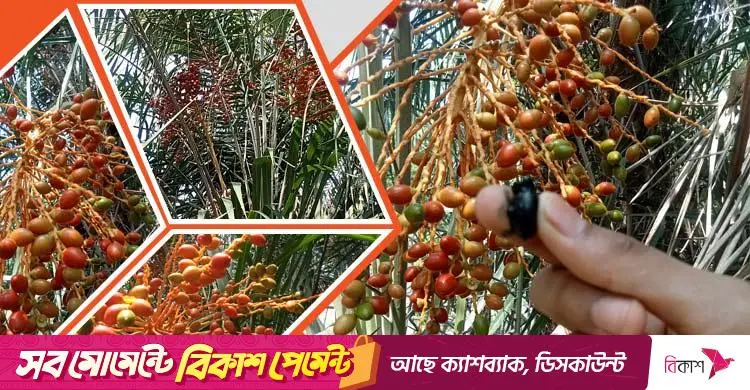
A few days ago a video spread on social media and in the press: a wild date palm, or dwarf date palm, had been found at the Dharmapur sal forest in Birol upazila of Dinajpur. As soon as I saw the video I felt I had seen the tree somewhere. I was born and raised in Morrelganj upazila of Bagerhat. Because the Sundarbans is fairly close, I have come across many kinds of plants, among them one known locally as the "atal" tree, whose description matches this wild or dwarf date palm exactly.
The tree still grows in the courtyard of our home. As children we used to hear the saying "atale betal hoy", and that snakes live under this tree, so we never went near it. After seeing the video on Facebook, I set out from Khulna for home to look into it. The fruit looks like small dates, and four or five colours can be seen on the same bunch. When unripe it is green; a little more mature, it turns pale yellowish; when mature it turns deep orange or somewhat red; and when fully ripe it becomes jet black, looking like a ripe jam (black plum).
How it differs from the date palm
In the video I heard that the fruit was quite sweet, but when I tasted the fruit from our courtyard it was bittersweet. Although it turns black when ripe, the inside is somewhat bluish and the seed is shaped like a grain of wheat. The leaves are like those of the date palm, but date palm leaves are thick and heavy, while this tree's leaves are quite thin and glossy. Date palm leaves stand straight, but this tree's leaves are long and droop. The thorns on the stalks are also like the date palm's, but date palm thorns are thick, while these are narrow, thin and fine.
The difference is that the date palm has a thick trunk, while this tree is thinner even than a betel nut palm. The young tree has many thorns, but they are not seen once it grows a little. Its stalks are less hard than date palm stalks and break easily. The trees grow together in clumps of five or six, like a bamboo clump. The fruit ripens now, in the months of Baishakh and Jyoishtho. After the bunch is cut, the mature fruits slowly ripen and start to turn black.
A call for conservation
Much of the tree's description matches the wild date palm found in the sal forest at Birol. So I would like someone from the Forest Department to come and examine the tree at our home too, to see whether it is a wild date palm or some other species. The tree is almost gone in our area as well. My mother told me they ate its fruit as children; I never have. Many people cut off the top of the tree and eat the white part inside, known as "mati". Because it is very tasty, sweet and salty, people have eaten so much of it that the trees have dwindled.
My appeal to the Forest Department is that arrangements be made to conserve the tree. Because if it is not a wild date palm, then although it is known as the atal tree, it is nearly extinct. If it is conserved, there is a chance it will survive. It is worth knowing that the wild date palm (Phoenix acaulis; in Latin, acaulis means "stemless") is a species of the palm family, native to northern India, Bhutan and Nepal. It is a flowering plant species of the palm family.
The writer is a student in the Department of Geography and Environmental Science, Government BL College, Khulna.
Source: Jagonews24. First published in Bengali on The Agro News.
Comments
(0)