
In Bangladesh watermelon is a summer fruit, though it is now available more or less all year. On a hot day a slice of cold watermelon brings instant relief. Juicy, sweet and full of water, it is now one of the world's most popular fruits, grown in many shapes and colours. But watermelons were not always like today's.
Seeds in ancient tombs
Few people know that the history of watermelon goes back thousands of years. It was grown in ancient Egypt about 4,000 years ago, and archaeological excavations have found watermelon seeds in some ancient Egyptian tombs. It is believed that watermelon seeds were placed with other foods in the tombs of pharaohs and nobles in the belief that they would need food in the afterlife.
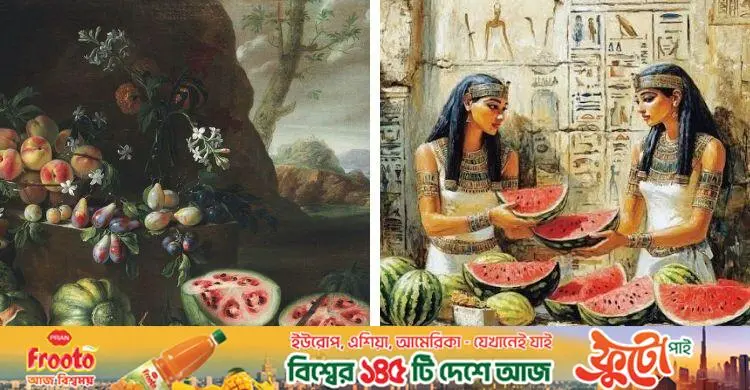
Wall paintings and artefacts from ancient Egypt also show that watermelon was regarded not just as food but as a fruit of special importance. However, the watermelons of that time were not bright red, sweet and juicy like today's. The present form was created over a long history of cultivation, selection and development of improved varieties.
Researchers believe the ancestor of the watermelon originated in Africa, where it was grown 5,000 years ago before spreading north to the Mediterranean countries and later to other parts of Europe.
A painting shows the change
Many people may be surprised that watermelons even a few hundred years ago were unlike today's. A still life by the 17th-century Italian painter Giovanni Stanchi shows a watermelon of that time whose inside was not fully red and fleshy but had hollow spaces and little juicy flesh.
Researchers say such historical paintings help explain the evolution of the watermelon. Varieties were gradually developed to suit human taste, with more sweet flesh, fewer seeds and attractive colour. The modern watermelon is thus the result of natural change as well as human agricultural research.
A source of water
The watermelon's greatest feature is its high water content, which is why it has been an important fruit in dry and desert regions since ancient times. Travellers on long journeys often carried watermelons, which met their need for food and helped replace lost water.
In the dry regions of Africa in particular, the ability to hold water was a major reason wild watermelons survived. Many researchers believe people first used watermelon not only as a sweet fruit but as an alternative source of water.
The origin of watermelon has long been debated, but most studies say Africa is its original home. Wild watermelons growing in various parts of ancient Africa gradually came under cultivation and later spread from Egypt to the Mediterranean region, Europe and various Asian countries. Once people realised watermelon was easy to grow and full of water, it found a place in the diets of many civilisations, and over time farmers worked to develop larger, sweeter and tastier varieties.
Japan's square watermelons
One of the most talked-about modern innovations in watermelon history is the square watermelon, first produced in Japan in the 1970s. The idea was practical: large round watermelons were often hard to fit into Japan's small refrigerators, so farmers devised a method of growing watermelons inside boxes of a set shape to make them square or triangular.
These watermelons are usually of ordinary varieties, but their shape is created by a special method. Easy to store in small spaces, they quickly became popular, and square or triangular watermelons later became known as luxury gifts rather than ordinary fruit. In Japan they became a customary gift on special occasions and cost far more than ordinary watermelons.
The change from the small, less sweet watermelons of ancient Egypt to today's large, juicy and sweet fruit did not happen overnight but through thousands of years of farming, human need and changing tastes. A fruit that was once a source of water for desert travellers is now a popular summer food around the world, and people have even made it a luxury product by giving it special shapes.
The history of watermelon is not just the history of a fruit but a unique example of human agricultural knowledge, innovation and reshaping nature to human needs. From the seeds placed in a pharaoh's tomb some 4,000 years ago to today's square and triangular watermelons, the long journey shows how an ordinary fruit can become part of an extraordinary story.
The article draws on History.com and National Geographic.
Source: Jagonews24. First published in Bengali on The Agro News.


Comments
(0)