
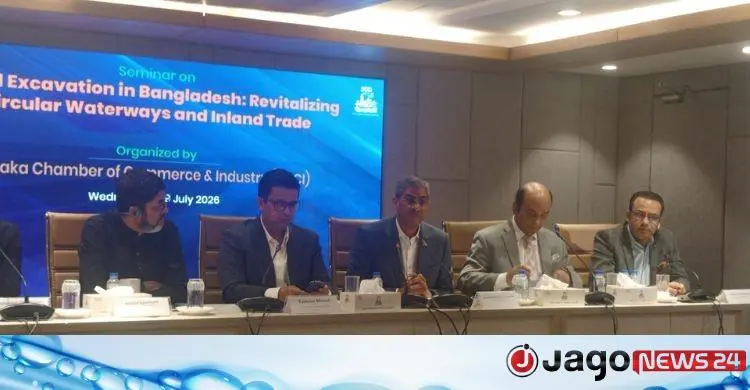
Rivers and canals cannot be protected without coordinated action, water resources minister Shahid Uddin Chowdhury Anee has said.
He said the country's canals are nature's blood vessels. If the natural flow of canals and rivers and the links between them are not maintained, the environment, water management and the economy will be at serious risk. All the ministries and agencies concerned must therefore work together on canal re-excavation, river conservation and water resources management.
He was speaking as chief guest on Wednesday, 29 July, at a seminar on "The role of the canal excavation programme in reviving circular waterways and expanding inland water trade in Bangladesh", organised by the Dhaka Chamber of Commerce and Industry (DCCI) in Motijheel, Dhaka.
Canals as blood vessels
The minister said that just as blood vessels are essential for blood to circulate in the human body, the country's canals are nature's blood vessels. If a canal is cut off from other canals and rivers, water flow will be disrupted, affecting agriculture, the environment, water transport and urban life.
He said the Ministry of Water Resources is now planning on the basis of research and discussion with expert bodies such as the Institute of Water Modelling (IWM), the Center for Environmental and Geographic Information Services (CEGIS) and WARPO. Instead of the isolated efforts of the past, the work is now being done in a coordinated way, he said.
Shahid Uddin Chowdhury Anee said that after taking office, on the prime minister's instructions, an inter-ministerial meeting was held with the ministries of land, agriculture, local government, shipping, environment, and disaster management and relief, among others. Canal excavation programmes had not delivered the expected results before because there was no such coordinated effort.
Dhaka's rivers in a fragile state
Expressing concern about pollution and encroachment of the rivers around Dhaka, he said the Buriganga, Shitalakshya, Turag, Balu and Tongi rivers are in a very fragile state. Industrial waste, encroachment and unplanned urbanisation have put them in serious crisis. This is not a problem for one ministry alone but a major challenge for the whole state and its people.
The minister said plans to clean up Dhaka's rivers, build riverside walkways and launch water taxis have been talked about for a long time but have still not been carried out, while river-based development plays an important role in the economy and tourism of cities in a neighbouring country.
Expressing concern at the rapidly falling groundwater table, he said Bangladesh will face a major crisis in future unless surface water sources are conserved. He stressed planning now with the next 50 to 100 years in mind to deal with the effects of climate change.
Outlining the government's plans, the minister said the election manifesto itself included re-excavating 20,000 kilometres of canals, tree planting, and improving environmental and water management. Since taking office, the government has been working steadily with experts to carry out that plan.
The government's aim is not just to dig canals, he said, but to build sustainable water management by conserving rivers, canals, reservoirs and the environment. Achieving this needs the joint participation of government bodies, experts, the business community and ordinary people.
Source: Jagonews24. First published in Bengali on The Agro News.

Comments
(0)