
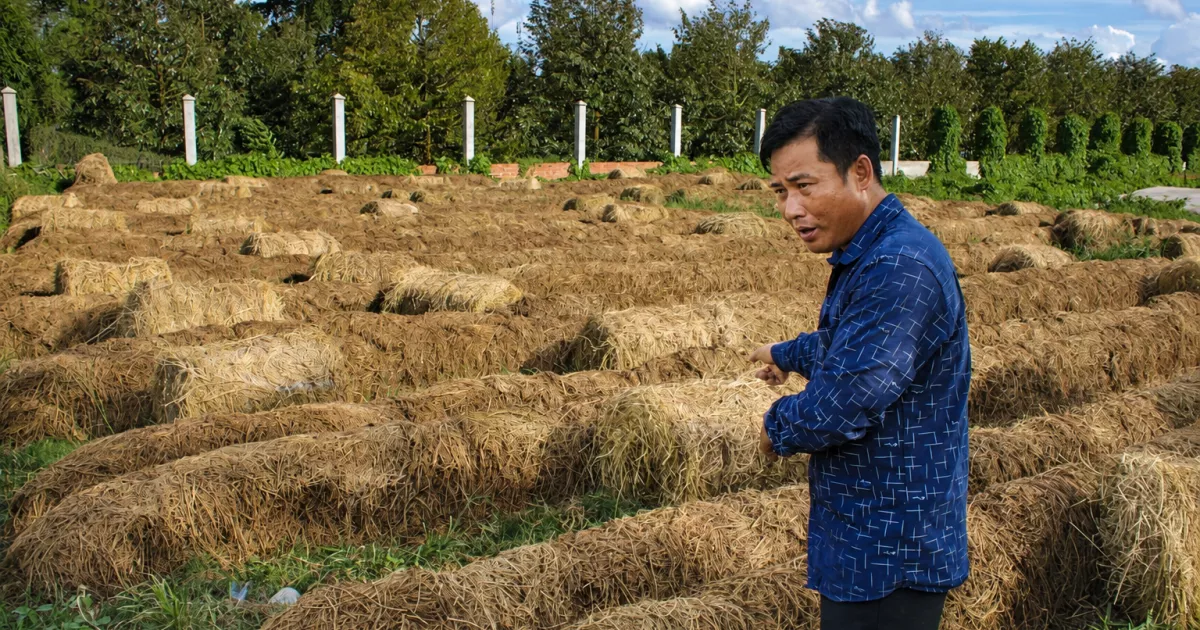
A rice cooperative in Vietnam's Mekong Delta has built a business out of the straw left in its fields after every harvest, turning it into mushrooms and organic fertiliser instead of burning it, according to a story from the International Rice Research Institute (IRRI) published by CGIAR.
New Green Farm Cooperative, set up in 2023 with seven core members, grew rice and vegetables and raised straw mushrooms on small plots by traditional methods. Its director, Dong Van Canh, was won over by a machine: through IRRI and its partners the cooperative was shown mechanised rice-straw composting, in which a compost turner cuts the labour and time needed to process straw at scale, along with a wider circular business model. The work was part of the Rice Straw-Based Circular Economy for Improved Biodiversity and Sustainability (RiceEco) project, funded by the Mekong-Republic of Korea Cooperation Fund.
The cooperative now collects straw with mechanised baling services from Tu Sang Machinery, uses the freshest bales for mushrooms, and turns the spent substrate, mixed with rice-husk ash, coconut coir and cattle manure, into compost that goes back onto rice, fruit trees and vegetables. It works with about 100 rice-farming households across 148 hectares. Its mushroom area has grown from 2,000 square metres to about 8,000 square metres outdoors, with 2,000 square metres for compost.
The figures are modest but add up. Rice still brings in about 60% of income, mushrooms about 30% and compost, vegetables and other crops the rest. The mushroom operations use about 9,000 bales a year at an estimated profit of US$0.38 a bale, roughly US$3,400 a year, and composting capacity of about 72 tonnes a year adds about US$2,700 at US$38 a tonne.
The rice itself became cheaper to grow. Combining straw-based fertiliser with high-quality, low-emission practices, the cooperative reported a 40% cut in chemical nitrogen use, savings of VND 1.5-1.7 million (US$57-65) per hectare per season on fertiliser and pesticide, and VND 350,000-400,000 (US$13-15) per hectare per crop from selling straw. Straw burning in its operating area has fallen by an estimated 90 to 95%.
Growth has exposed new limits. Mushrooms need cash up front while compost takes time to mature and sell, and the cooperative struggles to secure straw at peak times without a larger warehouse. Canh says the next stage needs affordable finance, machinery and storage, not only training. Across Vietnam and Cambodia, RiceEco reached 5,084 farmers and other stakeholders and helped pilot four businesses; the story was published by IRRI Vietnam.
Source: CGIAR
Comments
(0)