
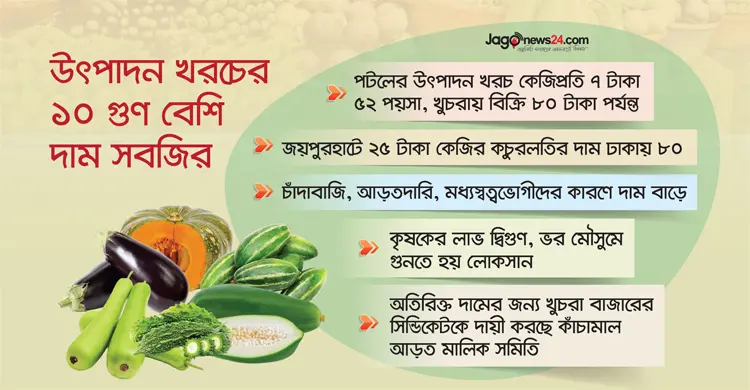
It costs a farmer Tk 7.50 to grow a kilo of pointed gourd. It sells in the local wholesale market for Tk 14 to 15. At Dhaka's Karwan Bazar, the wholesale price is Tk 35 to 40 depending on quality. And in the retail market, a consumer pays up to Tk 80 for the same pointed gourd. After passing through a few hands from the farmer, the price of the same vegetable rises tenfold.
This emerges from interviews with farmers and wholesalers and an analysis of vegetable price reports by the government's Department of Agricultural Marketing (DAM).
This gap between wholesale and retail prices as produce changes hands is not limited to pointed gourd but applies to almost all vegetables. Government data show that brinjal, bitter gourd, okra, bottle gourd, snake gourd, taro stolons, tomato, cucumber and other vegetables are now selling at six to ten times their production cost. Of this, prices rise about fourfold due to middlemen between wholesale and retail markets alone. On top of that come abnormal transport costs, extortion on the roads and repeated commission charges from the production centre to the point of sale.
Despite all this, no vegetable can now be found in Dhaka's markets for less than Tk 60 a kg. Ordinary consumers suffer the most. Farmers are not getting adequate prices either, while middlemen are profiting.
What each vegetable costs to grow
Using its field staff and research wing, DAM worked out the production cost of 27 important agricultural products in the country. For each product, production cost data were collected from 69 separate farmers.
That report showed that it costs a farmer Tk 7.52 to produce a kilo of pointed gourd. The production cost of brinjal is Tk 9.20, bitter gourd Tk 11.47, okra Tk 10.79, snake gourd Tk 8.30, bottle gourd Tk 5.33, tomato Tk 8.21 and cucumber Tk 8.04.
Information from DAM shows the report is two years old. Fertiliser and irrigation costs have risen somewhat since then; allowing for that, current costs could be Tk 1 or 2 a kg higher. On the other hand, vegetable yields have also risen somewhat in that time, so taking that into account, costs have not changed very much.
The report includes all of a farmer's costs at the production stage. For example, growing pointed gourd costs a farmer Tk 95,564 an acre. This includes Tk 3,206 for land preparation, Tk 10,578 for fertiliser, Tk 3,767 for seed, Tk 37,444 for labour, Tk 7,056 for irrigation and Tk 8,089 for pest management (pesticides and other items).
Beyond these costs, the total also includes rent or its equivalent of Tk 17,000 an acre, whether the land is leased or owned. Interest of Tk 2,103 has been counted as though the cost of cultivation were borrowed, along with other costs of Tk 6,322.
The yield of pointed gourd per acre is put at 12,711 kg, which gives a cost of Tk 7.52 a kg.
Jago News discussed DAM's cost calculations with ten farmers across the country. They called the figures relevant, though some said costs have risen considerably this season as pesticide, diesel, irrigation and fertiliser prices have all gone up together. By that reckoning, production costs would be Tk 1 or 2 a kg higher.
What farmers get
Farmers who gave data for the DAM report said they get Tk 14.38 a kg for pointed gourd, almost double the production cost. For other vegetables too, the report shows profits of double or close to it. Out of this, farmers also bear transport costs to regional markets and other charges, such as the fixed market toll and commission on sales.
Most farmers, however, objected to the report's figure of double profit. Kamruzzaman, a farmer in Akkelpur Sadar, Joypurhat, told Jago News that commission alone costs Tk 2 to 3 a kg. Then some vegetables spoil; traders don't take them and they have to be thrown away. About 10 per cent must be counted as spoilage.
He said a price of double the cost is only available when supply is tight. When supply exceeds demand, even the production cost is not recovered and farmers make a loss. This happens most in the peak season; sometimes, when the market is flooded with vegetables, farmers have even had to leave their produce behind unsold.
Shahidul Islam, a farmer in the Bhagabanpur area of Naogaon Sadar, said the profit is not large given the risk, investment and labour that go into growing vegetables. And with seed and pesticide prices rising, the profit margin is shrinking day by day.
He said vegetables often sell wholesale for Tk 3 to 5 a kg. This happens every year with brinjal and pointed gourd in the peak season, when not even half the production cost is recovered.
The middlemen's share
From the village markets where farmers sell their vegetables to the retail market, there are now several layers of middlemen. Some farmers said they sell to traders at the village market who buy on behalf of commission agents.
These traders representing commission agents are the first tier of middlemen in rural areas. For a commission of Tk 1 to 3 a kg, they buy vegetables for various village depots. The produce then comes to the village depot, and from there, with further mark-ups (the commission agent's profit), it goes to large regional markets, such as Mahasthan Haat in Bogura, the biggest vegetable market in the north.
Md Faruk Mia, owner of a commission agency at Mahasthan Haat, told Jago News that produce has passed through two hands before it reaches him, by which time the price has nearly doubled. This includes transport and labour costs and one round of commission. They then take their profit and send the produce to wholesale depots in cities across the country as demand requires, where another round of commission must be paid.
For the capital, a large part of the vegetables then comes to Karwan Bazar. There traders take the produce from the trucks to depots again, and it changes hands several times as demand requires, raising the price once more. That is because hundreds of wholesalers, small traders, stockists and exporters' representatives are there to make a profit. Some wholesalers also pick out the kinds of vegetables they need from the variety available, and sometimes retailers buy directly from the depots. With each sale, besides the traders' profit, commission must be paid.
According to DAM, agricultural produce changes hands at least three times on its way from farmer to consumer. In this process, traders at every level, local, wholesale and retail, make much more profit than the farmer.
Unwritten costs
Several traders who bring vegetables to the capital said the fare for transporting 14 tonnes of vegetables from Mahasthan Haat in Bogura to Dhaka used to be Tk 20,000. Now they pay Tk 30,000 to 32,000. Over the past few months, fares on every route have risen by an average of 25 per cent.
Besides transport there are market tolls and the cost of labourers and porters for bagging, as well as extortion along the way. On the way to Dhaka, about Tk 2,000 to 3,000 has to be paid in extortion at various places, including Bogura Bypass, Sherpur, Koddar Mor, Elenga Bypass, Tangail Bypass and Karwan Bazar.
A trader named Aktaruzzaman said extortion along the roads pushes up vegetable prices. "As soon as they see a vegetable truck, they demand money. If you don't pay, you face harassment. To avoid trouble and transport quickly, we are forced to pay."
How Tk 25 taro stolons become Tk 80 in a day
Taro stolons from Joypurhat go all over the country and are also exported. On 24 May, Jago News spoke to people along the chain from farmers in the area to retail vegetable sellers in Dhaka, and found that by the time they reached Dhaka's retail market the stolons cost Tk 80 a kg.
That morning, taro stolon farmer Sabuj Mia at Panchbibi Bazar in Joypurhat told Jago News: "This morning I sold stolons at Tk 25 a kg. Sending them from here should cost about Tk 2 a kg in transport."
The same night, the stolons were seen selling for Tk 40 to 43 at a depot in Karwan Bazar's tin-shed market. The next morning, 25 May, they were selling for Tk 80 at Rampura Bazar.
Asked about the price there, retailer Enamul said: "Everyone just sees the profit. But no one sees that every night we have to sell unsold vegetables for next to nothing. No one counts the vegetables that rot and spoil in the shop."
He said that after buying there are packing and transport costs; the fare for a van of vegetables from Karwan Bazar to Rampura is Tk 500. Some produce is spoiled and has to be sold cheaply, and weight is lost as it dries. Then there is shop rent, labour bills and staff salaries. "Because of the high costs, we are forced to sell at higher prices," he said.
Last year DAM prepared another report for the agriculture ministry, showing how prices of agricultural products rise on their way from farmer to consumer. It found that among traders, small traders (farias) make a profit of 6 to 7 per cent and wholesalers 11 to 21 per cent, while retailers in the capital make 33 to 46 per cent.
What those involved say
There is no oversight or rule in this country on how much profit a trader may make on a sale. As a result, there is a tendency towards unethical profit among all four classes of traders between farmer and consumer. Those involved say plans are needed to curb this through proper and effective policies.
Md Imran Master, president of the Bangladesh Kachamal Arot Malik Samity (fresh produce commission agents' owners' association), directly blames retailers for the abnormal price gap. Citing the price of taro stolons, he said: "How do retailers buy stolons at Tk 40 and sell them at Tk 80? How can their costs be so high? In fact, retailers are now the biggest syndicate in the market. Market-based syndicates are making profits and traders are taking the blame. The government needs to look into this."
Masud Karim, director general (additional secretary) of DAM, told Jago News that product-based syndicates have formed in every market and need strict monitoring. The process of produce changing hands so many times between farmer and buyer must also change, and the many unwritten syndicates operating from village to city must be broken.
Golam Rahman, president of the Consumers Association of Bangladesh (CAB), said vegetable prices will stay bearable if produce changes hands fewer times. He told Jago News that if farmers can sell vegetables in retail markets through associations or other means, both they and consumers will benefit. In other words, a direct link must be created between production centres and sales points. If vegetables can be marketed directly from the production level through cooperative societies, the dominance of middlemen will fall. The government must play the biggest role in this, and proper and effective policies are needed.
Source: Jagonews24. First published in Bengali on The Agro News.


Comments
(0)