
Bangladesh exports fresh vegetables to more than 40 countries, yet its reach in the world vegetable market remains very limited. One of the main reasons is that, for a long time, the bulk of vegetable exports has gone to the same six countries. Earnings from the rest are very small in comparison.
According to the Export Promotion Bureau (EPB), the six countries bringing in the most vegetable export earnings are the United Arab Emirates, Malaysia, Qatar, the United Kingdom, Saudi Arabia and Kuwait. More than 35 other countries, such as Italy, Singapore, Bahrain, Sweden, Canada and Germany, account for only 20 per cent of the total. This picture emerges from an analysis of EPB data on vegetable export earnings.
Where the money comes from
The EPB report shows that Bangladesh exported vegetables worth US$118.7 million in the last fiscal year (2020-21). Of this, the UAE brought in $28.3 million, or 24 per cent of the total. Vegetables worth $23.3 million, 20 per cent of the total, went to Malaysia, and 12 per cent, or $14.3 million, went to Qatar.
In the same breakdown, vegetables worth $12.6 million, ten and a half per cent of the total, went to the United States. Saudi Arabia, the fifth country, accounted for 8 per cent of earnings, with $9.3 million of vegetables exported there last fiscal year. Kuwait took $5.8 million, or 5 per cent.
Data for the previous year tell the same story. In fiscal 2019-20, vegetable exports earned $163.9 million. Of this, 36 per cent came from Saudi Arabia, followed by 20 per cent from the United States, 11 per cent from the UAE, 8 per cent from Malaysia and 4 per cent from Kuwait.
India and Pakistan move in
Asked why most earnings are confined to six countries, Mohammad Mansur, general secretary of the Bangladesh Fruits, Vegetables and Allied Products Exporters' Association (BFVAPEA), told Jagonews: "Our export sector keeps stumbling for various reasons. Despite the potential, we cannot hold on to new markets. Later India and Pakistan take them over."
He said: "The biggest reasons our market does not grow are the cost of air transport and the lack of ports. Our two rivals in vegetable exports, India and Pakistan, are in a much better position. Their freight costs are much lower. Where we send vegetables to nearby countries by air, India exports them by ship from Bombay. They quickly capture the markets we build by offering lower prices, because their costs are lower and they can absorb it."
Giving an example, the exporter said: "We had increased vegetable exports to Oman considerably. Now India has taken that market. They send vegetables by ship directly from Bombay within three days. Where our air freight costs $6 a kg, theirs is $1. This is happening in many countries. We are steadily falling behind in the Middle East too."
Exporters say that since vegetable exports began, about half of all Bangladesh's vegetable exports went to Middle Eastern countries, and exports there grew every year. But freight problems are now adding to the challenges, so attention has to turn to European Union (EU) countries.
They say agricultural exporters have been hit hardest by high air fares for a long time. In the world vegetable market, the products of Bangladesh, India and Pakistan are of the same kind and go to the same destinations. But because India and Pakistan have better freight rates and other facilities, foreign buyers buy more from them, and Bangladeshi exporters are falling behind despite the potential.
What is exported and who buys it
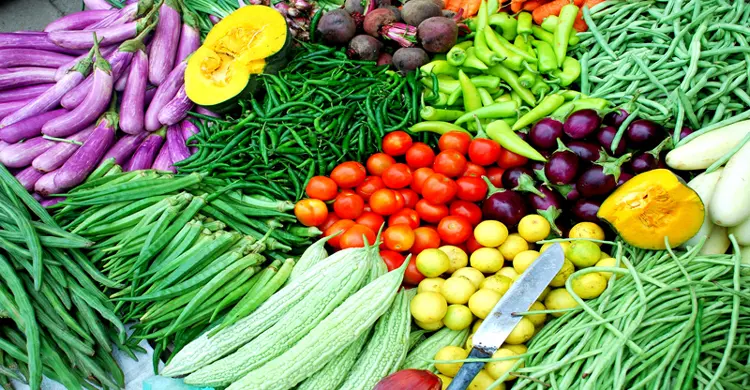
Bangladesh exports many kinds of vegetables. The main ones are bottle gourd, pumpkin, pointed gourd, aubergine, okra, potato, papaya, snake gourd, spiny gourd, green chilli, yardlong bean, flat bean, tomato and various leafy greens. Being perishable, all except potatoes have to be carried by cargo plane.
There are about 10 million Bangladeshi expatriates worldwide, more than half of them in the Middle East. Bangladeshis living there are the main buyers of these vegetables. Expatriates from India, Pakistan, Sri Lanka and Myanmar also eat Bangladeshi vegetables, and Middle Eastern buyers now buy some too.
Exporters say some fresh vegetables are exported all year and some seasonally. For seasonal vegetables, which must arrive quickly, there is less competition by air. But Bangladesh lags behind in shipping vegetables that are in demand all year round by sea. With a deep-sea port, India has the advantage.
Even so, vegetable exports have grown. Exports were worth $46.84 million in fiscal 2009-10, so more than three times as much is exported now, although exports dipped somewhat in the last fiscal year because of the coronavirus.
Source: Jagonews24. First published in Bengali on The Agro News.


Comments
(0)