
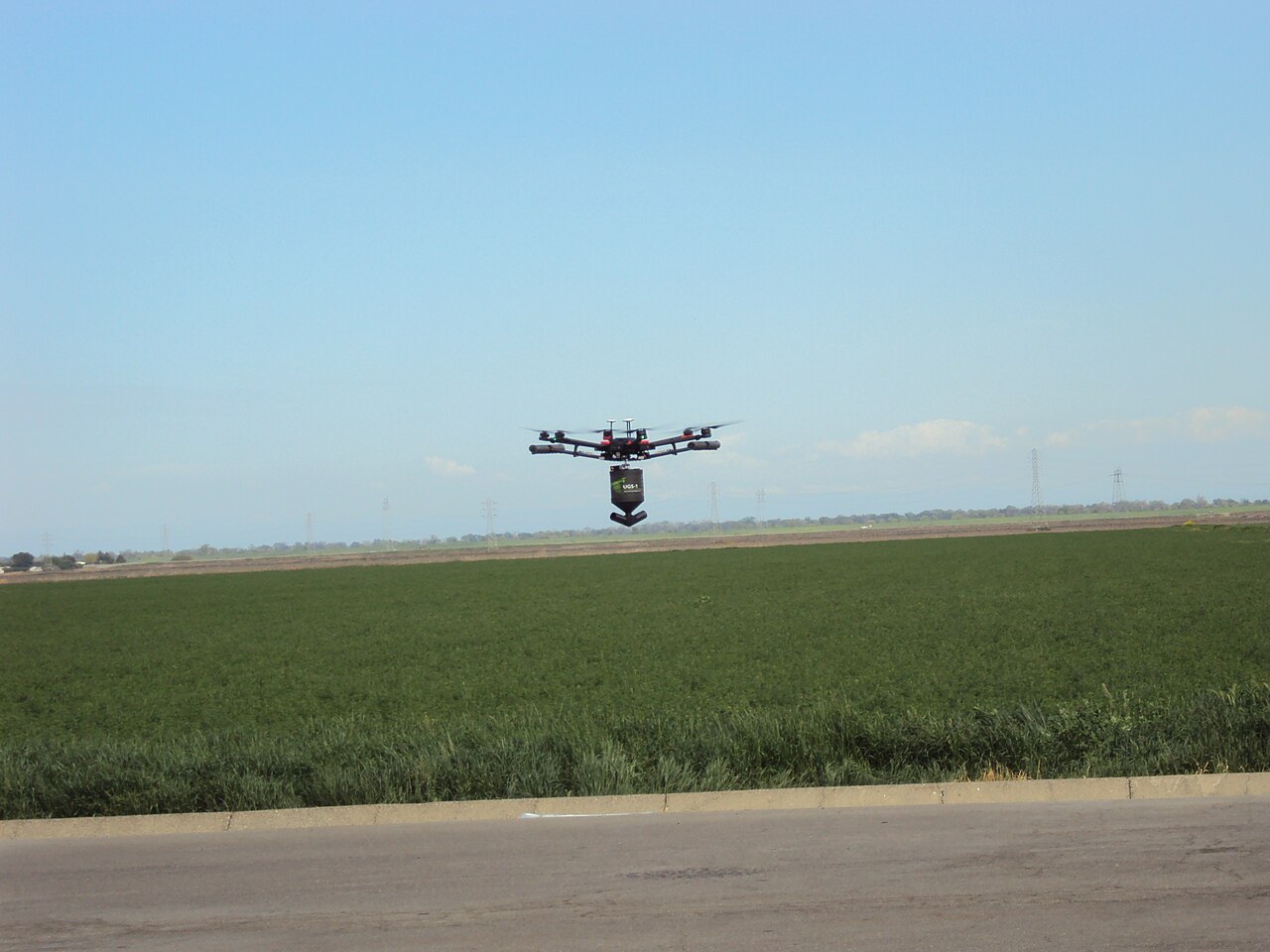
New US tariffs on imported drones, aimed mainly at the Chinese maker DJI, have taken effect and are starting to raise costs for the small but fast-growing group of American farmers who use drones for crop spraying and scouting, Global Agriculture reports.
The tariffs were announced under Section 232 of the Trade Expansion Act on 13 August and the main measures began on 3 September. Drones over 25 kilograms or fitted with thermal imaging, with their docking stations and critical components, face a 100% tariff; smaller drones without features the administration deems sensitive face 25%. Drones from the EU, Japan, Liechtenstein, South Korea, Switzerland and Taiwan pay 15% and UK-made drones 10% if they meet local-content rules. Equipment cleared before 3 September is exempt.
Washington presents the measure as national-security and supply-chain policy, but DJI's Agras heavy-lift spraying drones, widely used for pesticide and fertiliser application on row crops and orchards, generally exceed the 25 kg threshold.
USDA survey data cited in the report show about 12% of large family farms use drones, against 9% of midsize and 2% of small family farms. Of adopters, 40% cite higher yields and 40% labour savings, with smaller shares citing lower input costs and more precise application.
The cost will fall mostly on larger farms and custom applicators with existing fleets, for whom doubling the landed price of a replacement drone, battery or dock is a real expense before the next spraying season, at a time of soft prices and high input costs.
Photo: US Forest Service, Forest Health Protection / Wikimedia Commons (Public domain)
Source: Global Agriculture
Comments
(0)