
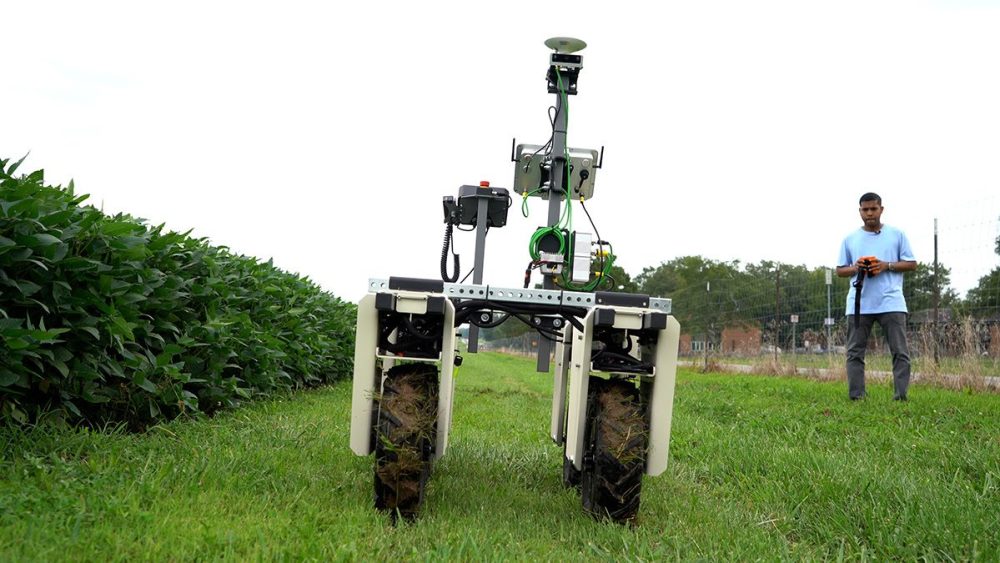
Researchers at Southern Illinois University Carbondale have built a battery-powered field robot and are developing artificial intelligence models so that it can detect soybean diseases before symptoms appear, with the aim of letting farmers treat only the parts of a field that need it.
Many soybean diseases are caused by soil fungi that spread with rain, and by the time lesions show on leaves or stems the plant is too damaged to yield well, said Billy Ram, assistant professor of precision agriculture. "Once the disease attacks the farmer's crops, the yield can be reduced to 60 to 70%," he said, and late-season fungicide is not very efficient.
Ram and doctoral student Samuel Singh first flew a drone over a University Farms field infected with frogeye leaf spot to make hyperspectral and multispectral maps, but its cameras could not see lesions on the undersides of leaves and low on the stems. So they built a four-wheeled robot with GPS and several cameras that view plants from above and below, and an autonomous mode that follows the rows of an uploaded field map.
"The robot should be able to drive down the field, keep track of each plant, identify if the plant has a disease and which type, and then share what percentage of the crop is diseased," Ram said. The team is now building the AI models to recognise frogeye leaf spot. The work is funded through the Illinois Soybean Center.
Singh wants to produce hot-spot maps so farmers can apply fungicide to specific areas instead of spraying whole fields. The longer-term goal is for machinery makers to turn the predictive technology into affordable tractor or sprayer attachments.
Illinois is the top US soybean state, with 43,000 soybean farmers. The American Ag Network item pointed to the university's full release, which was read for this report; the picture is by Todd Duermyer, courtesy of SIU.
Source: American Ag Network
Comments
(0)