
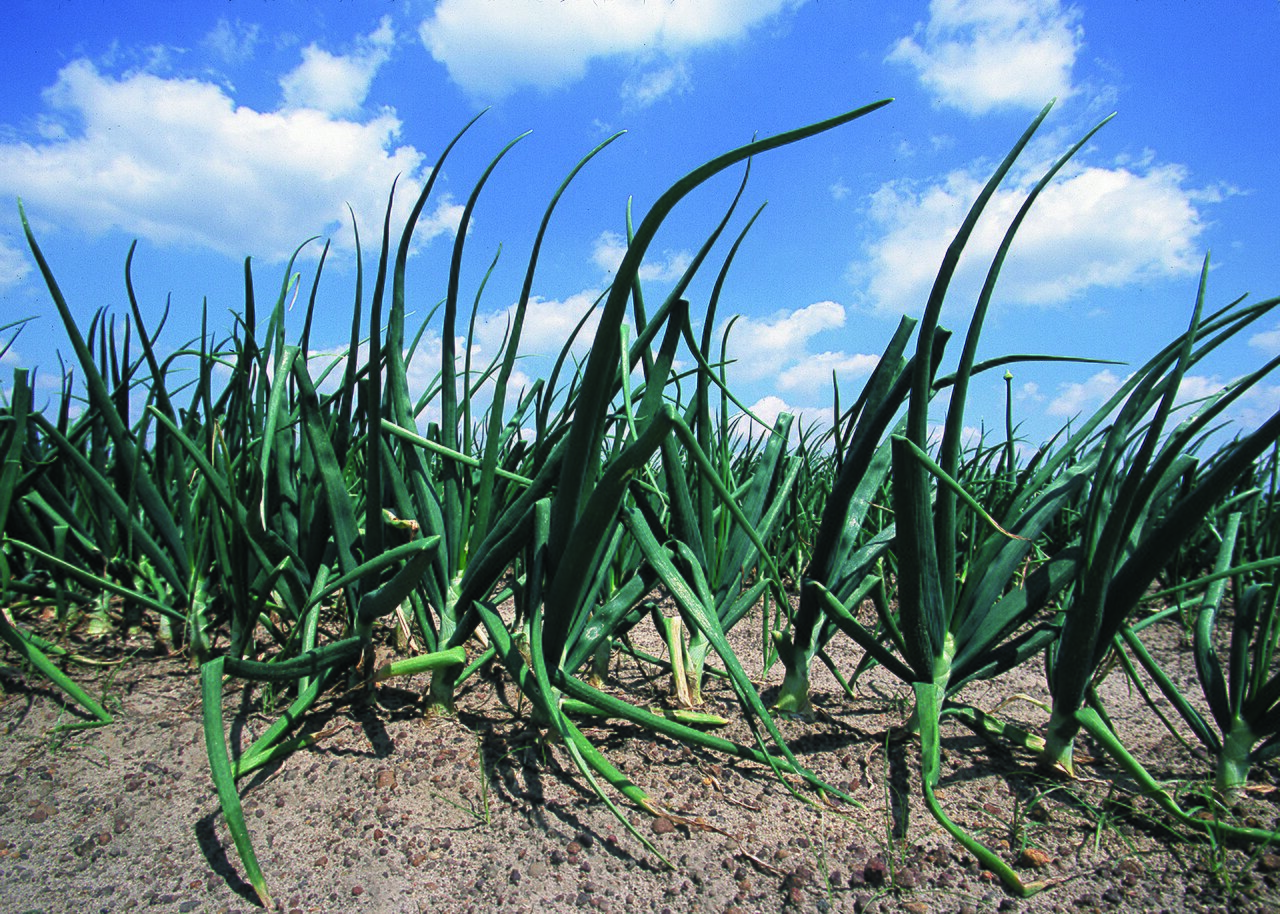
Researchers at the University of Georgia's College of Agricultural and Environmental Sciences (CAES) have field-tested a sprayer guided by artificial intelligence that cut herbicide use by about 60 percent in an onion crop. It does so by opening and closing more than a hundred separate nozzles in real time as it moves down each row.
The machine was built by the university's Precision Horticulture Team, led by Luan Oliveira, an assistant professor and precision agriculture extension specialist in the CAES Department of Horticulture. It carries 156 nozzles about half an inch apart, against one nozzle every 20 to 30 inches on a conventional boom. Each nozzle works on its own and opens only when a machine vision system, cameras and software that identify objects in real time, sees a weed directly below it.
The team compared it in a field trial on onions, one of Georgia's signature vegetables, with a standard broadcast sprayer that treats the full bed width whether or not a weed is there. Oliveira said the targeted approach gave the roughly 60 percent cut in herbicide volume and less injury to the crop, because the chemical no longer lands on onion plants growing between weed patches. The university's release of 25 November gave no plot size and did not name the camera or software.
Most spot sprayers already on the market work at a coarser resolution, often triggering a single nozzle over a foot or more of row. UGA's design narrows that to about the width of one onion plant, which the team says is what lets it treat a weed without treating the crop beside it. Onions are sensitive to several common herbicides at the seedling stage, so keeping spray off the crop matters for its safety as well as for the chemical bill.
The same team has tested a related machine for tree crops, Smart Apply, which pairs LiDAR (laser distance sensing that maps shapes in three dimensions) with real-time AI to map each pecan tree's canopy and spray fungicide only where the canopy is. Oliveira said a trial with it saved about 60 percent of fungicide compared with conventional spraying.
For growers, the appeal of both machines is less chemical without less weed or pest control, which lowers input costs and leaves less product on the soil or in runoff. No figure for the reduction in crop injury has been published, and the team has given no plans or timetable for commercial sale or wider on-farm testing.
Photo: Jeff Vanuga, USDA Natural Resources Conservation Service / Wikimedia Commons (Public domain)
Source: Global Agriculture

Comments
(0)