
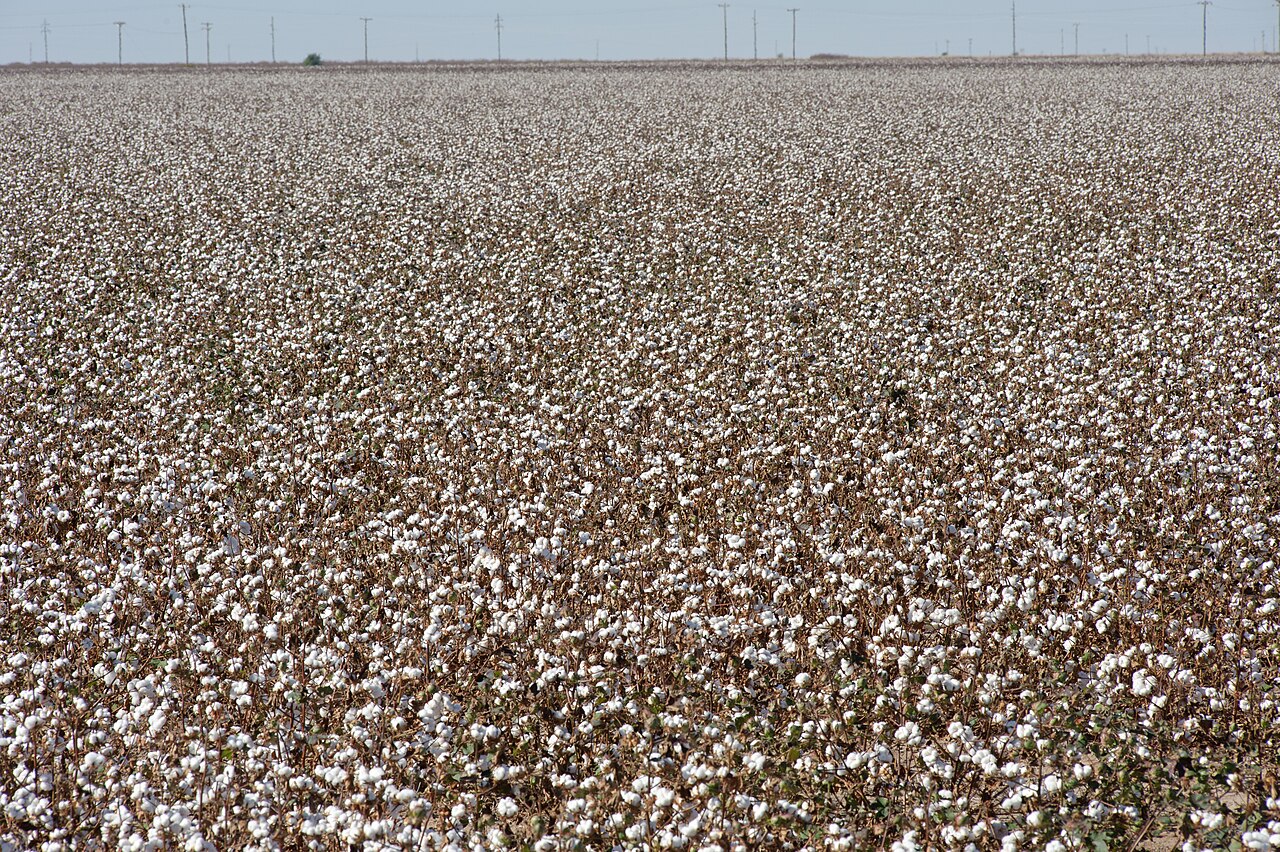
Cotton growers deciding whether to swap ground sprayers for spray drones at harvest-aid time now have several years of side-by-side field data. Auburn University trials found that drones defoliated cotton as well as a ground rig, even though less of the spray reached the plant.
The results were published on 9 November on Auburn's AU Precision Ag blog by extension specialist Simer Virk, whose programme has compared drone and ground-rig defoliation across large replicated blocks in cotton fields over four site-years.
Before cotton is picked by machine, growers apply harvest aids that strip the leaves and force the bolls open, so the picker gathers cleaner lint. The trials used a common three-way mix: Folex (tribufos, which kills leaf tissue on contact), ethephon (a growth regulator that releases ethylene inside the plant to loosen leaves and open bolls) and thidiazuron (another growth regulator that speeds defoliation). Harvest aids act only on the leaf surface they reach, so how evenly they land matters.
The ground sprayer applied the mix in 10 gallons of carrier water per acre, the standard rate for Southeast cotton. The drones applied the same chemicals at 3 and 5 gallons per acre. The researchers measured how much spray reached the upper, middle and lower canopy, then followed defoliation, leaf desiccation, regrowth and open bolls to harvest, and finally lint yield and fibre quality.
The drones left less spray on the plant than the ground rig at every canopy level, and their coverage was less even across the swath. Virk's team puts most of that gap down to the ground sprayer's far higher water volume and its boom height. Raising the drone rate from 3 to 5 gallons per acre narrowed the gap, especially in the upper canopy.
The chemistry still worked. Defoliation, desiccation, regrowth control and boll opening were similar for the two methods in every trial year. Only one site-year showed higher desiccation under the drone, which the researchers link to that season's conditions. Lint yield was the same, and fibre quality showed no meaningful difference.
Drones can reach wet, rutted or oddly shaped fields that ground rigs struggle with, and can fly in the short weather windows before harvest, while labour shortages are pushing growers toward aerial application. The researchers caution that the result depends on the basics: calibrate and check the drone's actual application rate, pick a swath width that keeps coverage even, follow the product label's volume and droplet-size rules, and fly only within recommended wind limits. Those steps matter more for a drone, because its low water volume leaves less margin for error.
Photo: USDA NRCS Texas / Wikimedia Commons (Public domain)
Source: Global Agriculture

Comments
(0)