
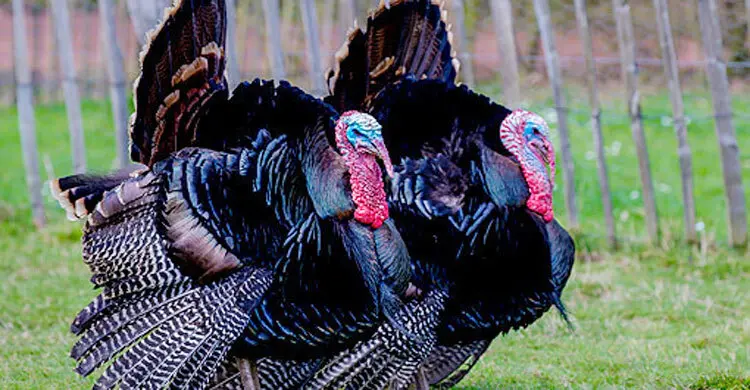
Turkeys are becoming more popular in Bangladesh, and many people now keep them at home as well as on farms. Crossbreeding of domestic turkeys produced the bronze turkey, which is popular today and is now the most widely reared.
Through selective breeding, several varieties of turkey have been developed, including the Bronze, Narragansett, White Holland, Bourbon, Red, Black, Slate and Beltsville White.
The bronze turkey
The bronze variety is the most commonly reared. White markings at the ends of the tail and wings make these birds very attractive, and their feathers carry coppery bronze markings. They look a faded earthy colour, similar to the wild turkeys of the Mississippi valley and eastern America.
An adult bronze tom weighs 16.5 kg and an adult bronze hen over 9 kg. A one-year-old bronze tom weighs 15 kg and a one-year-old hen 4 kg. Each bronze hen lays 40 to 80 eggs a year.
Eggs and breeding
Successful turkey farming depends on producing large numbers of fertile eggs, but turkeys lay at a very low rate. Young hens lay more than older ones. Egg records in California show turkey hens laying 77 eggs in the first year, 50 in the second, 44 in the third and 28 in the fifth.
Hatching time affects laying: birds that hatch sooner lay until winter, while those that take longer lay until about spring.
Artificial insemination raises the fertility of turkey eggs more than natural mating. The success of any breeding programme depends on the quality of the breeding flock, and careful selection of that flock is a precondition for success. Guidelines have been recommended in America for selecting turkeys for breeding, and these should be followed.
Feeding
Unlike other poultry, turkeys show deficiency symptoms sharply and immediately when any nutrient is lacking. For the first four weeks their ration should contain 28 to 26 per cent protein.
From four to eight weeks it should contain 23 per cent protein, and from eight to 12 weeks 21.5 per cent. The text then gives 18 per cent for 12 to 25 weeks and 16 per cent for 15 to 20 weeks.
Meat and bone meal, soybean meal and various protein concentrates can be used as protein sources. Essential amino acids, essential minerals, vitamins and enough clean water affect growth. Female turkeys need more protein than males.
In the first four weeks a turkey eats an average of 30 grams of feed a day; at 30 weeks it eats 300 grams a day. Turkeys convert feed quite efficiently.
From hatching to 12 weeks, chicks eat 2 to 2.5 kg of feed for every kilogram of weight gained. Growth slows after three months of age. By the seventh month each turkey weighs about 3.5 kg, and by the eighth month about five kg.
Diseases
Deaths among growing turkeys and breeding flocks hold back profitable production, and various diseases are the cause. Blackhead is a serious turkey disease caused by a type of protozoa.
The parasite lives in the turkey's caeca and can spread infection for several months. Turkeys three months old are more affected than older birds. The head turns black.
Affected birds pass thin yellow droppings and the liver becomes swollen and enlarged. Trichomoniasis resembles coccidiosis and can often be mistaken for it; it affects chicks of six to 10 weeks.
Another disease is caused by a bacterium called Clostridium botulinum. Affected turkeys become drowsy, make a sound in the throat, and different parts of the body become limp.
Turkeys also get the diseases chickens get, such as coccidiosis, fowl cholera, fowl pox and paratyphoid, and are infected by various kinds of worms. But with a vet's advice at the right time, turkey farming can be profitable.
Source: Jagonews24. First published in Bengali on The Agro News.
Comments
(0)