
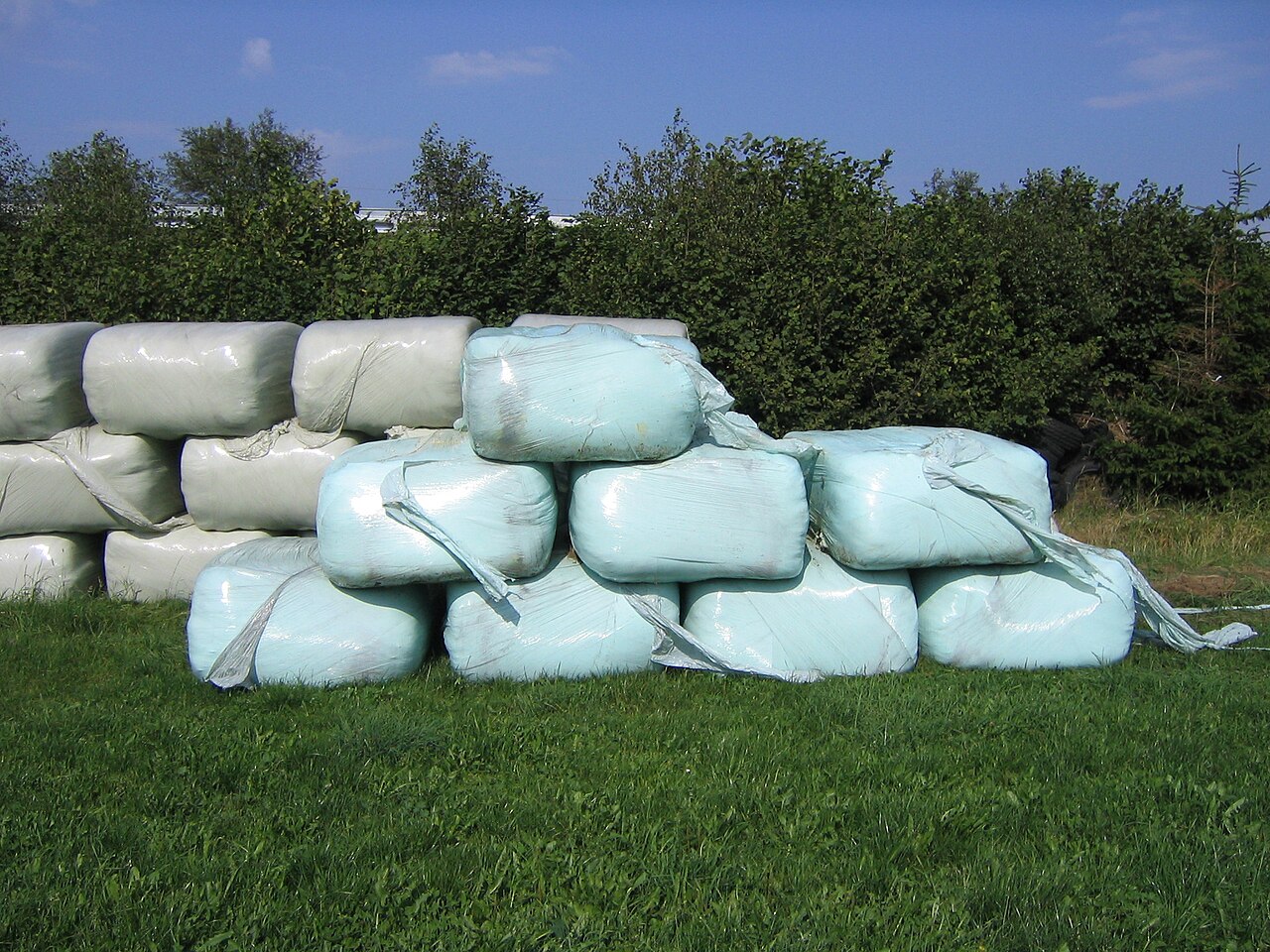
ICARDA and national partners in Tunisia are developing a locally made machine that bales and wraps haylage, so that smallholder livestock farmers can keep good forage for the months when fresh feed runs short, CGIAR reported.
Seasonal rainfall and recurrent dry periods limit forage in Tunisia, leaving farmers to rely on low-quality oaten hay, cereal straw and bought concentrate. Silage keeps forage close to its fresh value for months, but it usually needs bunker silos, machinery and investment that put it beyond smaller farms.
Baled haylage sits between hay and silage. Freshly cut forage is partly dried, pressed into dense bales and wrapped in airtight plastic film; without oxygen, lactic acid bacteria ferment the plant sugars and preserve it. Haylage typically holds 40 to 60 percent dry matter, against 80 to 90 percent for hay and about 30 to 40 percent for silage. Because the crop does not have to dry completely, fewer leaves are lost and the harvest depends less on long spells of dry weather. The method also suits forage legumes, which are hard to make into conventional silage.
It needs care. Forage must be cut at the right stage, wilted evenly and wrapped promptly, and the film must stay intact, because haylage ferments less than silage and spoils if air gets in. It is generally best used within six to 12 months. "It could help Tunisian farmers conserve locally produced, high-quality forages and improve the availability of quality feed during seasonal shortage periods," said Dr Salah Ben Youssef, forage specialist at the National Institute of Agronomic Research of Tunisia (INRAT).
The work grew from farmers' own requests. In Sers, members of a women's cooperative given bagged maize silage from a local feed firm reported about two litres more milk per cow a day and asked to make conserved forage themselves. Drawing on Algeria, where farmers already make haylage under ICARDA's Conservation Agriculture in Crop-Livestock Systems project, ICARDA engaged the Tunisian manufacturer ProMat to build a baler-wrapper prototype, and two ProMat engineers visited Algeria to study the machines there.
In parallel, ICARDA and INRAT are growing forage mixtures of vetch, oats and triticale: vetch adds protein, while oats and triticale give structure and energy. The next phase will field-test the prototype with INRAT and the Office of Livestock and Pasture (OEP) for performance, bale quality, wrapping and running costs, and test the mixture as haylage, with laboratory checks of pH, volatile fatty acids, ammonia and soluble nitrogen.
The partners plan to train farmers and machine operators and to explore shared services through cooperatives and machinery providers, so that small farms can have bales made without buying their own equipment. "The co-investment of ICARDA to develop this prototype of a locally manufactured haylage wrapper and the established linkages to INRAT (research), OEP (extension), and farmer communities will help us bring this new technology to scale," said Maher Kanoun, Director General of ProMat. The article was written by Udo Rudiger of ICARDA, Ben Youssef and Kanoun.
Photo: Flominator / Wikimedia Commons (CC BY-SA 3.0)
Source: CGIAR

Comments
(0)