
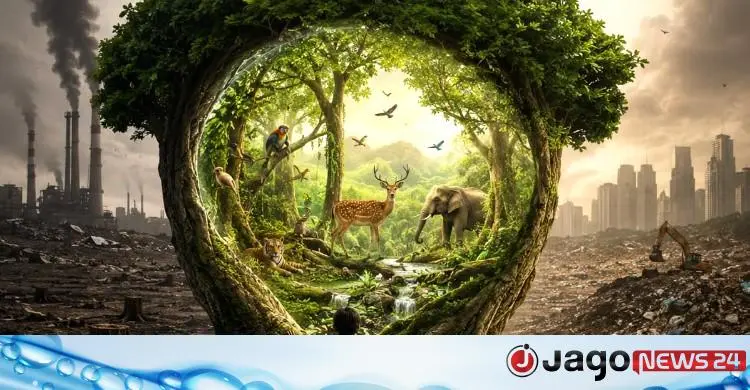
If any silent force works deep within human civilisation, agriculture, food and culture, one of them is the tree. A tree is not only a source of timber, fruit or shade; it is a living ecosystem where countless forms of life coexist. Beneath its roots, billions of micro-organisms, earthworms and beneficial bacteria make the soil fertile. Its branches shelter birds, bees, butterflies, squirrels and many useful insects. In truth, a tree is a living world.
Today the biodiversity crisis has taken on a frightening scale worldwide. Because of climate change, deforestation, overuse of chemicals, encroachment on rivers and canals and unplanned development, many of the world's animals, plants and micro-organisms are disappearing. In this reality, trees are not just a part of protecting the environment; they are a safe refuge for humanity's survival.
The tree at the centre of the web of life
Biodiversity does not mean only tigers, deer or rare birds. Tiny earthworms, bees, soil micro-organisms, snails, mussels, native fish and native rice varieties are all part of it. Every life in nature is connected to others, and at the centre of these connections is the tree. Fallen leaves give the soil organic matter. Earthworms and micro-organisms feed on the rotting leaves. Earthworms make the soil loose and fertile, so trees grow healthier. Through this cycle new life is born in nature.
A small world grows up around an old tree. Birds nest there, bees gather honey, butterflies settle on flowers and help pollination. These beneficial creatures are vital for agriculture. Without bees and butterflies, pollination of many crops would suffer and food production would fall. In other words, trees do not just give oxygen; they are the foundation of food security, farm production and ecological balance.
Farming that depends on nature
Bangladesh's agriculture is essentially nature-dependent. Its productivity rests on soil, water, native seed, beneficial insects and micro-organisms. Yet in the name of modern farming, overuse of chemical fertiliser and pesticides is badly damaging this natural balance. Once, many kinds of native fish were seen in the fields, canals and ponds of rural Bengal, and paddy fields held snails, mussels, frogs and various aquatic creatures. Many of them have disappeared today. Excessive pesticide kills not only harmful insects but also beneficial insects, fish, frogs and soil micro-organisms.
Around village homes there used to be countless uncultivated greens such as helencha, kalmi, shushni, thankuni and data shak. These greens were full of nutrients and part of rural culture. Now, because of chemical pollution and changes in land use, these plants are fast disappearing. Many native rice varieties are also on the way to extinction, though many of them tolerated drought, flood or salinity. In this time of climate change, protecting native rice diversity is extremely urgent, because the greater the biodiversity, the more resilient and sustainable agriculture will be.
The cost of excessive pesticides
Today excessive pesticides are used in farming in the hope of quick yields. They may control some pests temporarily, but in the long run they put the environment and human health at grave risk. Pesticides destroy beneficial bacteria and micro-organisms in the soil, reducing its natural fertility, and the land gradually becomes dependent on chemicals. At the same time, toxic chemicals wash with rainwater into canals, beels and rivers and destroy aquatic life.
In many cases pesticides are reducing the number of bees. This is deeply worrying, because a large share of the world's food production depends on pollination by bees. If bees disappear, the food system will be in crisis. So the time has come to expand integrated pest management, organic farming and environment-friendly technology. Agriculture must be seen not only in terms of production but also as part of protecting biodiversity.
Cutting a tree destroys an ecosystem
Cutting a large tree does not just destroy one plant; a whole ecosystem goes with it. Birds lose their nests, the homes of micro-organisms are destroyed, soil moisture falls and temperatures rise. Indiscriminate tree felling in towns and villages is raising temperatures. Climate change is increasing the risk of drought, flood, cyclones and salinity, and fewer trees disrupt the natural rainfall cycle. Trees, on the other hand, absorb carbon and play an important role in tackling climate change. So protecting trees is not just protecting the environment; it is securing the future of the next generation.
A social movement for conservation
Conserving biodiversity is not the government's responsibility alone; it must become a social movement involving families, schools, farmers, young people, researchers and local communities. Every village should take steps to plant native trees. Fruit, timber and medicinal trees should be planted along roads, at educational institutions, on khas land and in home yards. Priority should go to conserving native species, not just foreign ornamental trees.
At the same time there should be efforts to conserve native fish, native rice, uncultivated greens and aquatic life. Farmers should be trained in environment-friendly farming. As the use of technology in agriculture grows, special care must be taken that it is nature-friendly. Biodiversity and environmental education should also be given more weight in the school curriculum, because if we cannot teach children to love nature, the next generation will not be aware of the need to protect the environment.
Technology in balance with nature
The use of AI, IoT and digital technology in agriculture is growing worldwide. If this technology is used in an environment-friendly way, farming's dependence on chemicals can be reduced. Soil sensors can analyse the real condition of the soil so that fertiliser is applied only as needed, cutting excess chemical use. Likewise, if smart farming technology can give early warning of diseases and pests, indiscriminate pesticide spraying can also be reduced. Striking a balance between technology and nature will be the main challenge for sustainable agriculture in the future.
If biodiversity is destroyed, humans cannot survive either, because humans are not outside nature; they are part of it. Soil, water, trees, birds, fish and bees together make up the cycle of life on Earth. If today we cut trees, pollute rivers, overuse pesticides and destroy native biodiversity, we will leave an unsafe world for the next generation. So now is the time to respect, conserve and restore our biological resources. Planting a tree is not just planting a sapling; it is planting life for the future. Trees are our safe refuge and the greatest guardians of biodiversity. To keep the Earth habitable, we must be responsible towards trees, soil, water and biodiversity, because only if nature survives will people, agriculture and the planet survive.
Source: Jagonews24. First published in Bengali on The Agro News.
Comments
(0)