
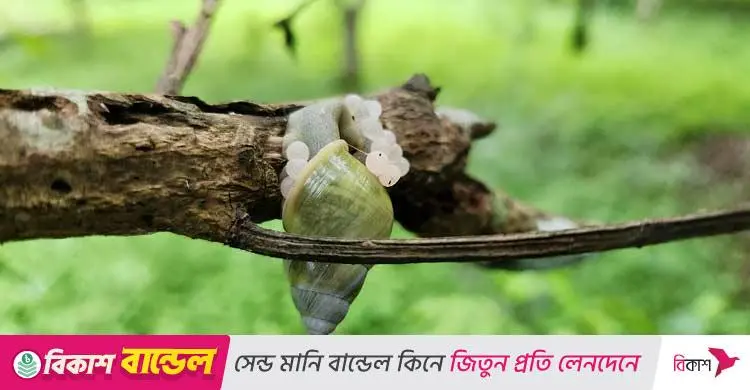
Researchers at Rajshahi University (RU) have identified, for the first time in the world, a novel breeding behaviour in the near-extinct tree snail Amphidromus globonevilli, known as the "pearl of nature". The research says the species lives and breeds entirely in trees. It is presented as the first documented record of egg-laying for snails of the genus Amphidromus, which is found across Bangladesh, Thailand and Myanmar.
The study has been published in the international science journal Folia Malacologica. The behaviour was observed during a five-day field survey at various places in Chattogram, Khagrachhari, Rangamati and Bandarban in September and October 2024.
The research was led by Prof Dr Mohammad Shahriar Shovon of the Department of Biochemistry and Molecular Biology, head of RU's Molluscan Research Laboratory, and Dr Takumi Saito of Vrije University in the Netherlands. The other team members were T S Rupmoy Tanchangya, an official at the Mohalchhari Upazila Health Complex, and two master's students of the Department of Biochemistry and Molecular Biology, Rahim Badsha and Zayid Hasan.
Eggs in tree cavities
The research found that the snail lays 10–50 pinkish-white eggs at a time in small cavities in trees. Some eggs were seen stuck to the snail's shell, and some were visible outside the cavity. From this behaviour, the researchers believe the snail's whole life cycle takes place in trees, something not previously documented anywhere.
The researchers believe the snails lay eggs not only in mango trees but also in jackfruit and other trees. Where earlier research had recorded eggs laid in nests made under leaves, this time egg-laying in tree cavities was observed.
Master's student Rahim Badsha (Sohan), a collaborator on the research, said the work has opened a new horizon in research on rare snails. Five new species have already been discovered and a unique behavioural observation published, with more research and publications in progress.
Prof Dr Mohammad Shahriar Shovon told Jago News: "Such snail species are extremely rare in the world. Keeping a large number of eggs together in a very tiny cavity is very challenging. Five of us researchers completed this study together. This documented information on the tree snail's breeding behaviour will play an important role in setting conservation policy."
The Molluscan Research Laboratory led by Prof Shovon has already identified five new species of tree snail in Bangladesh. It has also completed the world's first successful artificial breeding research on the snail, which is regarded as a breakthrough for the conservation of this near-extinct animal.
Source: Jagonews24. First published in Bengali on The Agro News.

Comments
(0)