
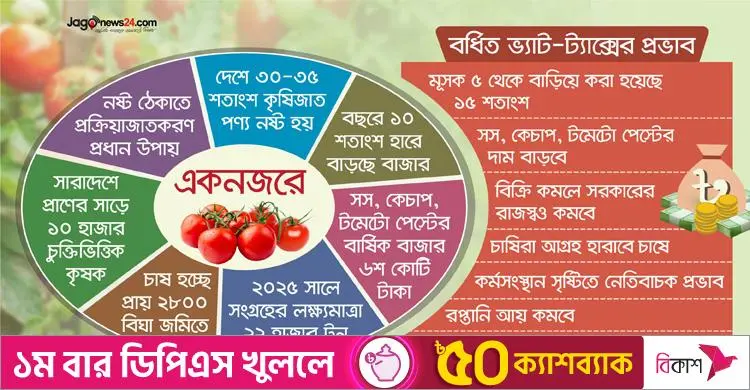
The feared effects of the VAT rise: a negative impact on job creation, a blow to exports, greater dependence on imported raw materials and lower government revenue.
"At the moment I am happy even with surplus produce, because oversupply is no longer a problem. Under contract farming, the contractor buys all the produce, so the farmer is protected. Yet at one time, with no buyers, we had to throw tomatoes away or sell them for next to nothing. Surplus tomato production was a curse for farmers; now it is a blessing."
So said Md Hasanuzzaman, a farmer from Paita Pukur village in Rajshahi's Godagari upazila, speaking to Jago News on Tuesday, 21 January.
Having grown tomatoes and other crops under contract farming for several years, he is now self-reliant and is educating his two sons.
Hasanuzzaman said that under contract farming, Pran Group provides financial support, technical training and various advice, so they can produce good-quality tomatoes and yields are much better than before. Under the agreement, Pran Group buys all their produce, so they face no problems and get a fair price.
From waste to processing
The picture 20 years ago or a little earlier was completely different. Farmers struggled every year with surplus tomatoes. With no buyers, many let their tomatoes rot in the field. Market prices fell to two to five taka a kg, and many destroyed or threw away their crop rather than sell.
For lack of proper storage and processing, many farm products such as tomatoes went to waste. Pran Group, the country's largest agro-processing company, came forward as a saviour for farmers. It has been making various food products from tomatoes since 2002. Pran gives top priority to product quality, which largely depends on good raw materials, and with this in mind it began contract farming of tomatoes in 2010.
Not only Hasanuzzaman but thousands of farmers like him grow and supply tomatoes and other crops to Pran Group under contract farming, which has improved farmers' lives and is creating new jobs.
Expressing frustration, Hasanuzzaman said: "The recent decision to raise VAT and tax will turn out to be even worse than a curse for us. It will raise product prices and reduce demand, so buyers will buy less. With lower consumption, makers of sauce and other products will buy fewer tomatoes. We will have to throw our produce away again, as we did 20 years ago."
The squeeze of VAT and tax will raise the prices of tomato-based products. If sales fall, industry and agriculture will feel the effects in several ways: job creation will suffer, exports will take a hit, dependence on imported raw materials will grow and government revenue will fall.
According to a report by the world food organisation, 30 to 35 percent of agricultural produce in Bangladesh is wasted simply for lack of processing. If sales now fall, large amounts of produce will go to waste and farmers will suffer.
At one time tomatoes had no use other than being eaten raw as salad or cooked or made into chutney. Processing them for year-round use had not caught on, and the facilities did not exist in the country; at one point the country became dependent on imports. Companies such as Pran came forward to process tomatoes and make them usable throughout the year. Sauce, ketchup, paste and other products followed, demand grew and people became used to consuming them. Sauce and ketchup are used not only with fast food but also to add variety to cooked dishes. As consumers of tomato products have increased, so has interest in growing tomatoes.
VAT raised from 5 to 15 percent
On 9 January, the VAT wing of the National Board of Revenue (NBR) raised value added tax (VAT) and supplementary duty on more than a hundred products and services. VAT on pickles, biscuits, cake, chutney, tomato paste, tomato ketchup, tomato sauce and mango, pineapple, guava and banana pulp was raised from 5 percent to 15 percent.
This season, 10,500 of Pran's contract farmers across the country grew tomatoes on about 2,800 bighas. The target for tomato procurement this year is 22,000 tonnes.
Farmer Iftekhar Ahmed said: "This year I grew tomatoes on 75 bighas. The yield has been good, and I will make a profit of Tk 20,000–30,000 per bigha. A good number of people earn their living working in my fields. If demand for the product falls and sales drop, we will not get a fair price."
"Since sales will fall because of higher prices and manufacturers will take less, we will face losses, so we will farm less land. This will also affect jobs in the sector," Iftekhar said.
He added: "If tomatoes, mangoes or other perishable fruit are not processed, middlemen and buyers cheat us. We have even suffered heavy losses when produce was not taken during times of oversupply. This will discourage farmers and push them to farm less land. Marginal farmers will be hit hardest by the VAT. To save marginal farmers, the government should not raise taxes and should withdraw the increased rate immediately."
The market for sauce, ketchup and tomato paste in the country is now worth Tk 600 crore a year and is growing by 10 percent annually. But if the recent VAT and duty rise pushes up prices, many people will stop buying these products, and if factories close as a result, uncertainty will fall on the lives of a large number of workers.
Economist: revenue will fall
Dr Zahid Hussain, former lead economist at the World Bank's Dhaka office, said that as tax and VAT rise, product prices will go up, consumers will use less and sales will fall. If sales fall, the government will get less revenue.
He said the impact on marginal farmers and the public should be considered in any government decision. The recent rise in VAT and tax is not a correct or timely decision, and the government could think of other ways to raise revenue without putting pressure on ordinary consumers and farmers.
Pran currently leads the sauce and ketchup market. Pran Group has the capacity to produce 30,000 tonnes of tomato sauce a year, and its sauce is now available in 11 variants, priced from Tk 3 to Tk 1,070.
There is good demand for Pran's sauce and ketchup abroad too, and the market is steadily expanding. It is currently exported regularly to 20 countries, including the United States, the United Kingdom, Italy, France and Malaysia, and the company is working to expand this market further. Pran's products are currently exported regularly to 145 countries, so there is scope to export sauce to 125 more. The bigger the market for sauce, the more farmers will benefit.
Pran: exports at risk
AKM Moinul Islam Moin, deputy managing director of Pran Agro Limited, said: "We have been making sauce since 2002. Since 2010 we have been producing larger quantities of tomatoes through contracts with farmers. Now we make sauce from local tomatoes, which has cut our sauce costs considerably."
He said Pran Group now collects and pulps tomatoes at the Barind Industrial Park (BIP) in Rajshahi and at the Pran Agro factory in Natore.
Moinul said: "We used to sell in most countries. We have been exporting for the past few years. At the moment we export sauce to 20 countries, including the United States, the United Kingdom, Italy, the Netherlands and countries in the Middle East. The 10 percent VAT rise will have a very big impact on us."
He said it is not as if VAT has only been raised by 10 percent; it has been raised 300 times. Sauce is not an essential product that people eat regularly. This is a time of inflation, and people will now eat less sauce. If sales fall, prices will rise.
"Until now we were able to supply sauce at competitive prices in the world market. Now the price of our products will go up, and we will lose export markets too. Our request is that if the tax is brought back to the previous rate, this sector will survive. And if we go on to import tomato paste, we will become import-dependent," he added.
Source: Jagonews24. First published in Bengali on The Agro News.


Comments
(0)