
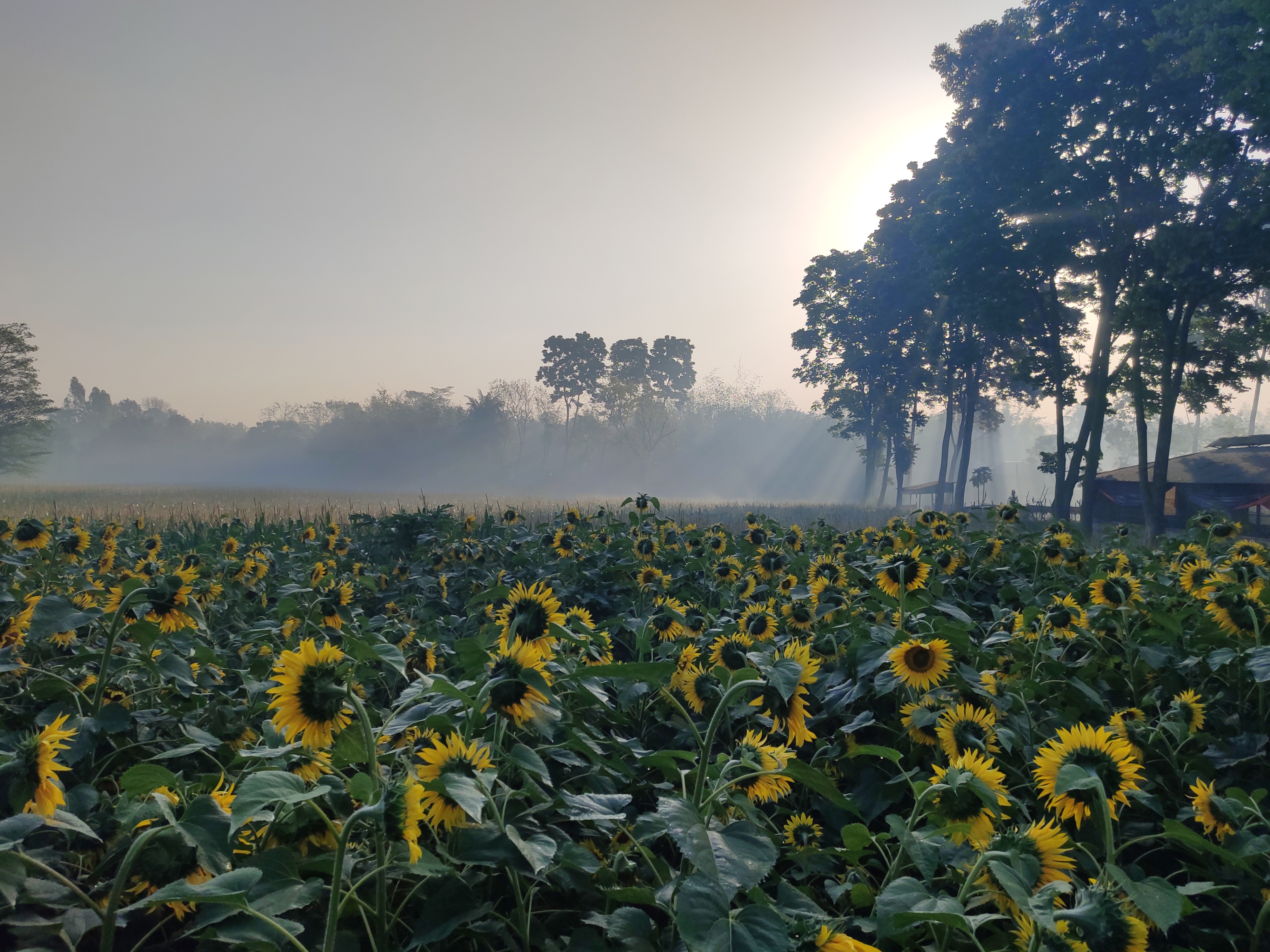
Sunflowers were in full bloom across wide stretches of land in several upazilas of Tangail in March 2026, and the farmers who grew them were hoping for a bumper harvest, Jagonews24 reported on 11 March 2026. The Tangail office of the Department of Agricultural Extension (DAE) said sunflowers had been sown on 178 hectares in the district's 12 upazilas in that rabi (dry winter) season, and the agriculture office said growers would profit if the weather stayed favourable.
The fields had flowered well that season. When the soft early-morning sun fell on them, whole fields glowed golden. At dawn the reporter found the flowers shining along the bank of the Jamuna river in Kakua union of Tangail Sadar upazila, standing tall above the green leaves as if turned towards the sun to greet the day. Farmers said they hoped to make a good profit from sunflowers with little capital, and the agriculture department said steps had been taken to secure a good yield.
Bees, butterflies and visitors on the Jamuna bank
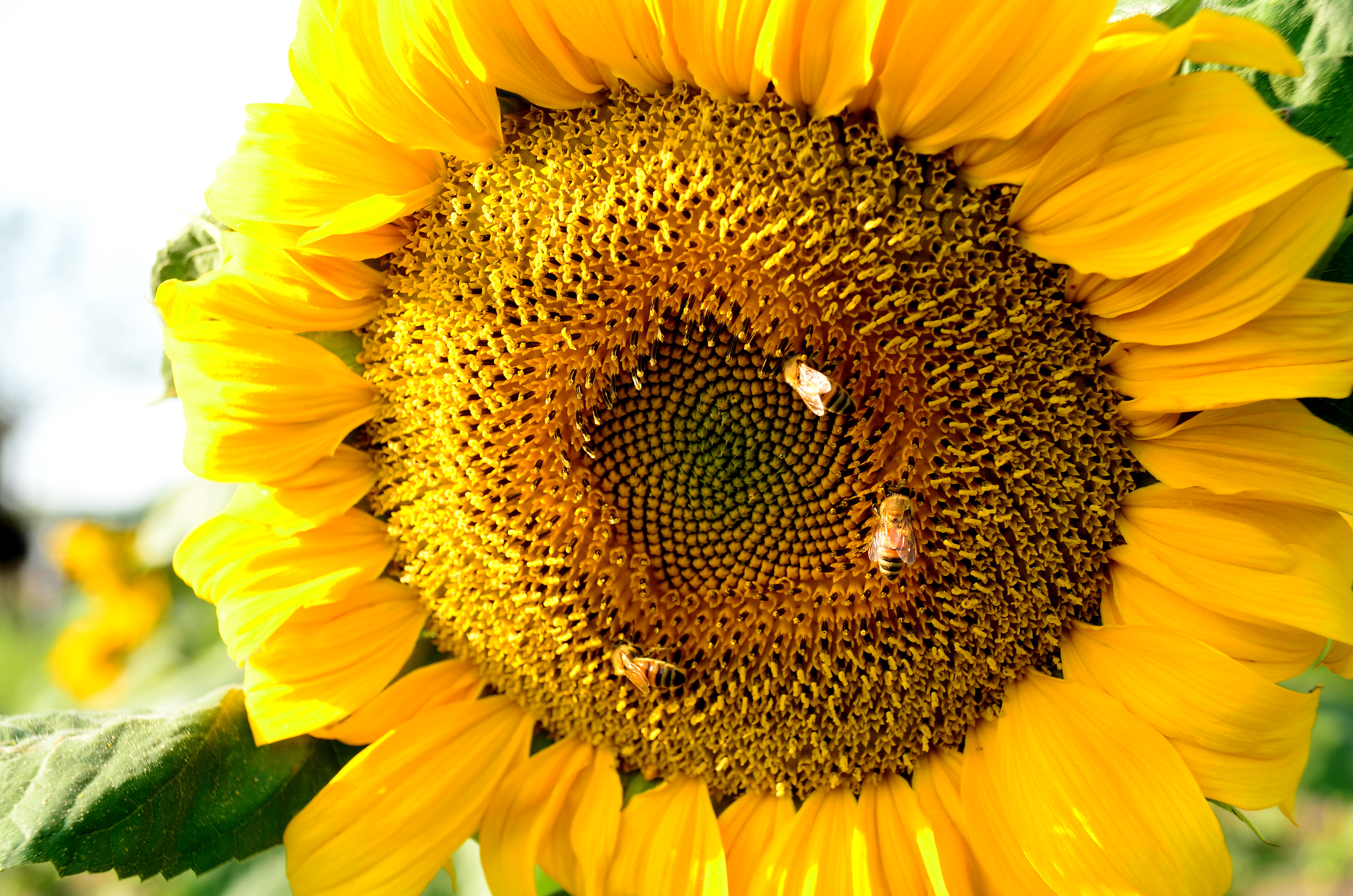
Butterflies and bees were busy in the flower fields every day, collecting nectar, and their presence added to the scene. From morning to afternoon visitors came from different areas to see the sunflowers, and young people and others of all ages walked through the fields taking photographs and selfies.
Jagonews24 was not alone in noticing the fields that fortnight. On 1 March 2026 the state news agency BSS reported from Tangail that the vast char lands of the Jamuna were covered in yellow, that Tangail Sadar upazila had a high yield that season and that sunflowers were also being grown in the char areas of Bhuapur, Gopalpur, Nagarpur and Kalihati upazilas. BSS said that, under a government incentive and through farmers' own interest, a hybrid oilseed sunflower of the TSF 275 variety had been sown on about 45 hectares in Tangail Sadar, including the remote char of Dakshin Goyla in Kakua union.
The farmers BSS spoke to described why they had chosen the crop. A marginal farmer said he had once thought of the sunflower only as an ornamental flower, but had grown it on one bigha of land on the agriculture office's advice and, judging by the crop, expected to meet his family's oil needs and still earn money. Another said he had grown sunflowers the year before, earned several times more than from other crops, and was growing them commercially on seven bighas that season. A third farmer said paddy and jute needed a lot of water and fertiliser, while sunflowers needed less water and suffered fewer pest attacks.
The Daily Inqilab, reporting from the same area on 26 February 2026, described Kakua union and the riverside lands as a meeting of yellow and green. Farmers there told the paper that their costs were much lower than for paddy and other crops, and one said several neighbours were thinking of growing sunflowers the following year after seeing his field. Visitors, some of whom had come after seeing photographs online, called the fields a form of agro-tourism.
Farmers told Jagonews24 that sunflowers cost less to grow than other crops and had a better chance of profit. Because oil pressed from sunflower seed is valued for its nutrients, they said, demand in the market was rising day by day, and many farmers were taking up the crop for the first time that year. A farmer named Md Rafiqul said: "I have grown sunflowers on 1 bigha of land. I hope the yield will be good this time."
178 hectares in 12 upazilas
According to the DAE's Tangail district office, as Jagonews24 reported it, sunflowers had been sown on a total of 178 hectares in the district's 12 upazilas that season. The upazila figures were:
- Tangail Sadar: 45 hectares
- Basail: 46 hectares
- Kalihati: 8 hectares
- Ghatail: 10 hectares
- Nagarpur: 10 hectares
- Mirzapur: 10 hectares
- Madhupur: 14 hectares
- Bhuapur: 5 hectares
- Gopalpur: 5 hectares
- Sakhipur: 3 hectares
- Delduar: 20 hectares
- Dhanbari: 2 hectares
Basail and Tangail Sadar had the largest areas, followed by Delduar and Madhupur, while Dhanbari and Sakhipur had the smallest plots in the district. Several of the upazilas with sunflower fields, among them Tangail Sadar, Bhuapur, Gopalpur, Nagarpur and Kalihati, lie along the Jamuna and its chars, which BSS identified as the main sunflower areas.
The reports did not agree on the figure for Tangail Sadar. Rumana Akter, the Sadar upazila agriculture officer, told Jagonews24 that sunflowers had been grown on 25 hectares in Tangail Sadar that year, and she gave the Daily Inqilab the same figure, about 25 hectares, on 26 February. The DAE district breakdown that Jagonews24 published gave 45 hectares for Sadar, and BSS also reported about 45 hectares there on 1 March. None of the reports explained the difference, which may reflect different stages of counting or different areas covered, so both figures are given here as the sources stated them.
What the agriculture officers said
Rumana Akter told Jagonews24: "Sunflower cultivation keeps increasing. On one hand oil is being produced, on the other people enjoy the beauty. Farmers are being given regular advice, training, fertiliser and seed support to encourage them. Grown by modern methods, sunflowers could become a promising cash crop for the district."
Speaking to BSS a few days earlier, she described the sunflower as a more profitable oilseed crop that could meet the demand for a healthy edible oil as an alternative to mustard, and said the area under sunflowers was increasing rapidly in Tangail's char lands. She said growers had received regular training, quality seed and fertiliser from the agriculture department, and that the crop was meeting the demand for edible oil while also creating a large opportunity for agro-tourism.
Ashek Parvez, deputy director of the DAE in Tangail, told Jagonews24: "If the weather stays favourable, farmers will get a good yield. Farmers are being encouraged to grow this cash crop to reduce dependence on imported edible oil and to meet the demand for nutritious oil. We have stood by farmers in the field and given them an idea of improved seed varieties and modern cultivation methods. I hope farmers will get a good yield this time."
Tangail grows a wide range of fruits, field crops and flowers through the year. The report argued that if local farmers received more training in sunflower cultivation with government support, the crop could become another promising source of income for the district.
Tangail, the Jamuna and Kakua union
Tangail is a district of Dhaka division covering 3,414.35 square kilometres, according to Banglapedia, the national encyclopedia published by the Asiatic Society of Bangladesh. It is bounded by Jamalpur district to the north, Dhaka and Manikganj to the south, Mymensingh and Gazipur to the east and Sirajganj to the west, across the Jamuna. Its main rivers are the Jamuna, Dhaleshwari, Lohajang, Bangshi, Turag and Jhinai. Tangail became a subdivision in 1870 and a district in 1969, and it has 12 upazilas, of which Ghatail is the largest and Dhanbari the smallest. The 2011 census counted 3,605,083 people in the district, and Banglapedia lists agriculture as the main source of income for 57.28 percent of households.
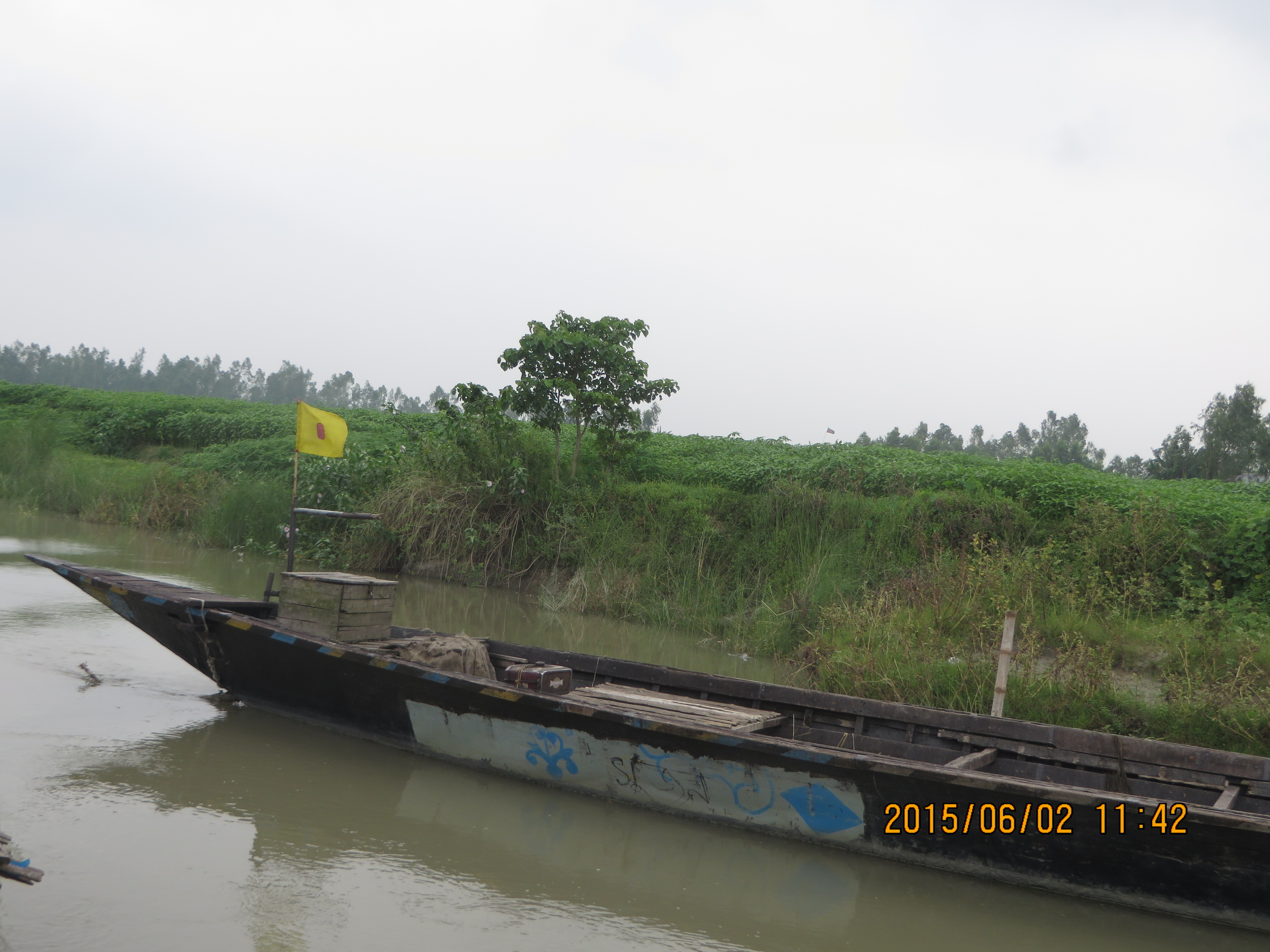
Tangail Sadar upazila covers 334.26 square kilometres. Banglapedia lists its main rivers as the Jamuna, Dhaleshwari and Lohajang, and its western boundary runs to Belkuchi and Chauhali upazilas of Sirajganj on the far side of the Jamuna. The upazila has 12 unions, and Kakua, where the reporter saw the sunflowers at dawn, is one of them: its area is 8,712 acres, and the 2011 census counted 13,955 men and 13,305 women there, with a literacy rate of 31.8 percent. The main crops Banglapedia lists for the upazila are paddy, jute, mustard, wheat, potato, sugarcane, groundnut, maize and vegetables; the sunflower is not among them.
Chars are the sand bars that rise in a river's course, either as islands in the channel or attached to the bank, and once vegetated they are settled and farmed. Banglapedia notes that island and attached chars tend to be less productive than the neighbouring mainland, because of less favourable soil in some chars and the uncertainty caused by erosion and frequent floods, and that irrigated crops are scarce on many of them. Sunflowers have been tried on such land elsewhere in Bangladesh. In February 2024 The Daily Star reported, citing the DAE, that in the five districts of the Rangpur region sunflowers had been grown on 229 hectares by 620 farmers that season, up from 195 hectares the year before, and that about 70 percent of that area lay on 60 chars of 26 rivers, including the Brahmaputra, Teesta and Dharla.
The sunflower as a crop
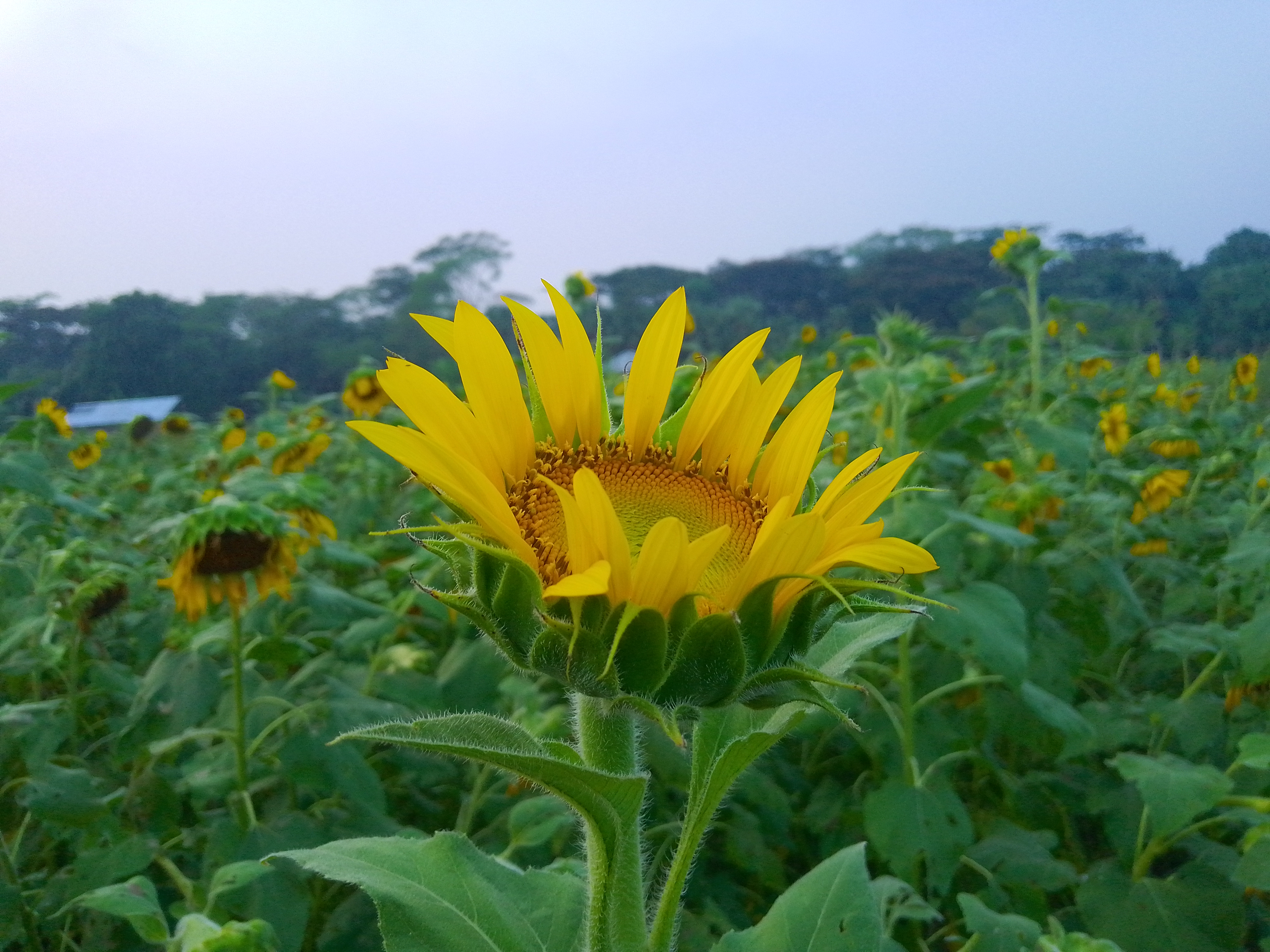
The sunflower, Helianthus annuus, is an annual herb of the family Asteraceae whose flower heads, with their yellow rays, sometimes reach 30 centimetres across, according to Banglapedia. Its seeds are used as poultry feed and as a source of edible oil, and the pressed cake left after oil extraction is used to feed livestock. Banglapedia says the cultivated sunflower probably originated in Mexico; a 2023 paper by Bangladesh Agricultural Research Institute (BARI) scientists describes it as native to North America. In Bangladesh it was first grown as a garden plant, and some dwarf varieties were introduced as an oilseed crop in the 1980s; Banglapedia says it is grown as both a kharif and a rabi crop in some central and northern districts and takes about 90 to 110 days to harvest.
The 2023 paper, published in Acta Universitatis Agriculturae et Silviculturae Mendelianae Brunensis by researchers from BARI's Oil Seed Research Centre, the Spices Research Centre and partner institutes, calls the sunflower the world's fourth-largest oilseed crop and an important minor crop in Bangladesh, cultivated on a small basis since 1975. It notes that the plant is not sensitive to day length and can be grown in both rabi and kharif seasons in all parts of the country, but that the rabi season is the best time. It grows on soils from sand to clay with a pH of 5.7 to 8, and its deep, branched taproot lets it draw moisture from the subsoil, which helps it through dry spells. The authors class it as moderately sensitive to salinity, with a tolerance range of 2 to 12 dS/m.
Each seed contains 40 to 47 percent edible oil, the paper says, and compared with rapeseed and mustard oil, sunflower oil is high in the fatty acids linoleic and linolenic acid and contains no erucic acid. In two seasons of field trials at Benarpota in Satkhira, in 2014-15 and 2015-16, the variety BARI Sunflower-2 gave 10 to 15 percent more seed than the variety SVS 00901, and the best management practices recommended by BARI gave 25 to 30 percent more seed than moderate management and 35 to 42 percent more than poor management.
Field figures from the DAE give a sense of the crop's economics. In the Rangpur region report of February 2024, DAE sources told The Daily Star that sunflower seed should be sown in the middle of November, that farmers could harvest in 100 to 110 days, that a hectare produced 2,100 to 2,400 kilograms of seed at a cost of 65,000 to 70,000 taka, and that the seed was selling at 100 to 110 taka a kilogram that season. Yields and prices vary by district, variety and year, and farmers are advised to take the current figures from their upazila agriculture office.
Seed quality matters for the oil. In May 2023 Jashim Uddin, director of the DAE's project to increase oil crop production, told bdnews24.com that imported hybrid seed yielded 42 to 43 percent oil, while locally grown sunflowers that were not properly cultivated often left immature grains that gave no more than 32 to 35 percent, which made oil processors prefer imported seed. The fields in Kakua were of a hybrid variety, TSF 275, according to BSS.
Why the flowers face the sun, and why the bees matter
Both Jagonews24 and BSS described the flowers as looking towards the sun. Research has refined that picture. A study published in the journal Science in August 2016 by scientists at the University of California, Davis, and the University of Virginia found that young sunflower plants track the sun from east to west during the day and turn back during the night to face east before dawn, while mature plants stop moving with their flower heads facing east. The researchers showed that the plant's internal circadian clock drives this movement, and that the east-facing flower heads received more visits from pollinators.
Those visits matter for the seed. A study in the Proceedings of the National Academy of Sciences in 2006, by researchers at Princeton University and the University of California, Berkeley, notes that pollinators are needed to produce 15 to 30 percent of the human food supply. Working in hybrid sunflower seed fields in California, they found that honey bees made 72 percent of 20,472 bee visits recorded from 33 bee species, and that interactions with wild bees raised the pollination efficiency of honey bees by up to five times. Fields closer to natural habitat received more of this help from wild bees.
The bees and butterflies that the Jagonews24 reporter and BSS saw gathering nectar in the Tangail fields were therefore part of the crop's work as well as of its beauty. BSS noted the same scene, with bees collecting nectar from the sunflowers late in the afternoon.
Edible oil imports and the oilseed drive
Ashek Parvez linked the sunflower push to Bangladesh's dependence on imported edible oil. In May 2023 bdnews24.com reported, citing Ministry of Agriculture statistics, that the country's annual demand for edible oil was 24 lakh tonnes and that about 88 percent of it had to be imported; according to Bangladesh Bank data, edible oil imports had cost 2.53 billion US dollars in the 2021-22 fiscal year. About 3 lakh tonnes of oil was then produced at home from mustard, sesame and sunflower. The government had set out to produce 40 percent of the demand, or 10 lakh tonnes, at home by 2025 without reducing rice production.
Jashim Uddin told bdnews24.com that mustard was the country's main oilseed and sunflower came next, that the greatest potential for sunflowers lay on the saline coastal land where boro rice could not be grown, and that sunflowers had been sown on 14,700 hectares nationwide that season. The government's aim, he said, was to bring 34,600 hectares under the crop by the 2024-25 fiscal year, which could yield 53,400 tonnes of seed and 20,292 tonnes of oil. He added that sunflower seed could be pressed directly in local oil mills, or ghanis, unlike soybean.
In May 2025 The Daily Star's Bangla edition reported figures from the DAE's Field Services Wing showing that the area under sunflowers had risen by 13.77 percent over five years, while mustard had grown fastest among the oilseeds, by 23.39 percent. The DAE said Barguna grew the most sunflowers of any district. An additional director of the DAE in Barishal told the paper that the government had taken several steps aimed at cutting edible oil imports by 40 percent.
At a roundtable held at Prothom Alo's office in September 2025 and organised with Solidaridad Network Asia, speakers said Bangladesh still imported about 90 percent of its edible oil, about 30 lakh tonnes a year, of which 15 lakh tonnes was palm oil and 10 lakh tonnes soybean oil, at a cost of about 2.5 billion US dollars, and that demand could rise to 35 lakh tonnes by 2030. They said the right seed, technology and policy support were needed to raise oilseed production at home. It is against this background that the Tangail officers spoke of the sunflower as a way to reduce import dependence.
Incentives, seed and the market
Much of the sunflower area in districts like Tangail is sown with government help. On 24 January 2026 BSS reported that, in the 2025-26 season, the DAE in the Khulna region had begun distributing incentive seed and fertiliser to 70,050 listed farmers. Under the programme, each farmer received support for one bigha (33 decimals) of land for one of 11 rabi crops, sunflower among them: 1 to 20 kilograms of seed depending on the crop, 10 to 20 kilograms of diammonium phosphate (DAP) and 5 to 10 kilograms of muriate of potash (MOP), free of charge. The farmers collected the inputs from government-approved dealers, following Ministry of Agriculture instructions, and in each upazila a committee led by the upazila nirbahi officer oversaw distribution.
The programme was not new. On 4 September 2023 the Ministry of Agriculture announced, in a press release reported by The Daily Star's Bangla edition, an incentive of 188.49 crore taka for 10 rabi crops, sunflower among them, for 19,53,700 small and marginal farmers in 64 districts. Each farmer received free seed and fertiliser for one bigha of one crop, including 1 kilogram of mustard or sunflower seed. In Tangail, BSS said the Kakua crop had been sown under a government incentive, and the Sadar upazila agriculture officer said farmers had received seed and fertiliser support.
Selling the crop has been harder than growing it in some areas. Farmers in the Rangpur region told The Daily Star in February 2024 that sunflower seed was not as easy to sell as other crops, and that they had sold it for 95 to 100 taka a kilogram the year before; a local agriculture officer said the department had contacted oilseed buyers to help them. In May 2023 farmers in Patuakhali told bdnews24.com they struggled to find buyers who would pay a fair price, and Jashim Uddin said the main reasons were a lack of oil extraction machines and market links and poor-quality seed, adding that traders were offering 60 to 70 taka a kilogram.
For Tangail's growers in March 2026 the harvest was still ahead. The DAE expected a good yield if the weather held, and farmers such as Md Rafiqul were waiting to see what their single bighas would bring.
Photo: Moheen Reeyad / Wikimedia Commons (CC BY-SA 4.0)
Sources: Jagonews24, BSS, The Daily Inqilab, The Daily Star, bdnews24.com, Prothom Alo, Banglapedia, Acta Universitatis Agriculturae et Silviculturae Mendelianae Brunensis (2023), Science (2016), Proceedings of the National Academy of Sciences (2006)
Comments
(0)