
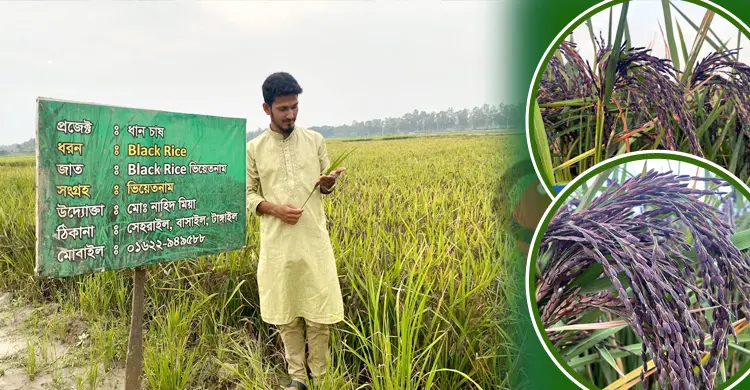
Young agricultural entrepreneur Nahid Mia, 24, has succeeded in growing "black rice", valued for its medicinal and nutritional qualities, in Paschimpara of Basail municipality in Tangail. He is a first-year degree student at Government Saadat College and the son of Nasir Uddin of Basail Paschimpara. Alongside his studies he grew the paddy on 50 decimals as a hobby, and had a bumper crop. The black rice is now swaying in the breeze in Nahid Mia's field in Sehrail village of Kauljani union, Basail upazila.
Nahid grew the black rice on his own initiative on 50 decimals of his father's land. The paddy is largely ripe and he will harvest it in a few days. Many people are crowding in to see the field, and many farmers are keen to grow it. He ordered the seed of this Vietnamese paddy online.
An old grain
Black rice (also known as purple rice) is a special type of rice, the report says. It is not on the agriculture ministry's list. Seven or eight varieties of black rice are grown worldwide, some producing quite sticky rice. They include Indonesian black rice, Vietnamese rice, the Philippines' Balatina rice, Chinese black rice and Thai jasmine black rice. In Manipur this kind of black rice is known as chak-hao, and sweets made from it are served at the main meal of ceremonies.
Though unfamiliar to many, black rice has an ancient history and has been grown in parts of Asia for thousands of years. Folk accounts of Chinese history tell of a strange rule: only members of the royal family could eat it, and it was forbidden to ordinary people. Many believe the aim was to reserve it as a royal food because of its nutritional value. Several kinds of black and brown paddy are grown in Bangladesh's hill regions, where farmers have long understood their value. Bengali farmers used to eat such high-fibre rice, which kept them full for a long time, so that a morning and an afternoon meal were enough.
The report says black rice is about three times as nutritious as ordinary rice. Its colour comes from anthocyanin, which acts as an antioxidant and boosts immunity. It has more protein, less sugar and more fibre than other rice, and contains vitamin E. Because of its high fibre it produces glucose in the body very slowly, keeping blood sugar under control, which is why it is said to be very good for people with diabetes. It can be grown twice a year on the same land, in winter and in summer.
"Seed ordered online"
Nahid Mia said: "I first learnt about growing this paddy on YouTube. Then I collected the seed online, buying 5kg of Vietnamese black rice seed at Tk 500 a kg. Growing it on 50 decimals cost Tk 6,000-7,000 in all. It can be harvested within three months. I hope to get 40-45 maunds from the 50 decimals."
"I grew this paddy for the first time as a hobby alongside my studies, and succeeded. The yield is bumper and I hope to profit. Next year I will grow more. Other farmers in the area are interested, and many have ordered seed in advance, so I want to keep this crop as seed and get it to farmers cheaply," he said.
Local farmers Kader Mia, Mofiz and Rohiz Uddin said: "We had heard of black paddy but this is the first time we have seen it. The paddy has ripened and the yield is about one and a half times that of ordinary paddy. Many are coming from far away to see it. We are taking advice from Nahid, and since it gives more yield at low cost we will collect seed and grow it."
Officials cautious
Basail upazila agriculture officer Shahjahan Ali said: "This variety of black paddy is not officially listed in the country. The young entrepreneur Nahid has been asked to bring a sample of the paddy to the office. The upazila agriculture department will give him all kinds of support in growing it."
Ahsanul Basar, deputy director of the Department of Agricultural Extension (DAE) in Tangail, said: "It is a very good initiative. If young people come forward, the country's agriculture will go far. But because this paddy was not grown from approved seed, I cannot say anything just yet."
Source: Jagonews24. First published in Bengali on The Agro News.
Comments
(0)