
By Md Abu Zahid Mallik and Shah Bilia Zulfiqar
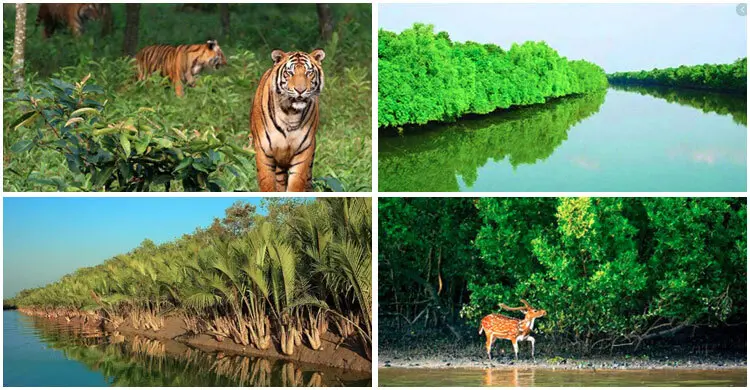
The Sundarbans is Bangladesh's broad forest and one of the wonders of the world. As the largest mangrove forest in a saline coastal environment, it is the world's largest continuous forest, covering about 10,000 square kilometres. It is called the 'life' of Bangladesh and is part of the world's heritage. In 2001, 14 February was declared 'Sundarbans Day', and it has been observed every year since, although the important day is lost behind Valentine's Day.
The tiger and its neighbours
Any talk of the Sundarbans' biodiversity must start with the Royal Bengal tiger, a truly regal animal famous for its black stripes on yellow. An adult male averages 10 feet from nose to tail tip, of which the tail is about 3 feet. Average weight is 200–250 kg, though the largest tiger found in the wild weighed about 325 kg. Solitary by nature, tigers live by hunting wild boar, deer and buffalo. Scientists estimate there are about 25,000 in all of South Asia, 10 per cent of them in the Sundarbans.
Besides the tiger, notable residents include the rhesus macaque, spotted deer, grey-headed fish eagle, blue kingfisher, saltwater crocodile and sawfish. The Irrawaddy dolphin, a mammal, lives in the rivers that flow through the forest. But river pollution has put this biodiversity under threat.
The beautiful spotted deer is under threat too. Once there were more than 100,000 in the Sundarbans; now there are 30,000. Thirty-one species endangered worldwide still survive in the forest, 12 of them most commonly seen here. During cyclones and tidal surges the Sundarbans is a natural shield for coastal people and a home for endangered animals, among them the Royal Bengal tiger, fishing cat, lesser adjutant, great knot, king cobra, olive ridley turtle, two dolphin species (Irrawaddy and Ganges), two otter species and the saltwater crocodile.
A shrinking forest
UNESCO declared the Sundarbans a World Heritage Site in 1977, according to the writers. Of the 50 saltwater plant species in the world, 35 are found here. But the forest faces many problems today: sea-level rise, river erosion, illegal settlement and uncontrolled felling are steadily shrinking it.
A 2020 World Bank report said the Sundarbans covered 11,904 sq km in 1904–1924, falling to 11,663 sq km in 1967 and 11,506 sq km in 2021, meaning it shrank by 451 sq km in 100 years. Analysis of the report shows the Bangladesh part covered 7,142 sq km in 1904–1924 and 6,871 sq km in 2015–2016, a loss of 252 sq km in 100 years, or about two and a half square kilometres a year, equal to 350 FIFA football pitches.
The sundari tree, symbol of the forest's beauty, has declined by about 28.75 per cent. Climate change has put Bangladesh at risk, above all through sea-level rise and reduced freshwater flow in the northern rivers. As a result, seawater has entered the soil and rivers of the whole south, making them saline. Finding and applying solutions or ways to adapt is urgent in the national interest.
Pollution and hope
With chars forming in the Bay of Bengal, tides now rise much higher than before. In the past, roads five or six feet high could protect settlements from the tide, yet the Sundarbans has sheltered coastal people. Black stains of burnt oil and mobil from vessels using Mongla port can be seen on the trees. The noise of ships' engines inside the forest, and their lights and searchlights at night, disturb wildlife. Cement and other large factories have grown up in Mongla and are polluting the environment.
Above all, the whole Sundarbans environment is now under threat, and an accident involving a chemical-carrying ship or a factory near the port would be a disaster for the forest. The hopeful sign is that the Royal Bengal tiger has given local people an interest in conserving the Sundarbans. Both Bangladesh and India have made the tiger their national animal, so both countries can be expected to do their utmost to save it and its habitat. The world hopes their joint efforts will save its only forest of breathing roots.
Md Abu Zahid Mallik is a student of the Folklore Department and Shah Bilia Zulfiqar a student of the Law and Justice Department at Jatiya Kabi Kazi Nazrul Islam University.
Source: Jagonews24. First published in Bengali on The Agro News.



Comments
(0)