
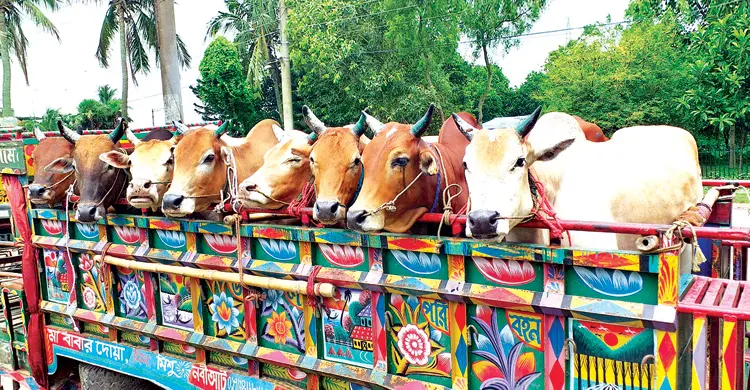
Eid-ul-Azha is at the door, and sacrificial animals will be bought, sold and transported for two more days. Small farmers across the country raise animals for sacrifice through hard work, and most head for the cities hoping for good prices. Their biggest problem is transporting the livestock. This year the administration is taking a tough line on any problem, including transport, extortion on the roads, illegal tolls and obstruction of unloading animals at markets. The national emergency number 999 will also play an important role.
The Ministry of Fisheries and Livestock recently held a preparatory inter-ministerial meeting on estimating demand for sacrificial animals, their supply and ensuring their free transport from remote areas. The meeting discussed guidance on these issues with the relevant people. It was told that the Ministry of Fisheries and Livestock would work on the Eid-ul-Azha celebrations alongside other government offices and agencies. On the Prime Minister's instructions, livestock production in the country has increased, so there must be no dependence on animals from outside. Law enforcement agencies must stay alert to prevent any illegal entry of cattle, to protect the country's farmers and producers.
Rules for markets and transport
The meeting was told that livestock must be able to move from one region to another, sellers must be able to enter markets freely, and vehicles carrying sacrificial animals must be given priority on roads and bridges, so that animals are not held up on the road and an artificial shortage created. All steps must be taken, including remedies through 999, so that there are no problems with the sacrifice. The authorities concerned will be careful that markets are not held on highways or anywhere they could obstruct traffic.
As in previous years, a farmer who sells animals from home will not have to pay a market toll. A farmer who wants to take animals to a distant market cannot be forced to unload them on the way. Law enforcement authorities and local government units, that is, municipalities, upazila or union parishads and city corporations, will ensure this.
If someone sells an animal on the way to the market, the lessee cannot forcibly collect extortion money or a toll from them. Bangladesh Bank has started digital transactions so that farmers can make payments by smart alternative methods without carrying cash.
Fisheries and Livestock Minister SM Rezaul Karim told the meeting that livestock were sold online last year and this would continue this year, to the satisfaction of both buyers and sellers. A system to get money back if a buyer does not like a cow bought online is also being added this year, so that buyers are not cheated in any way. Veterinary teams will work so that buyers can buy steroid-free animals at the markets.
Md Shamim Hasan, deputy secretary of the Public Security Division, asked people to contact 999 for emergency help with any problem, including the transport of sacrificial animals.
Divisional commissioners who joined the meeting virtually said they would keep watch to stop extortion in the transport of sacrificial animals and take steps for the proper preservation of hides.
Shah Imran, general secretary of the Bangladesh Dairy Farmers Association, said preparations across the country were satisfactory this year. A large share of livestock supplied to Dhaka comes from the north-west. To ensure supply, harassment in transport must stop, animals must get priority on ferries, and lessees' unethical collection of tolls must end.
According to Bangladesh Bank sources, Tk 33 crore of digital transactions were made at six cattle markets last year through the central bank's initiative. The programme has been expanded this year. Agent banking from various banks will be available at the markets, steps have been taken so that farmers can use banking channels safely, and staff with devices will be at the markets to detect counterfeit notes.
Surplus of 2.14 million animals
According to the Department of Livestock Services, there are 12,536,333 animals fit for sacrifice this year, 411,944 more than last year. They include 4,843,752 cattle and buffaloes, 7,690,000 goats and sheep and 2,581 animals of other species. By division, Dhaka has 895,454, Chattogram 2,053,128, Rajshahi 4,511,614, Khulna 1,511,708, Barishal 493,206, Sylhet 410,225, Rangpur 1,962,951 and Mymensingh 698,047. Probable demand for sacrificial animals this year is 10,394,739, leaving a surplus of 2,141,594 animals.
Last year there were 12,124,389 animals fit for sacrifice, and 9,921,941 were sacrificed.
Speaking to Jago News, Minister SM Rezaul Karim said: "This time too, a farmer who sells animals from home will not have to pay a toll. A farmer who wants to take animals to a distant market cannot be forced to unload them on the way. Law enforcement agencies and local government units, that is, municipalities, upazila or union parishads and city corporations, will ensure this."
"If someone sells an animal on the way to the market, the lessee cannot forcibly collect extortion money or a toll. If this happens, 999 or the local administration will take action as soon as they are told. But those who buy or sell on the way or from home must keep a document with them, so that no one can claim the animal was bought at the market and a toll is due."
The minister added that Tk 33 crore of digital transactions were made at six cattle markets last year through Bangladesh Bank's initiative. This year Bangladesh Bank has taken steps for cashless transactions at cattle markets in Dhaka and Chattogram, using QR codes, smart apps, ATM booths, point-of-sale machines, mobile financial services (MFS) and agent banking. With the help of the Department of Livestock Services, digital transactions have also begun in 26 districts through 10 banks and three MFS providers. Animal prices will stay within people's means this year, he said.
Calls to 999
Police Inspector Anwar Sattar, media and public relations officer of 999, told Jago News: "People have been told to inform the relevant police station of any problem on the way to the market. When a call comes to 999 from a given location, we immediately connect it with the police station concerned and monitor it. Lately we have been separately monitoring how many such calls come in. In many cases we also connect victims with the people running the market. We don't just connect them; we also monitor what action was taken on the complaint and whether the complainant is satisfied."
He added that at Eid they work separately on sacrificial animal issues and have already received many calls. Most complaints are about cattle trucks being held at other markets and not allowed to reach their destination. In many cases, sellers want to move an animal to a busier market if there are few buyers where it was unloaded, and are often not allowed to take their cattle out. "We have solved those problems," he said.
Source: Jagonews24. First published in Bengali on The Agro News.

Comments
(0)