
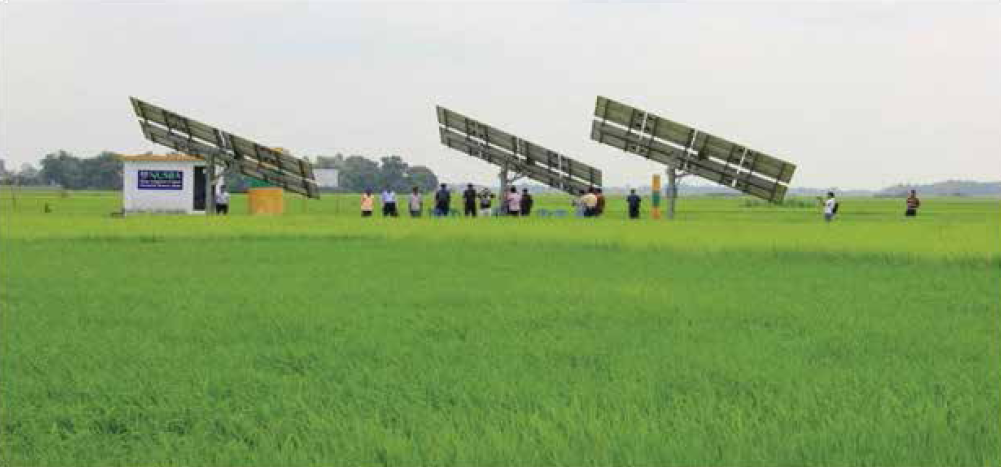
In the drought-prone Barind region, solar-powered pumps are lifting groundwater onto dry fields without the roar of diesel engines. Land in Mohanpur upazila, Rajshahi, that once lay fallow now grows rice, aubergine, tomato, cauliflower, cabbage and chillies, and some farmers harvest rice three times a year, a BSS special report says.
Project director SM Hasanuzzaman said six 550-watt solar panels generate 3,200 watts, and the 2-horsepower pump can water 20 to 25 bighas between 8am and 4pm. Each pump cost about Tk 500,000 to install under the tender.
The problem was falling groundwater. Hasanuzzaman gave the example of a deep tube well whose command area shrank from about 150 bighas to about 80. Local farmer Anarul said farmers used to drag long pipes from distant ponds with diesel pumps, costs ate up the profit, and there was no rural electricity connection. Now the pump starts when the sun rises, with no fuel bill.
By Anarul's count one pump now irrigates 30 to 35 bighas belonging to about 20 farmers, and a farmers' committee runs it. Farmer Sumon said they once relied on aman rice and winter vegetables or pulses, but now grow aus and boro rice and early vegetables too. Akhtar Hossain is raising early cauliflower seedlings using polythene mulch.
The pumps are supplied free under the Department of Agricultural Extension's project for agricultural development in Rajshahi division through modern technology. In two years, 32 solar irrigation systems have been installed in the division: 24 fixed 2-horsepower systems, eight portable units farmers can move from field to field, and 10 precision solar systems for targeted irrigation of orchards. The project director said irrigation costs have fallen almost to zero and cropping intensity has risen by about 50 per cent, and there are plans to add solar panels to existing diesel and electric pumps.
Mohanpur upazila agriculture extension officer Abdul Matin said solar irrigation works especially well in remote areas without power, and would mean more if surplus electricity outside the irrigation season could be fed into the national grid. Agricultural economist Dr Jahangir Alam called it an important development, since irrigation is the main energy-dependent input in Bangladesh's farm production.
This report is based on a BSS special report from Rajshahi.
Photo: Power Division, Government of Bangladesh / Wikimedia Commons (CC BY-SA 4.0)
Source: BSS

Comments
(0)