
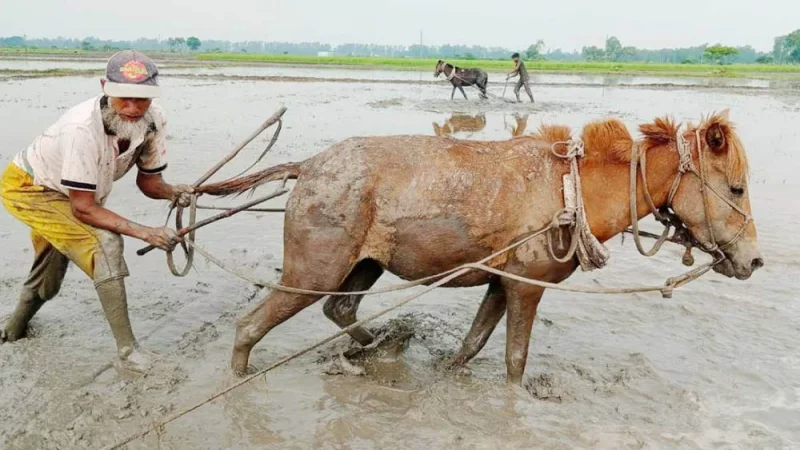
High fuel prices are driving up demand for horse ploughing and levelling in several villages of Tarash upazila, Sirajganj. In Gonta, Jontipur, Paril, Lauta, Harisena, Roknapur and Gulta villages of Talam union, a number of farmers now plough and level other people's land with horses for a fee as a full-time trade.
On Sunday farmer Shafiqul Islam was levelling a muddy field in Gonta with his horse, which he bought about five years ago for Tk 24,000. He charges Tk 250 a bigha for levelling and can do about five bighas a day, earning around Tk 1,250. Over the Aman and Boro seasons he makes about Tk 50,000 to 60,000, and the horse is also used to prepare seedbeds.
Local farmers say ox-drawn ploughs have all but vanished from Tarash, tractors and power tillers are hard to find when needed, and the fuel cost of machine ploughing has risen sharply. Tractor driver Serajul Islam said the fuel rise has pushed up the cost of ploughing per bigha, so many farmers are hiring horses instead; a horse needs no fuel.
Farmers say a horse can be turned over the same spot several times, which levels high and low patches well so irrigation water spreads evenly.
Ayez Uddin Fakir of Jontipur used to haul paddy and goods by horse cart and now ploughs with his horse; his grandson Ashraful Islam has done the same for four years in the Aman and Boro seasons. He says at least 10 bighas can be ploughed and levelled a day, at Tk 200 a bigha.
In neighbouring Singra and Gurudaspur upazilas of Natore a few people also earn a living this way. Mokhlesur Rahman of Singra ploughs three to three and a half bighas a day with two horses, earning Tk 1,000 to 1,500, though feeding the two horses costs Tk 400 to 500 a day.
Tarash upazila agriculture officer Sharmistha Sen Gupta said horse ploughing is rarely seen now because of modern machinery, but some farmers are doing it out of need and for extra income. The agriculture department advises farmers to use modern, improved farm machines.
This report is based on information from Desh Rupantor's Sirajganj correspondent.
Source: Desh Rupantor
Comments
(0)