
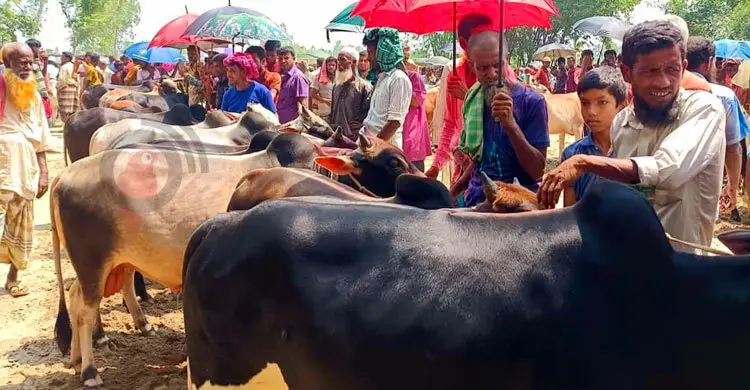
Azizul Haque, 48, is a farmer in Brahmagachha union of Raiganj upazila, Sirajganj. Besides farming his own land, he also works in other people's homes. Six months ago he took a loan of Tk 1.5 lakh from Grameen Bank and bought two bulls, planning to rear them and sell them at a good price at Eid-ul-Azha.
Because of the loan, he had to pay an instalment every Tuesday, while he also had to buy feed regularly to fatten the bulls. With little work in the village after the paddy harvest, he fell into difficulty, and took a further Tk 50,000 at high interest from a local lender, using it to pay instalments and buy feed.
Over six months, the straw from his three bighas of land, concentrate feed and bran cost another Tk 1.5 lakh. Leaving aside his own daily labour, the total cost from buying the two bulls came to Tk 3 lakh, and with the interest on the loans added, about Tk 3 lakh 30 thousand.
Trader's quick profit
On Sunday, 25 June, Azizul took the two bulls to the Dhangara market in Raiganj upazila and sold them to traders for Tk 4 lakh 15 thousand.
He received Tk 4.15 lakh against costs of Tk 3.3 lakh, excluding his labour. That leaves a profit of Tk 85,000, but he says nothing remains once six months of work are taken into account.
"Right in front of me the trader sold one bull for Tk 2 lakh 30 thousand and the other for Tk 2 lakh 25 thousand. That gave the trader a profit of Tk 40,000 with no cost at all, which we cannot make even in six months," Azizul said.
It is not only Azizul: farmers in different upazilas of the district are in the same position.
Abdul Momin, a farmer from Shyampur village in Sirajganj Sadar upazila, said that after months of labour, farmers are not fulfilling any dreams; simply surviving has become hard, while middlemen profit from their work.
Traders' view
Tujam Sekh, a cattle trader at the Dhangara market, told Jagonews that the price of a sacrificial cow is set not by its meat but by how much a buyer likes it. "We buy cattle to make a little profit. Sometimes we make more, sometimes less," he said.
A tour of several cattle markets found that no cattle can be had for under Tk 1 lakh. Buyers say prices are high, but sellers say they are not high given feed prices.
At the Tarash market, cattle trader Shah Jamal told Jagonews: "We do not buy many cattle through the year, but at Eid-ul-Azha ten of us go together from village to village buying cattle, and we make a fairly good profit."
Makbul Hossain, a farmer who sold a cow at the Bagbati market in Sirajganj Sadar upazila, told Jagonews that counting feed costs and labour, it is a loss. "I bought a cow for Tk 80,000 and sold it four months later for Tk 1.5 lakh. Including the price of the cow, my total cost over four months was about Tk 1 lakh 40 thousand. If I count the value of my labour, there is no profit at all, yet the traders will certainly make a profit."
Officials on middlemen
The district agriculture department says farm produce changes hands at least three times on its way from farmer to consumer, and in the process local traders, wholesalers and retailers earn much more than the farmer; these middlemen make several times more profit by selling the farmer's produce.
Raiganj upazila agriculturist Kamrul Islam told Jagonews: "To be honest, agricultural policy is made with the middlemen's interests in mind. Nobody really thinks about people like village cattle farmers. Progress in agriculture will not be sustainable this way. Big steps are needed before farmers' backs are against the wall."
Sirajganj district livestock officer Dr Gouranga Kumar Talukder said traders are taking advantage because they know the cattle market better than farmers, and he advised farmers to be careful.
He said 3,86,396 animals will be sold through 31 permanent and 16 temporary markets in the district: 1,71,712 cattle, 1,405 buffaloes, 1,55,000 goats and 61,133 sheep. Demand for sacrificial animals in the district is 1,60,000.
Source: Jagonews24. First published in Bengali on The Agro News.
Comments
(0)