
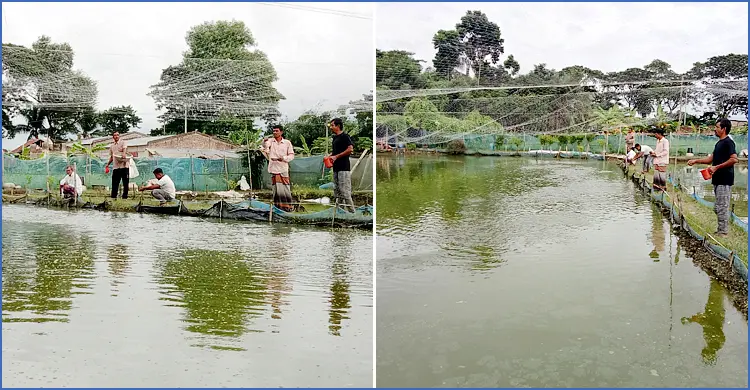
Three friends in Sharsha upazila of Jashore are farming native shing fish using modern methods. They have had no training from the Department of Fisheries, yet seeing their farm, many others in the area have reportedly started farming shing too.
The three self-taught, previously unemployed friends are Aftab Hossain (50), son of the late Motleb Biswas of Swarupdaha village in the upazila; Abdur Rashid (45), son of the late Raihan Sardar, who lives on the bank of the Shibchandrapur WAPDA canal; and Sohag Hossain (35), son of Matiar Rahman.
How the farm works
A visit to the farm found that they stocked 5,000 shing fry weighing four grams each per decimal in a 32-decimal pond. They feed the fish twice a day, morning and night. A modern machine inside the pond clears the fish waste.
The whole day's waste is lifted out of the water with this technology and used again as organic fertiliser, with which various vegetables are also being grown alongside. The three friends of Sharsha now dream of success with shing. It was their friend Abdur Rashid who got them interested in farming the risky shing fish with modern technology.
While in India, Abdur Rashid worked for five years at one of the largest fish hatcheries in Belapur, Maharashtra. Besides caring for fish there, he gained experience in shing farming technology, and returned home fully experienced. He then decided to farm shing himself.
Because Abdur Rashid had no capital, the three friends, with the help of the other two, first leased a pond on 15 kathas of land, prepared it in March this year and released fry. Soon afterwards they planned to make their own feed and built a feed-making machine. Using their own technology, they make a high-protein fish feed from a mix of broiler and poultry chicken intestines, earthworms, snails, salt, oil cake, molasses and honey.
Their shing farming journey began amid severe financial hardship. At the start the fish weighed one kilogram per one lakh fish; in three months they have grown to 10 fish per kilogram.
Care is the key, farmer says
Fish farmer Abdur Rashid said that after two to three months shing fish can develop bent tails because of faulty care, and then they do not grow. "Whoever farms shing will never succeed without knowing how to care for them," he said. The upazila fisheries officer from the Sharsha fisheries office had visited their farm and given them some advice, he added.
Rashid also said: "If anyone wants help with shing farming, they can contact us and we will certainly lend a hand."
The three friends said shing farming is very rare in Sharsha upazila and the method is new. Without any government help, the self-taught friends turned to shing farming amid severe hardship and on borrowed money. None of those who have farmed shing here have become established, they said.
"But we are trying, and we will become established, Insha'Allah. We want to farm native shing on a large scale here with modern technology. But willpower alone is not enough; money is needed too. If the government arranged micro-credit for us, we could go further with more success," they said.
Abul Hasan, senior upazila fisheries officer of Sharsha, said that on hearing that Abdur Rashid and his two friends were farming shing at a place called WAPDA Khal in Swarupdaha village, he visited them several times himself.
"I gave them various advice on the technical side of shing farming. I have assured them of whatever help can be given by the government, and if they want to take a bank loan, we will give them every support," he said.
Source: Jagonews24. First published in Bengali on The Agro News.

Comments
(0)