
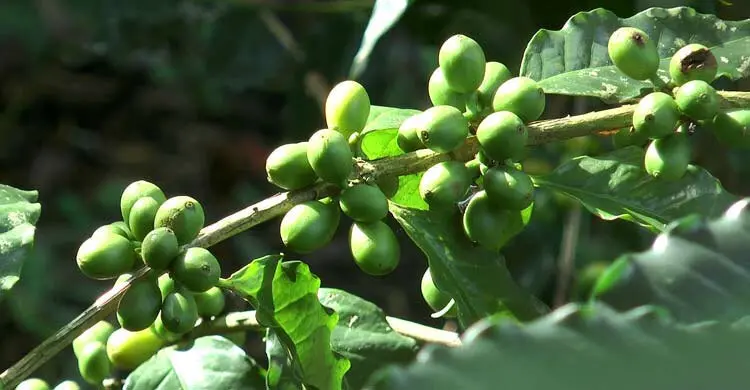
At a glance, as the report sets out: trees start bearing after three years at 6-7 kg each; coffee sells at Tk 80-100 a kg; 600-700 trees can be planted per acre; 600 trees yield 3,000-5,000 kg a year; and one acre can earn Tk 3-5 lakh a year.
Farmers see the prospect of success in coffee farming in Nalitabari on the Sherpur border. Local entrepreneurs believe coffee farming can expand further with government and private support and simple methods of processing and marketing. The agriculture department says the moisture and fertility of the soil in the upazila's hilly areas suit coffee, and that steady rainfall and the soil structure together give the crop a bright future there. Farmers interested in coffee are therefore getting the help, training and constant follow-up they need.
From job to coffee garden
Sajjad Hossain Tulip is an agricultural entrepreneur in Nalitabari upazila of Sherpur. After four years of experimental coffee farming he has succeeded commercially, and at least a hundred farmers are now turning to coffee with seedlings he gives them free. He was inspired by seeing coffee grown in the hill tracts while working for a private organisation in Bandarban. In 2021 he quit his job and started growing coffee in his home village. Starting with five kilograms of coffee seedlings, over the past three years he has prospered himself while training local farmers and supplying them with free seedlings. His coffee goes to several coffee shops in Mymensingh, Dhaka and Cox's Bazar.
Sajjad Hossain Tulip said: "If the necessary steps are taken to increase local coffee production and processing, dependence on coffee imports can be cut and economic prosperity achieved. If the weather is favourable in Sherpur's hilly areas, coffee worth Tk 3-5 lakh can be sold from each acre."
How the crop grows
According to the agriculture office, Arabica and Robusta coffee have begun to be grown commercially in the area. Robusta suits Bangladesh's hilly areas. Each mature tree starts flowering between March and mid-April, the flowers turn into small fruits in May-June, and the fruit ripens from mid-August to September. It then has to be dried in the sun, and the beans ground by machine to make them ready for market and for drinking. Seedlings can also be raised from coffee seeds.
A coffee tree bears fruit three years after planting, though it takes six to seven years to get a large crop. With favourable weather, 5-7 kg of coffee can be had from each tree, selling at Tk 80-100 a kg. An acre takes 600-700 trees, so 600 trees yield at least 3,000 to 5,000 kg a year, worth at least Tk 2.4 lakh to Tk 5 lakh. Because it pays, interest in coffee has grown among farmers.
Local farmers are finding success growing coffee as a companion crop at relatively low cost in any shady place, in gardens or on pond banks. More than a hundred farmers have already started, and the fresh coffee they grow is processed by a firm called Tulip Coffee Farming and Roastery.
Farmers follow
Farmer Atikur Rahman said: "Tulip bhai in our area has grown coffee for a long time. We took it up after seeing him. Coffee needs no extra land; it can be grown in shady spots in a home garden. Farmers in Nalitabari do not have to go anywhere to sell their coffee, because Tulip Coffee Farming and Roastery buys the coffee cherries itself. The farmers are very happy to get the right price."
Student Sadikur Rahman Khoka said: "For a long time I was looking for a low-cost way to earn and could not find one. Then, on Tulip bhai's advice, I took up coffee farming. He has trained 100 of us farmers in various ways and supplied coffee-growing guides and handbooks. Many have started producing coffee and many are about to. Tulip bhai himself buys fresh coffee from everyone, prepares it and markets it."
The agriculture department says it continues to support interested farmers with training and incentives to raise coffee output. Nalitabari upazila agriculture officer Abdul Wadud, an agriculturist, said: "Nalitabari's climate and terrain suit coffee. Local entrepreneur Tulip grows coffee commercially and at the same time distributes free seedlings and training to local farmers. More than a hundred interested farmers have already been trained and more than 5,500 coffee seedlings distributed. This support will continue as farmers need it."
Source: Jagonews24. First published in Bengali on The Agro News.

Comments
(0)