
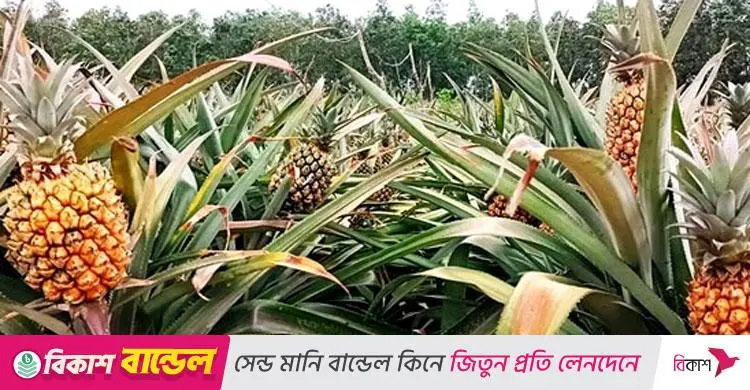
Juicy pineapple has joined Sherpur's farming, opening new prospects for the district's agriculture. The fruit is grown in the Garo Hills along the border. Local people say that with government backing, and if wild elephant attacks can be stopped, thousands of hectares of fallow land in the Garo Hills could become thriving pineapple fields and bring farmers financial security.
The Garo Hills stretch along 40 km of border in Sherpur's Jhenaigati, Sreebardi and Nalitabari upazilas. On hundreds of hectares of hill land nothing was grown but cassava, and because demand for cassava in local markets was low and it was not very profitable, most of the land lay nearly uncultivated.
Hardship was the daily companion of farmers here. Most made a living by collecting and selling firewood from the hills, breaking stones or working as labourers extracting red sand. Now hard-working farmers in these areas have brought a revolution to hill farming by growing new crops, and their households have become better off.
Growers' experience
Jomshon Mrong, a farmer of West Bakakura village in Jhenaigati upazila, said he leased 18 bigha of fallow hill land next to his home four years ago and began growing pineapples. He succeeded, and despite losses to elephant attacks sold Tk 16 lakh worth of pineapples. Many who came to see his garden became interested in growing the fruit.
Farmers said pineapple farming has spread in Jhenaigati, Sreebardi and Nalitabari. The Joldubi variety is grown here, and these pineapples are sweeter than Madhupur pineapples. They first sourced saplings from Madhupur and Rangamati, but now produce their own, supply saplings and help others with every aspect of pineapple farming. Pineapple grower Jomshon Mrong said growing pineapples on 3 bigha in the Gazni Obokash area cost Tk 1 lakh, and he hopes to make Tk 3 lakh profit after all costs.
Ashraful Alam grows 1.5 lakh pineapples on 18 bigha of hill land in the West Bakakura area. "The first time I collected saplings from Madhupur and Rangamati. Now I produce saplings myself. Anyone can get saplings and advice for farming. These pineapples are very tasty, and because farming is profitable, many are becoming interested. If wild elephants don't cause damage, we will get a good yield and profit," he said.
Pineapple grower Subrata said: "I've been growing Joldubi pineapples for two years. I hope to get a good yield like last time." Several labourers from Bakakura village, including Md Bijoy and Sabur Ali, said many people have found a source of income working in the pineapple fields.
Officials see promise
Muhammad Shakhawat Hossain, an agriculturist and deputy director of the Department of Agricultural Extension (DAE) in Sherpur, said: "Because the soil and weather suit pineapple, farmers are becoming interested. Seeing the farming in Jhenaigati, it is now also being done in Nalitabari and Sreebardi. After meeting local demand, these pineapples can be sold in neighbouring districts, and farmers will benefit."
Source: Jagonews24. First published in Bengali on The Agro News.


Comments
(0)