
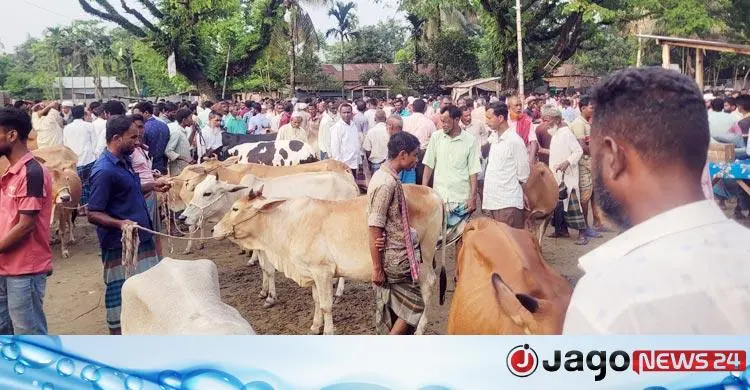
Sacrificial animal markets in the border district of Sherpur are getting busier. As more buyers and sellers turn up, sales are rising, though demand is highest for medium-sized cows.
Law enforcement agencies are working to prevent irregularities, trouble and the use of fake notes at the markets. District police are also working jointly with the Border Guard Bangladesh (BGB) to stop Indian cattle entering across the border, the police said.
Visits to several markets in the district on Tuesday (26 May) showed them growing livelier ahead of Eid. Animals are arriving every day from outside Sherpur, from Islampur and Bakshiganj in Jamalpur and Phulpur upazila in Mymensingh. Buyers say that although there are plenty of animals, prices are sky-high. Many are buying animals they like within their means, while others are going round in circles over high prices.
Sellers cite feed costs
Sellers say that although the markets are full, buyers are still mostly just looking.
Saiful Islam, a seller at the Nouhata municipal cattle, buffalo and goat market in Sherpur, said: "Broken rice, rice bran, wheat bran and straw are all expensive, and the prices buyers offer for cattle are way off the mark. We cannot sell at a loss."
Other sellers said the same. Making the numbers add up is very hard this year, they said, and if Indian cattle come in it will be a disaster, so they urged the administration to keep a strict watch on the border.
Dr Rezuanul Haque Bhuiyan, head of the district livestock department, said 20 permanent markets had been set up in the district this year, with a medical team working at each. The district needs 62,000 sacrificial animals and has a supply of about 93,000, he said.
Additional Superintendent of Police Mizanur Rahman Bhuiyan told Jagonews that district police and other law enforcement agencies were working in co-ordination with the BGB to stop smuggling of cattle and other goods across the border. "Law enforcers are determined to keep cattle smuggling across the border at zero," he said.
Source: Jagonews24. First published in Bengali on The Agro News.

Comments
(0)