
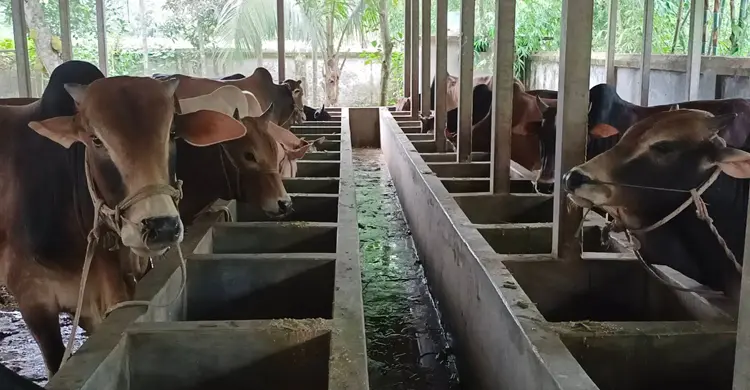
Fodder prices in Sherpur are rising again and again. After two floods in a month, prices have gone up by Tk 20-50 within a week, leaving the district's farmers in difficulty. Many are selling their cattle early.
Farmers in Sherpur fatten large numbers of cattle for Eid-ul-Azha, but fodder prices keep rising, so they have cut back on feed. Cows that gave a kilogram of milk on concentrate feed now give half as much with less feed, and farmers are losing money.
Prices up across the board
There are about 20,000 small and large farms in the district's five upazilas. Besides straw and grass, the cattle are fed wheat bran, khesari bran, gram bran, gram husks and other concentrates. But in the past 15 days the price of every kind of fodder has risen by Tk 5-20 a kg, or Tk 150-300 a sack.
The abnormal rise has increased the cost of milk production and cattle fattening for farmers, who are struggling to keep their animals.
According to the district livestock department, the district has 13,606 fattening farms, 5,877 dairy farms and 138 buffalo farms, with 4,40,301 cattle and 5,662 buffaloes. Although there are more animals than needed for Qurbani, the late rise in fodder prices has made animals expensive too.
Many farmers said that, unable to afford feed and supplements, they are having to feed their cattle straw. They complain that while milk prices have not risen, a 25 kg sack of feed has gone up by Tk 200 in a month. Mustard and sesame oil cake, broken rice and molasses have also risen by Tk 2 to 8 a kg.
Milk no longer pays
Farmers say it cost Tk 35 to 40 to produce a litre of milk two to three months ago; now it costs about Tk 40 to 45. Despite the higher cost, wholesale milk prices have barely risen. A litre sells for Tk 55 to 60 at retail but Tk 45 to 50 wholesale.
Rahim Munshi, a farmer in Jhenaigati upazila, told Jago News: "This time the price of Eid animals is rising because fodder prices have risen. Farmers have no other option, or else they make a loss."
Farmer Zulfikar Hasu said: "Milk prices have not risen at the rate fodder prices have risen in a month, so we are already making losses. Many have stopped selling milk at the market altogether."
Sherpur district livestock officer Mostafizur Rahman said some instability in the international market has affected domestic fodder prices, and the floods have also caused some price differences. The market may stabilise somewhat after Eid, he said.
Source: Jagonews24. First published in Bengali on The Agro News.

Comments
(0)