
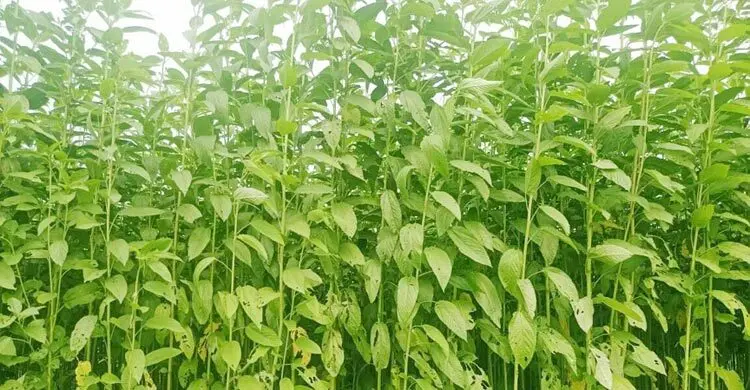
Jute cultivation has increased this year in Sharsha upazila of Jashore thanks to a favourable environment and good profits, and farmers have already begun to dream colourful dreams of the golden fibre. Because the soil in the area suits jute, its high-quality fibre is in great demand. Jute costs comparatively less to grow than other crops and yields well. With the crop profitable and easy to grow, and a wholesale market in place, farmers have turned to jute. Regular motivation and advice from the agriculture department and government support have also increased interest. With all these favourable conditions, the jute area is growing every season.
The upazila agriculture office said jute was grown on about 5,460 hectares in Sharsha upazila in the 2022-23 season and on 5,465 hectares in 2023-24. Thanks to loam soil, few diseases, government subsidies, free seed and profitability at low cost, 5 hectares more were planted this year. Notable varieties include the deshi varieties CVE-3, CC-45, D-154-2, BJRI-5 and Robi-1, and among Indian varieties Krishi Sebine-13524, Shankha-9897 and Tosha-8.
How the crop is grown
Farmers in the upazila either prepare the land by ploughing and sow the seed, or broadcast the seed on paddy land without tillage. Jute sown on ploughed land is ready to cut within 120 days, and jute broadcast on paddy land within 110 days. Visits to various fields show that thousands of bighas have been planted with high-yielding deshi and foreign jute varieties.
Farmers Abul Mia, Mizam Uddin and Mahbub Ali of Daridurgapur village in Dihi union, Nazim Uddin of Shyamlagachhi village in Sharsha union, Amirul Islam of Khajura village in Ulashi union, Mesher Ali of Panch Kayba village in Kayba union, Golam Rasul of Gogar and Mohiuddin Ahmed of Bahadurpur said: "Following the encouragement and advice of agriculture officials, we have broadcast jute on about 5-20 bighas of land this year. Because we took early measures, there is hardly any disease in the jute despite the intense heat. If the weather stays favourable until just before harvest, we can expect 10-16 maunds of jute a bigha."
They said that if they get a good price for jute in the market, they can all make a profit of about Tk 20-25 thousand a bigha after all costs. They also hope to earn good money from selling jute sticks, which are in good demand locally and in other districts.
Seed support from the government
Sharsha upazila agriculture officer Dipak Kumar Saha said: "This season 1 kg of jute seed each was distributed as a government incentive among 2,600 farmers in the upazila. Fertiliser could not be given because there was no allocation, but the Department of Jute has helped the farmers. If they get the chance to ret the jute properly, it is fair to hope that farmers will profit from growing it."
Source: Jagonews24. First published in Bengali on The Agro News.

Comments
(0)