
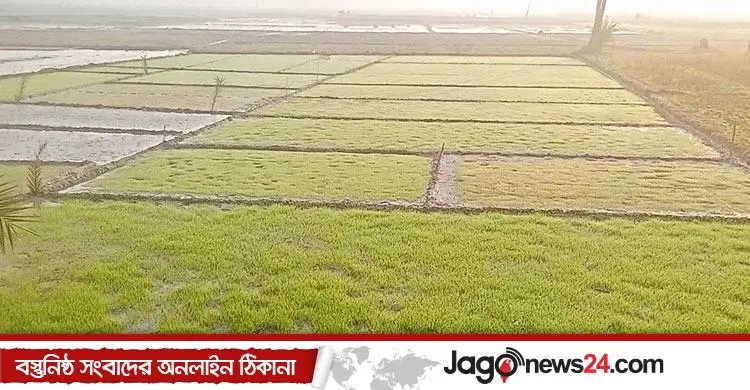
Severe cold is damaging boro rice seedbeds in Sharsha upazila of Jashore. Farmers are trying to save them by covering the seedbeds with polythene.
An official at the weather office run by the Bir Sreshtho Shaheed Matiur Rahman air base in Jashore said temperatures in Jashore have been falling for a week, reaching 11 degrees Celsius on Saturday. Temperatures will drop by one to two degrees a day, the official said.
According to the upazila agriculture office, the target for boro this season in Sharsha is 23,150 hectares. The seedbed target was 1,157 hectares, and seedbeds have been prepared on 1,175 hectares. Many are still preparing seedbeds, so the area will far exceed the target.
Farmers face extra costs
Farmer Jahedul Islam said: "This is the season for boro seedbeds, but right at the start dense fog and severe cold are threatening to ruin them. So I am buying polythene from the market to try to save my seedbed."
Another grower, Abdul Mannan, said: "This year we suffered losses because the aman yield was low. On top of that we face extra costs buying polythene at high prices to protect the seedbeds. If this continues, boro cultivation will become expensive."
Sharsha upazila agriculture officer Dipak Kumar Saha said that in cold and fog, water collects on rice seedlings and the seedbeds are also damaged by the cold. Farmers have therefore been advised to cover their entire seedbeds with polythene.
Md Abu Talha, deputy director (training) of the district Department of Agricultural Extension (DAE), said there is no alternative to quality seedlings for a good boro yield. "We have been advising farmers in advance on dealing with such adverse weather. Farmers, drawing on experience, are covering seedbeds with polythene at night and removing it during the day," he said.
Source: Jagonews24. First published in Bengali on The Agro News.

Comments
(0)