
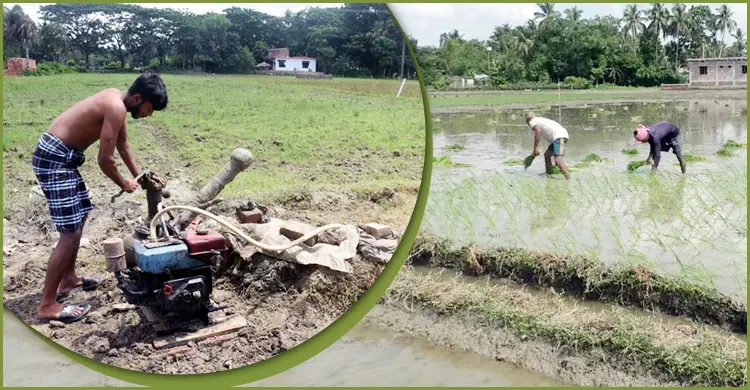
The transplanted Aman season has begun in Sharsha upazila of Jashore, but even in the monsoon the expected rain has not come. As time runs out, most farmers have started planting seedlings with irrigation. The extra cost has left them worried, and several thousand farmers in the district are downright despondent about transplanted Aman. Fears are growing that land will be left fallow.
According to the agriculture department, the target for transplanted Aman in the upazila this year is 20,800 hectares. So far 12,580 hectares have been planted, and the rest will be planted within this month. Last year the target was 20,500 hectares; 21,142 hectares were planted and 77,105 tonnes were produced.
Farmers say much land will lie idle this year because of the extra cost. The agriculture department says the transplanted Aman target will be met even if it takes supplementary irrigation, and steps will be taken to make farmers' extra costs bearable.
Waiting for rain
In the months of Asharh and Srabon, farmers usually rely on rainwater to plant transplanted Aman. But this season there has been hardly any rain in Sharsha, with rainfall less than half last year's. With no rainwater standing in the fields, farmers cannot start Aman planting properly.
A month of the planting period has already passed, leaving farmers anxious. Many have been forced to stop waiting for rain and start planting seedlings with water from shallow machines. Farmers say this will raise production costs and leave much land fallow.
Abul Kashem, a farmer from Shyamlagachhi village in Sharsha upazila, said: "Aman farming is in very bad shape this year. We are in great hardship. Planting should have started a month ago, but we waited because there was no rain. In the end we started with water from shallow machines. Costs will be higher this time, almost as much as for Iri (Boro) rice. I can't hope for a profit this year."
Another farmer, Anisur Rahman, said: "We grow Aman relying on rainwater. This year there is no rain at all. Lifting groundwater needs diesel and electricity, which cost more, and fertiliser, pesticide and seed all cost more too. So I don't think growing Aman with irrigation will pay this year."
Mahabub Rahman of Namaj village in Benapole said: "I ploughed my land three times this year for Aman, but with no rain it was no use. Now I am ploughing again and planting seedlings with irrigation water, which raises costs. Besides, labourers can't be found, and when they can, the wages are very high. Irrigation charges have also gone up this time. All in all, I am in heavy loss."
Touhid Islam of Chhoto Achra village said: "With no timely rain this year, many people have given up their land. I used to farm five bighas on lease; this time I will do two. Besides, there are several hundred bighas in the beel with no irrigation, so I fear a lot of land will lie fallow this year."
Because of lack of rain and other reasons, Aman production costs rise every year. Farmers are demanding subsidies on irrigation, fertiliser and seed to cut costs.
Officer: time remains
Sharsha upazila agriculture officer Dipak Kumar Saha said: "There is still time. Planting can go on until the end of August. If the hoped-for rain does not come by then, farmers are being advised to plant Aman with irrigation. Farmers got good prices for rice this year, and if they get good prices ahead, they will be able to make up the extra cost."
"Because of the global situation, farming costs are rising too," he said. "Ours is an agriculture-based economy, and the government is thinking about farmers. The agriculture department is working on bringing farmers under subsidies in future to make their costs bearable."
Reported by Md Jamal Hossain.
Source: Jagonews24. First published in Bengali on The Agro News.
Comments
(0)