
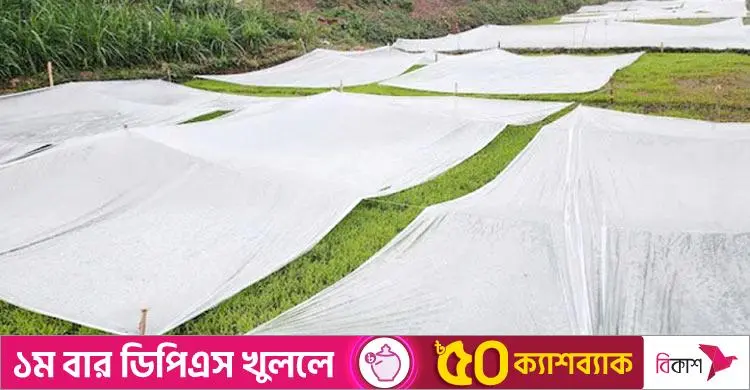
Both cold and fog are increasing in border Sharsha-Benapole in Jashore. From evening until the next morning, the landscape is blanketed in fog. Farmers' freshly prepared seedbeds are now at risk of cold injury, and farmers are trying to protect them by covering them with polythene.
According to the weather office, winter set in rather late in the region this season. Warm weather lingered until late November, but temperatures began falling steadily from the start of December, and the cold has tightened its grip over the last few days.
On Sunday (5 January), an official at the weather office run by Jashore's Bir Shrestha Shahid Matiur Rahman air base said temperatures in Jashore have been falling for the past week, by one to two degrees every day.
Farmers face extra costs
Along with the intense cold, heavy fog has put boro seedbeds in the region under serious threat, and farmers say their costs are rising.
According to the upazila agriculture extension office, the boro target in Sharsha upazila this season is 1,157 hectares, and 1,175 hectares of boro seedbeds have been prepared accordingly. Many are still preparing seedbeds. Farmers are covering them with polythene to protect them from cold injury, and in many fields of the upazila farmers have covered their boro plots with polythene.
Farmer Zahidul Islam said: "It is now the peak season for preparing boro seedbeds, so we are busy raising rice seedlings. But right at the start, dense fog and severe cold are threatening to destroy the seedbeds. So we are buying polythene from the market to try to save them."
Another farmer, Abdul Mannan, said: "We already made a loss this year because of the low aman yield. Now we face extra costs buying polythene at high prices to save the seedbeds. If this continues, boro farming will become expensive."
Officials advise covering seedbeds
Sharsha upazila agriculture officer Dipak Kumar Saha said seedbeds are damaged by cold and by water collecting on the tips of seedlings in cold and fog. Farmers have been advised to cover entire seedbeds with polythene, which is now the only way to protect them. Many farmers prepared seedbeds using the synchronised (somoloy) method this year, he said.
Md Abu Talha, deputy director (training) of the district Department of Agricultural Extension, said quality seedlings are essential for a good boro yield. "We have long been advising farmers on dealing with such adverse weather. Drawing on past experience, farmers are covering seedbeds with polythene at night and removing it during the day," he said.
He said that if temperatures fall further, farmers are also being advised to drain cold water from the fields and irrigate more often.
Source: Jagonews24. First published in Bengali on The Agro News.

Comments
(0)